
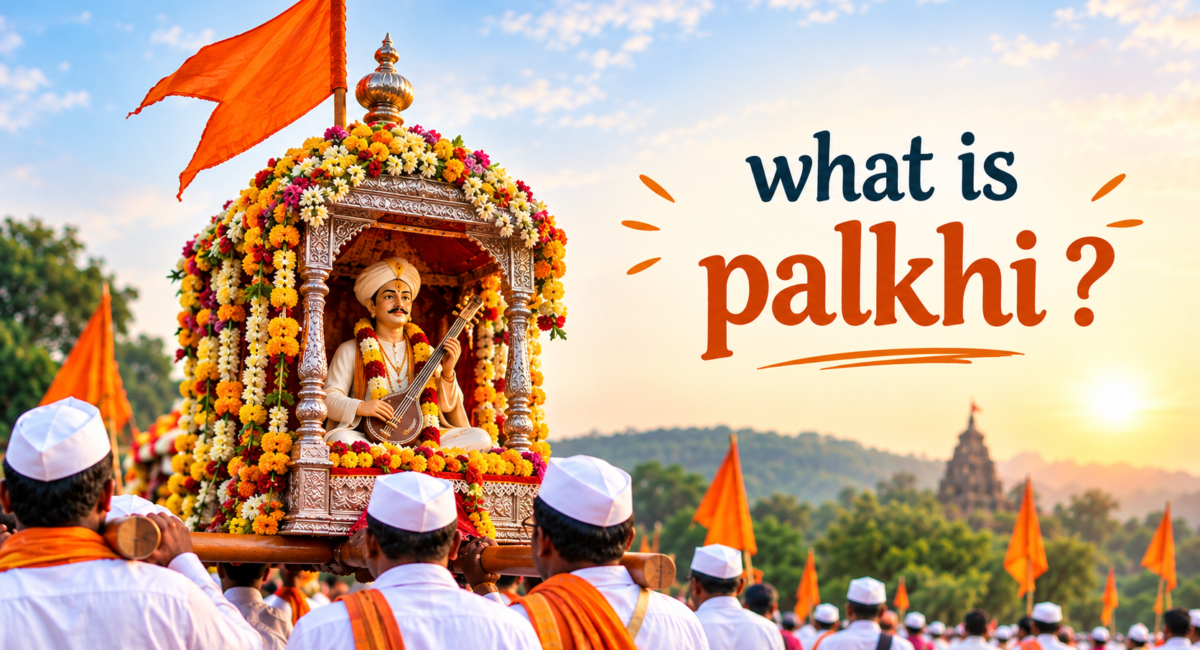
Palkhi: Meaning, History, Routes & Significance of the Pandharpur Wari Palkhi
Palkhi at a Glance
A Palkhi is a palanquin. In the Pandharpur Wari, the Palkhi carries the padukas (sandals) of a revered Marathi saint, such as Sant Dnyaneshwar or Sant Tukaram, from the saint’s place to Pandharpur for Ashadhi Ekadashi, with thousands of Varkari devotees walking alongside in groups called Dindis.
| Quick fact | Detail |
|---|---|
| What it is | A palanquin carrying a saint’s padukas, central to the Wari |
| Destination | Pandharpur, Solapur district, Maharashtra |
| Timing | Walks for roughly two to three weeks before Ashadhi Ekadashi |
| Best-known Palkhis | Dnyaneshwar Maharaj (from Alandi), Tukaram Maharaj (from Dehu) |
| Who walks | Varkaris, in groups called Dindis |
| What is sung | Abhang, Bhajan, Kirtan |
| Key chant | “Vithal Vithal”, “Gyanba Tukaram” |
What Is a Palkhi?
In everyday Marathi and Hindi, Palkhi simply means a palanquin, a decorated seat carried on poles. In the Varkari tradition, however, the word has a much deeper meaning. The Palkhi is the symbolic seat of a saint and carries the saint’s padukas, which are treated with great reverence. Devotees see the Palkhi as the saint himself walking to meet Lord Vitthal at Pandharpur.
The annual procession is often called the Palkhi Sohala (the Palkhi festival), and it forms the centre of the Pandharpur Wari.
Palkhi vs Wari vs Dindi: What Is the Difference?
| Term | Meaning |
|---|---|
| Wari | The pilgrimage itself, a periodic walk to Pandharpur |
| Palkhi | The palanquin carrying a saint’s padukas |
| Dindi | A group of Varkari devotees walking together, usually attached to a Palkhi |
| Varkari | A devotee who regularly undertakes the Wari |
| Sohala | The festival or ceremonial procession |
In simple terms, the Wari is the journey, the Palkhi is the heart of the journey, and the Dindis are the people who walk it.
History of the Palkhi
The Wari tradition is said to be several centuries old, and Varkaris traditionally trace its spirit to the devotion of the saints of Maharashtra. Over time, the practice of carrying a saint’s padukas in a Palkhi became an organised annual procession.
According to tradition, the Tukaram Maharaj Palkhi was started by Sant Tukaram’s family after his time, and the Dnyaneshwar Maharaj Palkhi took its organised modern form in the 19th century, with the contribution of devotees such as Haibatrao Bua. Dates and details vary between sources and family traditions, so treat precise years with care and verify them against reliable references before quoting them.
What matters to Varkaris is continuity. The tradition has survived across generations, with families walking year after year.
The Two Most Famous Palkhis
1. Sant Dnyaneshwar Maharaj Palkhi (Alandi to Pandharpur)
This Palkhi begins at Alandi, near Pune, the place associated with the samadhi of Sant Dnyaneshwar, author of the Dnyaneshwari. The Palkhi carries his padukas to Pandharpur. It is often described as the largest and most famous Palkhi of the Wari.
2. Sant Tukaram Maharaj Palkhi (Dehu to Pandharpur)
This Palkhi begins at Dehu, the birthplace of Sant Tukaram, whose Abhangs are among the best-loved works of Marathi Bhakti literature. His Palkhi leaves for Pandharpur and shares the road with Dnyaneshwar Maharaj’s Palkhi for part of the way, creating the shared atmosphere the Wari is known for.
Other Palkhis Travelling to Pandharpur
Several other Palkhis of saints from different parts of Maharashtra also travel to Pandharpur and join the gathering around Ashadhi Ekadashi, including those associated with Sant Nivruttinath (from Trimbakeshwar), Sant Sopandev (from Saswad), Sant Muktabai (from Muktainagar) and Sant Eknath (from Paithan). Each has its own route, dates and Dindis, so check each Palkhi’s official announcements for details.
Palkhi Route: How the Journey Unfolds
The Palkhis follow a traditional route, halting at set villages and towns each day. The broad pattern is:
- Departure from Alandi or Dehu, usually in the month of Jyeshtha, a couple of weeks or more before Ashadhi Ekadashi
- Halts near Pune, where the two Palkhis are welcomed by large crowds
- Journey southeast through towns and villages of Pune and Satara districts
- Entry into Solapur district, with some of the best-known halts in the final stretch
- Wakhari, the last major halt before Pandharpur
- Arrival in Pandharpur for darshan of Lord Vitthal, around Ashadhi Ekadashi
The exact day-by-day schedule, halts and timings are announced each year by the Palkhi committees (Sansthan). Always check the official schedule for the current year, since dates shift with the Hindu calendar.
Rituals and Traditions Along the Way
- Daily routine: The Palkhi usually sets off in the morning, halts for meals and rest, and stops for the night in a designated village
- Aarti and puja: Rituals are performed for the padukas at halts
- Ringan: At traditional spots, the Dindis take part in ritual circles, a highlight of the journey
- Kirtan and Abhang: Singing and storytelling continue morning, afternoon and night
- Fugdi, Bharud and devotional games: Part of the lively spirit of the Wari
- Tulsi on the head: Many women carry Tulsi plants (Tulsi Vrindavan) as a mark of devotion
- Pataka (flags): Saffron flags lead the Dindis
- Seva: Villagers offer food, water, shelter and medical care along the route
What Is a Dindi?
A Dindi is an organised group of Varkaris who walk together, each with a leader, a flag and musicians who carry taal (cymbals), mridang and veena. Each Dindi has a number and a place in the Palkhi’s procession. Dindis may come from villages, towns or cities and can include hundreds of people. Walking in a Dindi means following its discipline: timings, meals, devotional programmes and rules.
Why Is the Palkhi Important?
- Spiritual: For Varkaris, walking with the Palkhi is a form of devotion to Vitthal and the saints
- Cultural: It keeps alive Marathi Bhakti literature, Abhang and Kirtan
- Social: The Wari is known for its spirit of equality, as people of all backgrounds walk, eat and sing together
- Community service: The tradition is supported by villages that host and feed the walkers
- Living heritage: The Palkhi is one of the most visible living traditions of Maharashtra, and has drawn attention from scholars, journalists and travellers worldwide
Palkhi and Ashadhi Ekadashi
The Palkhis are timed to reach Pandharpur for Ashadhi Ekadashi, the day on which the Wari culminates in darshan of Lord Vitthal. After arriving, the Palkhis halt in Pandharpur for a few days, and devotees bathe in the Chandrabhaga river, attend Kirtan and queue for darshan.
Read more: Ashadhi Ekadashi | Pandharpur Guide | Kartiki Ekadashi
Saints Associated With the Palkhi
- Sant Dnyaneshwar: Author of the Dnyaneshwari; his Palkhi starts from Alandi
- Sant Tukaram: Famous for his Abhangs; his Palkhi starts from Dehu
- Sant Namdev: A major saint of Vitthal devotion
- Sant Eknath: A key figure of Marathi devotional literature
- Sant Chokhamela: A powerful voice of the Bhakti movement
- Sant Muktabai, Sopandev, Nivruttinath: Siblings of Sant Dnyaneshwar, each honoured by their own Palkhi tradition
Palkhi, Abhang and Kirtan
The Palkhi is as much a musical event as a religious one. As the Dindis walk, they sing Abhangs by the saints, and Kirtankars share stories and teachings at halts. For anyone interested in Marathi devotional music, the Palkhi is a living school of Abhang and Kirtan.
Explore on Kirtankar.com: What is Kirtan? | Kirtankar Directory | Varkari Kirtan | Sant Abhang | Sant Tukaram | Sant Dnyaneshwar
How to Experience the Palkhi as a Visitor
You do not need to walk the full distance to experience the Palkhi.
- Join for a day: Many first-timers walk with a Dindi for a day or part of a day
- Watch from the route: Large crowds gather near Pune and other towns to welcome the Palkhi
- Visit Pandharpur: Experience the arrival and the atmosphere around Ashadhi Ekadashi
- Visit Alandi or Dehu: Attend the departure ceremonies and temple visits
- Follow online: Official Sansthan announcements and local news provide current schedules
Tips for First-Time Visitors and Walkers
- Check the official schedule for the current year before you travel
- Join a registered Dindi if you plan to walk, and follow its rules
- Wear comfortable footwear and light clothing; carry water, a cap and rain protection
- Be prepared for heat, crowds and monsoon rain
- Keep valuables and medicines safe
- Respect the Palkhi: do not touch or crowd the palanquin, and follow volunteers’ instructions
- Ask before photographing devotees, and follow local rules
- Plan carefully with elderly people, children and anyone with health concerns
- Book accommodation early near Pune, Pandharpur and halt towns
Palkhi for International Visitors
International travellers often find the Palkhi one of India’s most striking living traditions. It is not a performance but an act of worship, so approach it respectfully, learn the meaning of the Wari beforehand, and follow local guidance.
Frequently Asked Questions About the Palkhi
What is a Palkhi?
A Palkhi is a palanquin. In the Pandharpur Wari it carries the padukas of a revered saint, and Varkari devotees walk with it to Pandharpur.
What is the Palkhi Sohala?
It is the annual Palkhi festival, the ceremonial procession of saints’ Palkhis to Pandharpur.
Which are the most famous Palkhis?
The Sant Dnyaneshwar Maharaj Palkhi from Alandi and the Sant Tukaram Maharaj Palkhi from Dehu.
How long does the Palkhi take to reach Pandharpur?
It walks for roughly two to three weeks, timed to reach Pandharpur around Ashadhi Ekadashi. The exact schedule is announced every year.
Where does the Dnyaneshwar Palkhi start?
It starts from Alandi, near Pune.
Where does the Tukaram Palkhi start?
It starts from Dehu, near Pune.
What is the difference between Wari and Palkhi?
The Wari is the pilgrimage. The Palkhi is the palanquin carrying the saint’s padukas that forms its centre.
What is a Dindi?
A Dindi is an organised group of Varkaris walking together with a flag, musicians and a leader.
Can anyone join the Palkhi?
Visitors are generally welcome, but it is best to join a registered Dindi, follow rules and respect local customs. Check official guidance for the current year.
When is the Palkhi held?
The Palkhis depart a few weeks before Ashadhi Ekadashi, which falls in the Hindu month of Ashadha. Dates change every year.
Why do Varkaris walk to Pandharpur?
For Varkaris, the walk itself is an act of devotion, a way of expressing love for Vitthal and remembering the saints.
Conclusion
The Palkhi is more than a procession. It is a moving expression of faith, music, equality and community that has defined Maharashtra’s devotional life for generations. As the Palkhi moves toward Pandharpur with the sound of Abhang and the chant of Vitthal’s name, it carries the memory of the saints to the place where their devotion found its home.
Vithal Vithal!
Explore More on Kirtankar.com
Pandharpur Guide | Ashadhi Ekadashi | Pandharpur Wari | Varkari Sampradaya | Sant Tukaram | Sant Dnyaneshwar | Vitthal Aarti | Vitthal Abhang | What is Kirtan? | Kirtankar Directory

Leave a Comment