
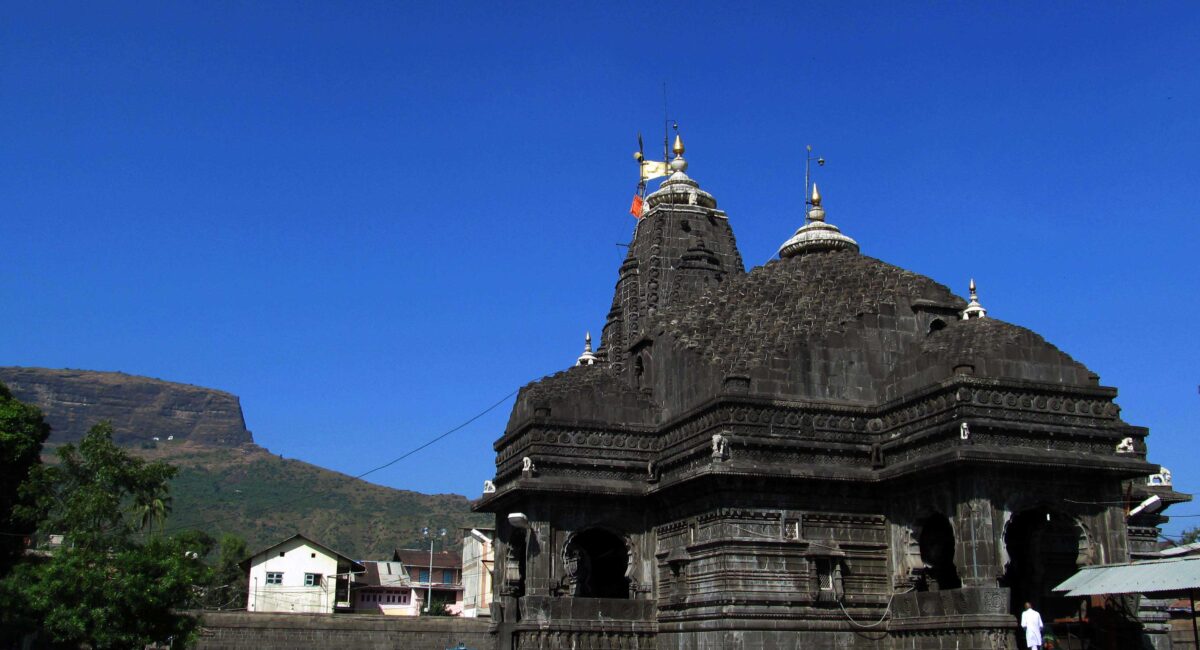
Trimbakeshwar Mandir
Comprehensive Indological and Anthropological Survey of Trimbakeshwar Jyotirlinga
Introduction: The Theological and Geological Convergence
The Trimbakeshwar Mandir Jyotirlinga, situated in the Nashik district of Maharashtra, represents a profound intersection of geology, mythology, and hydraulic civilization. Nestled at the foothills of the Brahmagiri mountain range a formidable formation within the Sahyadris the temple complex serves not merely as a place of worship but as the spiritual fulcrum of the Godavari Valley. As one of the twelve Jyotirlingas, the radiant signifiers of Lord Shiva’s cosmic presence, Trimbakeshwar occupies a unique position in Hindu theology due to its distinct iconographic representation. Unlike the conventional singular columnar lingams found elsewhere, the Trimbakeshwar lingam is characterized by a depression or void containing three distinct protrusions representing the Hindu Trinity: Brahma, Vishnu, and Mahesha (Shiva).
The site’s significance is magnified by its geographical status as the source of the Godavari River, the second-longest river in India, often venerated as the “Dakshin Ganga” or Ganges of the South. This hydrological origin point transforms the temple into a Tirtha Kshetra a crossing point between the mortal and divine realms where the purification of water meets the sanctification of fire. The interplay between the volcanic basalt of the Deccan Traps, the sacred waters of the Godavari, and the Hemadpanthi architectural mastery creates a landscape that has attracted ascetics, historians, and devotees for millennia.
This report provides an exhaustive analysis of the Trimbakeshwar Mandir, synthesizing its mythological corpus, architectural evolution under the Peshwas, the intricate sociology of its priestly lineages, and the practicalities of its complex ritual landscape.
Mythological Foundations and Scriptural History
The sanctity of Trimbakeshwar Mandir is not an arbitrary attribution but is deeply rooted in the Puranic textual tradition, specifically the Shiva Purana, Padma Purana, and the Skanda Purana. These texts provide the narrative infrastructure that legitimizes the site’s holiness.
The Legend of Sage Gautama and the Origin of Godavari
The foundational myth of Trimbakeshwar centers on the concept of sin and redemption. The narrative is set against a backdrop of a severe famine that lasted for twenty-four years, affecting the entire region. Sage Gautama and his wife Ahalya resided on the Brahmagiri hill during this period. Through the power of his rigorous penance and the grace of Varuna (the Lord of Waters), Gautama was gifted an inexhaustible grain pot. This miraculous vessel allowed him to feed thousands of starving Rishis (sages) and their families, establishing his ashram as a sanctuary of sustenance.
However, spiritual merit often breeds envy. The Puranas describe how other sages, jealous of Gautama’s rising spiritual stature and the abundance of his ashram, conspired to diminish his merit. They invoked Lord Ganesha, requesting him to create a mechanism to taint Gautama. Ganesha, bound by the sages’ collective prayer, assumed the form of a frail, illusionary cow. When this cow wandered into Gautama’s granary, the sage attempted to gently guide it away using a blade of Darbha grass. Upon contact with the grass, the cow instantly fell dead, burdening Gautama with the heinous sin of Gauhatya (cow slaughter)
Ostracized by the other sages, Gautama undertook a severe penance to propitiate Lord Shiva, seeking purification. He circumambulated the Brahmagiri hill and worshipped Shiva with earthen lingams. Pleased by his devotion and recognizing the deceit of the other sages, Lord Shiva appeared and offered a boon. Gautama requested the descent of the celestial River Ganga to wash away his sin. Reluctant to leave Shiva’s matted locks, the Ganga eventually descended, but only after Shiva commanded her to purify the sage. The river flowed onto Brahmagiri and was named Godavari (one who bestows cows) or Gautami.
Upon the request of the gods and Gautama, Lord Shiva agreed to reside eternally at this source. He manifested as the Trimbakeshwar Jyotirlinga, signifying the Lord of the Three Eyes (Trinetra) or the Lord of the Three Worlds. This narrative inextricably links the physical presence of the river to the metaphysical presence of the deity.
The Lingodbhava and the Curse of Brahma
A secondary, yet theologically critical legend, explains the unique tri-faced nature of the lingam and the physical depression in the sanctum floor. This myth addresses the cosmic dispute between Brahma (the Creator) and Vishnu (the Preserver) regarding supremacy. To settle the argument, Shiva manifested as a beginningless and endless pillar of fire (Lingodbhava). Vishnu assumed the form of a boar (Varaha) to burrow downwards to find the pillar’s base, while Brahma took the form of a swan (Hamsa) to fly upwards to find its apex.
While Vishnu returned admitting his inability to find the limit, Brahma falsely claimed to have reached the summit, presenting a Ketaki flower as a false witness. Angered by this deceit, Shiva cursed Brahma that he would never be worshipped in temples. However, Trimbakeshwar represents a rare theological exception. Here, Brahma is acknowledged within the trinity lingam, but he is situated within a depression or void in the floor. This “hollow” existence symbolizes his suppression or “pushing underground” as per Shiva’s curse. Thus, the physical anomaly of the lingam a hole rather than a projection is justified through this high-mythological drama.
Architectural Evolution: A Hemadpanthi Masterpiece
The structural integrity and aesthetic magnificence of the current Trimbakeshwar temple are a testament to 18th-century Maratha architectural prowess. While the site has been a center of worship since ancient times, the existing stone structure was commissioned by the Third Peshwa, Balaji Baji Rao (Nana Saheb), spanning a construction period from 1755 to 1786.
The Peshwa’s Wager and Construction
Historical anecdotes suggest that the reconstruction was precipitated by a wager. Peshwa Nanasaheb reportedly bet on whether the stone surrounding the Jyotirlinga was hollow inside. Upon proving that the stone was indeed hollow, and losing the bet, the Peshwa committed to building a marvelous temple out of basalt rock to honor the deity. The construction took 31 years to complete, a testament to the intricate labor involved.
Structural Composition and Style
The temple is a quintessential example of the Hemadpanthi style, a vernacular variation of the Nagara architecture prominent in the Yadav and Maratha periods.
| Architectural Feature | Description |
| Material | Locally sourced Black Basalt (Volcanic Rock) |
| Plan | Stellate (Star-shaped) exterior; Square interior Garbhagriha |
| Masonry Technique | Dry masonry with interlocking stones; Lime mortar added by Peshwas |
| Roofing | Curvilinear slabs rising in steps; Nagara style Shikhara with Amalaka |
| Motifs | Floral scrolls, Yakshas, human figures, and animals |
| Perimeter | Fortress-like stone wall with four entry gates |
The temple complex is enclosed by a high stone wall, giving it the appearance of a fortress, a common feature in Maratha temple architecture designed to protect wealth and divinity alike. The Garbhagriha (sanctum sanctorum) is crowned with a graceful curvilinear tower (shikhara) topped with a large Amalaka and a golden Kalasha. The exterior walls are replete with intricate sculptural work, featuring running scrolls, floral ornaments, and figures of gods and goddesses, which break the visual monotony of the black stone.
The Nandi Mandapa and Sacred Tanks
Facing the sanctum is a separate mandapa housing Nandi, the bull vehicle of Shiva. This structure follows the traditional axis of Hindu temple architecture where the devotee must view the Lingam through the space between Nandi’s ears. The roof of the mandapa is a curvilinear slab rising in steps, distinct from the main shikhara.
The temple premises also include the Amritavarshini Kunda (tank), measuring 28 meters by 30 meters, which serves as a ritual bathing spot for pilgrims. Additionally, there are three other water bodies: Bilvatirtha, Viswanantirtha, and Mukundatirtha. The integration of these water bodies within the temple complex reinforces the intrinsic link between the deity and the element of water.
The Legacy of the Nassak Diamond
The historical opulence of the Trimbakeshwar temple was once augmented by the famous Nassak Diamond. This large gemstone was originally dedicated to the deity and adorned the Shiva idol. However, during the chaos of the Third Anglo-Maratha War (1817-1818), the diamond was looted by British colonial forces. Its trajectory since then has been complex; it was sold into the jewelry market and has passed through various owners. Currently, it is believed to be in the private collection of Edward J. Hand, a trucking firm executive in Greenwich, Connecticut, USA. The absence of this diamond remains a point of historical grievance for the temple trust and local historians.
The Sanctum Sanctorum: Iconography and Worship
The core of the Trimbakeshwar temple differs significantly from other Jyotirlingas in its physical manifestation, necessitating unique ritual protocols.
The Unique Lingam and Hydrology
Unlike the Swayambhu (self-manifested) lingams at Kashi or Somnath which project upwards as phallic columns, the Trimbakeshwar lingam sits in a depression or hollow in the floor, resembling a pounding stone (ukhali). Inside this depression are three distinct thumb-sized lingas representing Brahma, Vishnu, and Shiva. This triune representation emphasizes a non-dualistic philosophy where the forces of creation, preservation, and destruction are unified.
A constant stream of natural water oozes from this depression, keeping the lingas submerged. This water is venerated as the secret, subterranean presence of the Godavari River within the sanctum itself. Over centuries, the lingam has shown signs of erosion due to the excessive use of water during abhisheka. This erosion is interpreted theologically as a symbol of the eroding nature of human society and the impermanence of the material world in the Kali Yuga.
The Golden and Silver Masks
Due to the depression in the floor, the lingam is not always visible to devotees from a distance. Typically, a silver mask depicting the face of Shiva covers the depression to facilitate darshan. However, on festive occasions specifically Mahashivratri, Kartik Purnima, and Dussehra a spectacular Golden Mask with five faces (Panchamukhi) is placed over the lingam.
This Golden Mask is adorned with a jeweled crown believed to date back to the era of the Pandavas, containing diamonds, emeralds, and other precious stones. A special viewing of this Golden Crown is organized every Monday between 4:30 PM and 5:00 PM, during which the mask is taken in a palanquin (Palki) procession to the Kushavarta Tirtha and back.
Sacred Geography: Subsidiary Shrines and Landmarks
The Trimbakeshwar experience is not confined to the temple walls; it encompasses a sacred geography dotted with tirthas (holy water bodies) and shrines that narrate the story of the river’s birth.
Kushavarta Tirtha
Located approximately 400 meters from the main temple, Kushavarta Tirtha is a 21-foot deep stone tank built in 1750 by Shrimant Sardar Raosaheb Parnerkar. It is revered as the spot where the Godavari River reappears after vanishing from the Brahmagiri hill. The tank is central to the ritual purification process; pilgrims typically take a holy dip here before entering the main temple. It is also the specific site for the Shahi Snan (royal bath) of the Sadhus during the Kumbh Mela.
Brahmagiri Hill and Gangadwar
Brahmagiri Hill, rising to about 1,295 meters behind the temple, is a massive monolithic formation. It serves as the physical backdrop and the mythological stage for the temple’s origin. A trek to the top involves climbing approximately 500–750 stone steps cut into the rock.
- Gangadwar: This is the initial point where the Godavari (Ganga) trickles down from the rocks. There is a shrine dedicated to Goddess Godavari here.
- Gorakhnath Gufa: Halfway up the hill lies a cave where Guru Gorakhnath, the exponent of Hatha Yoga and the Nath Sampradaya, is said to have performed penance. This site connects the temple to the ascetic Nath tradition, suggesting that Trimbakeshwar was a hub for yogic practices long before the current temple structure existed.
- Origin Point: At the summit, the river appears to flow from the mouth of a stone Nandi. Nearby are the Kolambika Devi temple and a group of 108 Shivalings.
- Shiv Jata Mandir: Situated on the western border of Brahmagiri, this temple marks the site where Shiva is believed to have released the Ganges from his matted locks (Jata).
Anjaneri Hills
Located nearby (approx. 7-10 km from Trimbak), Anjaneri is traditionally worshipped as the birthplace of Lord Hanuman. It is a popular trekking destination, featuring a fort and a temple dedicated to Anjani Mata (Hanuman’s mother). The trek is of medium difficulty and takes about 2-3 hours, offering panoramic views of the Trimbak region.
Sant Nivruttinath Samadhi
Trimbakeshwar is also a significant site for the Varkari sect. It houses the Samadhi (tomb) of Sant Nivruttinath, the elder brother and Guru of the famous Saint Dnyaneshwar. Nivruttinath took Sanjivan Samadhi here in 1297 AD. The temple, located near the Brahmagiri foothills, was renovated in 1812. The site recently saw the plantation of a “Suvarna Pimpal” tree, signifying its continued spiritual vitality.
The Ritual Complex: Vidhi, Dosh Nivaran, and Puja
Trimbakeshwar is globally renowned not just for darshan, but as the premier location for specific Vedic rituals designed to alleviate astrological afflictions (doshas). The presence of the Godavari (Dakshin Ganga) and the Jyotirlinga creates a “Synergy of Moksha” (liberation), making it the canonical site for rites related to the dead and the planets.
Kaal Sarp Dosh Puja
This is the most sought-after ritual at Trimbakeshwar. Kaal Sarp Yog occurs in a horoscope when all seven planets (Sun, Moon, Mars, Mercury, Jupiter, Venus, Saturn) are hemmed between the nodes of Rahu and Ketu. This planetary constriction is believed to cause stagnation, failure, and mental unrest.
- Theological Basis: The temple is the abode of Shiva (Mahakala), the ruler of time (Kaal) and death. Propitiating him here is believed to neutralize the serpentine constriction of Rahu and Ketu.
- Procedure: The puja typically takes 2-3 hours and is completed in a single day. It involves:
- Ganpati Pujan: Removing obstacles.
- Matruka Pujan: Worship of divine mothers.
- Navagraha Pujan: Worship of the nine planets.
- Rahu-Ketu Worship: Offerings are made to a silver idol of Rahu/Ketu and a gold snake.
- Havan: A fire sacrifice using black sesame seeds (Kala Tila) and ghee.
- Dress Code: This is strictly enforced to maintain purity. Men must wear a white dhoti and gamcha (towel). Women must wear a saree, but black and green colors are strictly prohibited as they are considered inauspicious for this specific rite.
- Cost Structure: The costs vary based on the location (inside vs. outside the temple hall) and the number of pundits involved.
| Ritual Type | Location | Estimated Cost (INR) | Inclusions |
| Group Puja | Outside Temple Hall | ₹1,100 – ₹1,500 | Basic Samagri, Shared Pundit |
| Individual Puja | Inside Temple Premises | ₹2,100 – ₹2,500 | Dedicated Pundit, Temple Entry |
| Maha Puja | Temple Premises | ₹5,100+ | Rahu-Ketu Jaap, Rudrabhishek, 3 Pundits |
| Premium Package | Temple Premises | ₹11,000 – ₹25,000 | Full rituals, multiple Jaaps, Havan |
Narayan Nagbali and Tripindi Shradh
These rituals are often confused with Kaal Sarp puja, but they serve distinct purposes related to ancestral liberation.
- Narayan Nagbali: This is a complex, three-day ritual performed to liberate the souls of ancestors who died untimely deaths (Durmaran e.g., suicide, accident, drowning) or to cure Pitru Dosh (ancestral curse). It consists of two distinct rites:
- Narayan Bali: To liberate the ancestral soul.
- Nag Bali: To expiate the sin of killing a cobra in a past or present life.
- Location: It is strictly performed at the Ahilya Godavari Sangam (confluence) and the Sati Maha-Smashan near the temple, never inside the main sanctum.
- Timing: It is based on specific Nakshatras and is often performed during Pitru Paksha.
- Tripindi Shradh: This rite is performed to pacify the souls of ancestors from the last three generations who may be trapped in the ghostly realm (Preta Yoni) due to a lack of proper funeral rites. Unlike other Shradhs, this can be performed by single individuals or widowers. It involves the affirmation “Yekechiprapene pindayente cha maheshwar” and is done to resolve problems like marriage delays or business failure caused by “demons” (spirits).
Rudrabhishek
This is the ceremonial bathing of the Lingam with sacred substances (milk, curd, honey, ghee, sugar). It is performed daily between 7:00 AM and 8:30 AM. Devotees believe this cools the “fiery” nature of the Rudra form of Shiva and invokes prosperity.
The Simhastha Kumbh Mela
Every twelve years, Trimbakeshwar and Nashik host the Simhastha Kumbh Mela, one of the largest religious gatherings on Earth. The timing is determined astrologically: it occurs when Jupiter (Brihaspati) enters the zodiac sign of Leo (Simha), while the Sun and Moon are in Cancer.
- Mythological Basis: The festival commemorates the Samudra Manthan (churning of the ocean), where Jayanta (son of Indra) fled with the pot of Amrit (nectar). Drops of this nectar fell at four places: Haridwar, Prayagraj, Ujjain, and Trimbakeshwar-Nashik.
- Historical Record: The event’s magnitude was noted even in the Mughal era text Khulasat-ut-Tawarikh (1695 CE), which described the massive gathering when Jupiter entered Leo.
- Ritual Significance: Millions of ascetics (Sadhus) from various Akhadas congregate to bathe in the Kushavarta Tirtha. This Shahi Snan is believed to cleanse all sins and liberate the soul from the cycle of rebirth. The last Kumbh was held in 2015, and the next is scheduled for 2027.
Pilgrim Guide: Logistics and Operations
Temple Timings and Schedule
The temple operates on a strict schedule, though timings can vary during festivals like Shravan Somvar and Mahashivratri.
| Ritual/Event | Time | Notes |
| Temple Opening | 05:30 AM | General Darshan begins |
| Morning Puja | 07:00 AM – 08:30 AM | Rudrabhishek & Brahma Puja |
| Mid-Day Puja | 10:45 AM – 12:30 PM | Mahadev Puja & Bhog |
| Afternoon Puja | 01:00 PM – 01:30 PM | Special Pooja |
| Golden Crown Viewing | 04:30 PM – 05:00 PM | Every Monday only |
| Palki Procession | 03:30 PM – 05:00 PM | Mondays; to Kushavarta and back |
| Evening Puja | 07:00 PM – 08:30 PM | Vishnu Puja |
| Temple Closing | 09:00 PM | Gates close |
Accommodation Options
Trimbakeshwar offers a range of accommodation, from austere pilgrim lodgings to comfortable hotels.
- Bhakta Niwas (Trust Accommodation): The Trimbakeshwar Trust operates facilities like Shivprasad Bhakta Niwas and Maheshwari Bhakt Niwas. These are affordable, offering basic amenities (beds, hot water). Prices range from ₹500 to ₹1000 depending on the room type (AC/Non-AC). Booking often requires contacting the trust directly or visiting in person.
- Gajanan Maharaj Sansthan: A highly recommended facility offering clean rooms and organized services. It operates on a strict “first come, first serve” basis. Room rates are nominal (approx. ₹450 – ₹950), making it a preferred choice for families.
- Private Hotels: Numerous hotels surround the temple, catering to higher budgets, though prices spike significantly during festival periods.
Food and Mahaprasad (Annachhatra)
Devotees can access free or subsidized meals (Mahaprasad) at several locations:
- Gajanan Maharaj Sansthan: Offers a wholesome meal (Poli, Bhaji, Rice, Sweet) for devotees. The distribution timings are generally 10:00 AM to 5:00 PM. The system is designed to feed thousands efficiently.
- Private Restaurants: The town is strictly vegetarian. Local eateries serve Maharashtrian thalis and snacks like Misal Pav and Vada Pav.
Travel Connectivity
- By Air: The nearest airport is Nashik (Ozar) Airport (~50 km). Mumbai Airport (~180 km) offers better international connectivity.
- By Train: The nearest major railway station is Nashik Road (NK), approximately 30 km away. It is well-connected to Mumbai (via Panchavati/Tapovan Express) and Delhi.
- By Road:
- From Nashik: Frequent MSRTC buses and shared taxis run from the Nashik Central Bus Stand (CBI). The drive takes 45 minutes.
- From Mumbai: Via NH160 (Mumbai-Nashik Highway). It is a 4-5 hour drive.
Contemporary Challenges, Sociology, and Devotee Advisory
The Purohit Sangh and “Fake” Pandits
The priestly community in Trimbakeshwar is organized under the “Purohit Sangh,” comprising Tamrapatradhari Purohits those holding ancient copper plates (Tamrapatra) that serve as deeds proving their hereditary rights to perform rituals at the temple. This system ensures a lineage of knowledge transfer.
Insight: A significant issue in Trimbakeshwar is the proliferation of unauthorized agents and “fake pandits” who tout services online or intercept tourists at bus stands. These individuals often charge exorbitant rates and may not perform the Vedic rituals correctly, often shortening the 3-hour puja to 15 minutes to maximize turnover.
- Scams: Police have registered cases against priests for scams, including the “ice linga” hoax (where ice was planted to mimic Amarnath) and “darshan pass” fraud where fake VIP tickets were sold.
- Advisory: Devotees are strongly explicitly advised to book rituals through the official Trimbakeshwar Trust website or the official Purohit Sangh office. Legitimate priests will never demand advance online payments without proper verification.
Shopping and Material Culture
The market lanes leading to the temple are a vibrant display of religious material culture.
- Rudraksha: As a Shaivite center, authentic Nepal and Indonesian Rudraksha beads are popular. Shops like Shree Balaji Gems and Real Rudraksha are noted dealers. Pilgrims are advised to check for authenticity certificates.
- Gemstones: Given the astrological focus of the temple (remedying planetary doshas), gemstone dealers are prevalent.
- Souvenirs: Sphatik (Crystal) malas, brass idols of the Jyotirlinga, and prasad sweets are common purchases.
Conclusion
The Trimbakeshwar Jyotirlinga is a site where the boundaries between the divine and the earthly blur. It is a place where the Godavari is not just water but a liquid form of grace, and where the Lingam is not just stone but a triune manifestation of the cosmic order Brahma, Vishnu, and Mahesh residing in a single void. For the historian, it is a marvel of Maratha architecture and resilience, standing tall against the ravages of time and invasion. For the pilgrim, it is the ultimate destination for ancestral liberation (Narayan Nagbali) and astrological redemption (Kaal Sarp Dosh).
While the commercialization of rituals and the presence of touts pose modern challenges, the core sanctity of the Brahmagiri and the Jyotirlinga remains untouched. A visit to Trimbakeshwar is an immersion into the deep continuity of Hindu tradition, offering a profound insight into how ancient mythology continues to shape the living culture, economy, and geography of Maharashtra. Whether one seeks the blessing of the three-faced Lord, the purification of the Kushavarta, or the adventure of the Anjaneri trek, Trimbakeshwar stands as a timeless testament to the enduring power of faith.
Leave a Comment