
Ellora Caves: Timings, Entry Fee, History & Complete Visitor Guide

Ellora Caves are one of India’s most extraordinary UNESCO World Heritage Sites a 2-km stretch of 34 rock-cut temples carved from volcanic basalt in Chhatrapati Sambhajinagar (formerly Aurangabad), Maharashtra. What makes Ellora truly remarkable is that it’s the only place on earth where Hindu, Buddhist, and Jain monuments stand side by side, carved by ancient hands between the 6th and 10th centuries CE.
Whether you’re planning a pilgrimage, a heritage trip, or a family weekend, this guide covers everything you need: accurate timings, entry fees, cave highlights, travel tips, and the best ways to make the most of your visit.
Quick facts at a glance
| Detail | Information |
| Location | Ellora village, Chhatrapati Sambhajinagar (Aurangabad), Maharashtra 29 km from city centre |
| Timings | 9:00 AM – 5:30 PM (Last entry: 5:00 PM) |
| Closed on | Every Tuesday |
| Entry fee – Indians & SAARC | ₹40 per person |
| Entry fee – Foreign nationals | ₹600 per person |
| Children (under 15 years) | Free entry |
| Video camera | ₹25 additional charge |
| Site shuttle bus | ₹22 per person (transports between cave clusters) |
| Total caves | 34 open to public (100+ total excavations) |
| UNESCO status | World Heritage Site since 1983 |
| Best time to visit | October to March (cool and dry) |
Pro tip: Arrive by 9:30 AM on weekends to beat the crowds. Morning light is also beautiful for cave photography between 10–11 AM. Weekdays are significantly quieter than weekends.
Ellora Caves entry fee and ticket booking
Ticket prices (2026)
| Visitor category | Entry fee |
| Indian citizens | ₹40 |
| SAARC / BIMSTEC nationals | ₹40 (with valid passport) |
| Foreign tourists | ₹600 |
| Children under 15 years | FREE – no ticket required |
| Video camera | ₹25 additional |
| Shuttle bus (within site) | ₹22 per person |
How to book tickets online
You can buy tickets at the counter on arrival, or book in advance through the Archaeological Survey of India’s official portal to avoid queues especially recommended on weekends and public holidays.
- Visit the official ASI ticketing portal: asi.payumoney.com
- Select city “Chhatrapati Sambhajinagar (Aurangabad)” and monument “Ellora Caves”
- Choose your date and preferred time slot (morning slots are less crowded)
- Fill in visitor details name, nationality, ID proof number, email, and phone
- Complete payment. A confirmation with e-ticket is sent to your email.
- Save the e-ticket on your phone or take a printout. Carry a valid photo ID.
Audio guides are available at the Tourist Information Centre near the entrance in Hindi, English, and Marathi. Hiring an ASI-approved guide (available at the ticket counter) is the best way to understand the art and history look for their official ID badge.
How long does a visit to Ellora take?
Ellora is a large complex spread over 2 km. How long you need depends on your interests and pace:
| Visit type | What to cover | Time needed |
| Short visit | Kailasa Temple (Cave 16) + 1–2 nearby caves | 2–3 hours |
| Half day | Key highlights from all three religious groups | 4–5 hours |
| Full day | All 34 caves with a guide ideal for history lovers | 6+ hours |
Use the site shuttle bus (₹22) to travel between the southern Buddhist caves, central Hindu caves, and northern Jain caves it saves 30–40 minutes of walking in the heat.
History of Ellora Caves
Construction timeline and dynastic patronage
The caves were carved over nearly four centuries, beginning around the 6th century CE and continuing until the 10th century CE. Three major dynasties shaped what we see today:
- The Chalukyas sponsored the earliest Buddhist excavations in the 6th–7th centuries.
- The Rashtrakutas commissioned the grand Hindu caves, including the iconic Kailasa Temple, between the 7th and 9th centuries.
- The Yadavas patronised the Jain caves in the later 9th and 10th centuries.
This multi-religious patronage is what makes Ellora unique in the ancient world. Rulers of different faiths supported monuments to traditions other than their own a deliberate expression of the pluralistic culture that existed in the Deccan Plateau.
Religious coexistence in stone
Buddhist viharas (monasteries), Hindu temples, and Jain shrines exist within metres of each other at Ellora not by accident, but by design. The site was also a major stop on the South Asian trade route, meaning merchants, monks, and pilgrims of all faiths passed through and left their mark. The carvings are not merely decorative; they are visual scriptures, conveying entire philosophical traditions in stone.
Architecture and cave groups
All 34 caves at Ellora were excavated from solid basalt rock using a technique called vertical excavation artisans worked from the top of the cliff downward, ensuring structural integrity without scaffolding. Below is a breakdown of the three cave groups
Buddhist caves Caves 1 to 12
The southernmost group, built between the 5th and 7th centuries, contains monasteries, prayer halls, and stupas. These are the oldest caves at Ellora and were used as residences, kitchens, and places of worship for Buddhist monks.
- Cave 5 (Maharwada): A massive hall with stone benches, possibly used for communal teaching or dining.
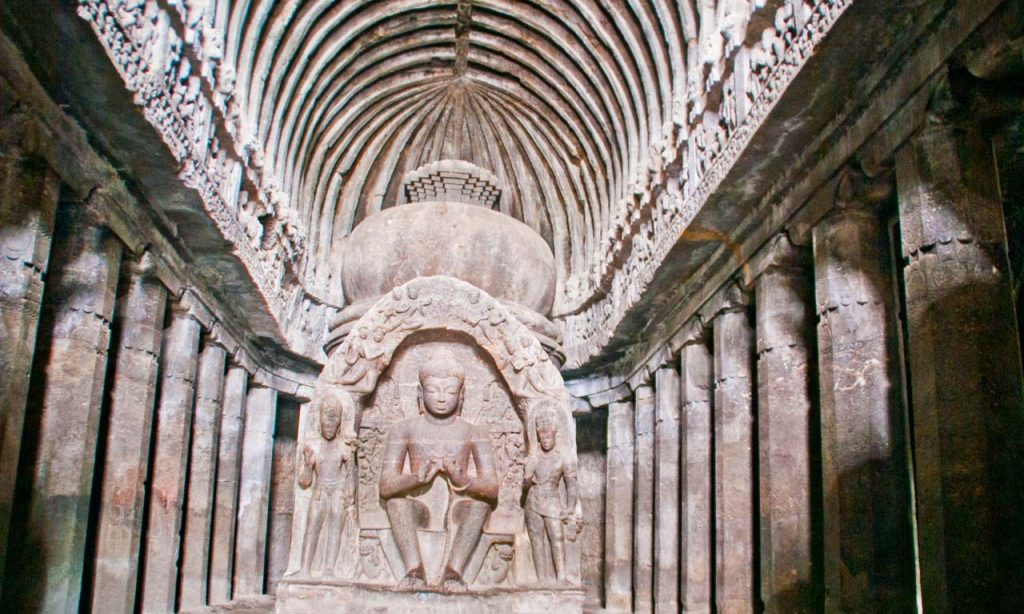
- Cave 10 (Vishvakarma Cave): The most striking of the Buddhist caves a cathedral-like chaitya hall with a ribbed ceiling designed to mimic wooden architecture. A 15-foot preaching Buddha sits at the far end.
- Cave 12 (Teen Tal): A rare three-storey monastery, one of the most elaborate at the site.
Hindu caves Caves 13 to 29
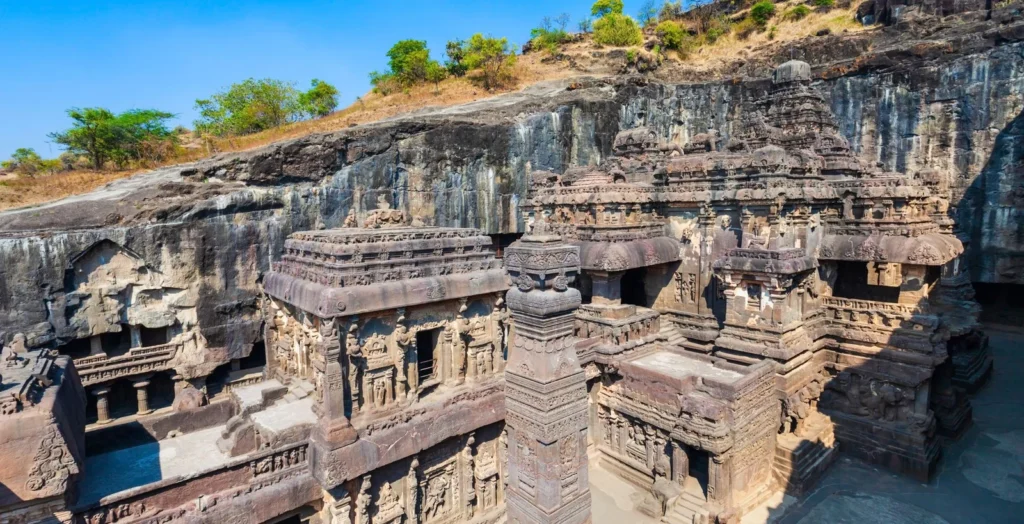
The central section holds the most dramatic monuments at Ellora, built primarily under the Rashtrakuta dynasty. Cave 16 the Kailasa Temple is the undisputed centrepiece of the entire complex and one of the greatest architectural achievements in human history.
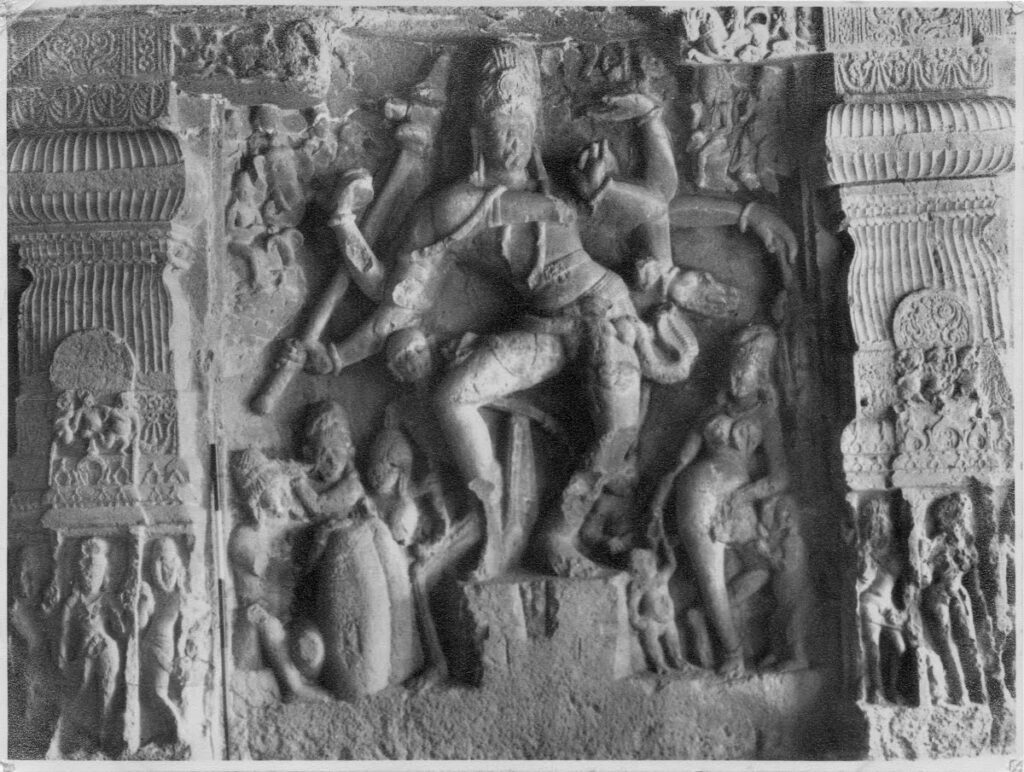
- Cave 14 (Ravana Ki Khai): Features large panels of Durga, Lakshmi, and Vishnu on Garuda.
- Cave 15 (Das Avatara): A two-storey cave with magnificent sculptural panels depicting the ten avatars of Vishnu.
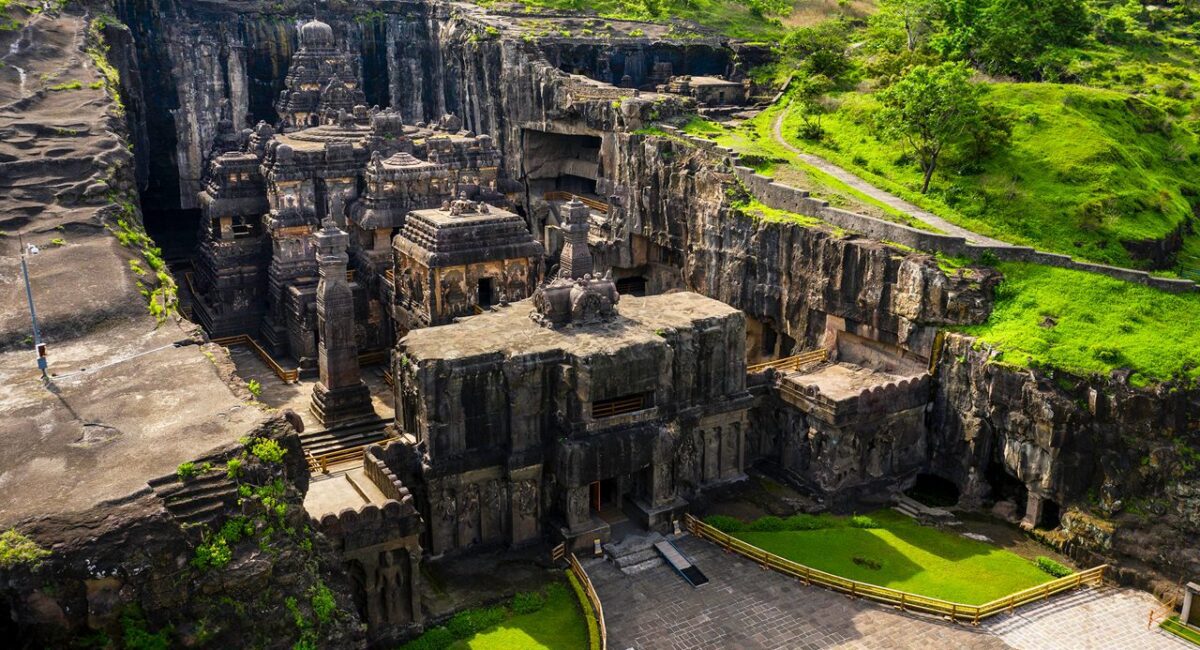
- Cave 16 (Kailasa Temple): The largest monolithic rock-cut structure in the world described in detail below.
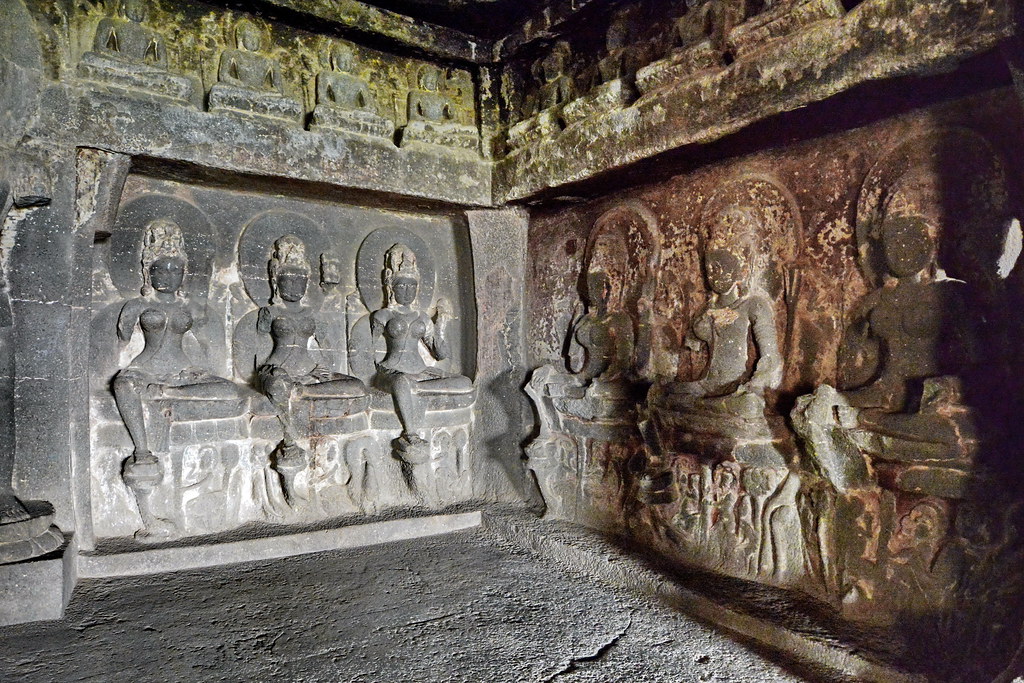
- Cave 21 (Ramesvara): Features the earliest depictions of river goddesses Ganga and Yamuna at Ellora, with beautifully carved apsaras (celestial dancers).
Jain caves Caves 30 to 34
The northernmost group, built in the 9th and 10th centuries, are smaller than the Hindu caves but extraordinarily detailed. Jain iconography emphasises precision, symmetry, and meditative stillness qualities that come through in every carved surface.
- Cave 30 (Chhota Kailasa): A miniature version of Cave 16, clearly inspired by the grand Kailasa Temple nearby.
- Cave 32 (Indra Sabha): Two-storey cave with Mahavira, Yakshas, Ambika, and intricate lotus carvings across the ceiling.
- Cave 33 (Jagannatha Sabha): Known for its meditative ambiance and detailed carvings of Tirthankaras.
Kailasa Temple Cave 16
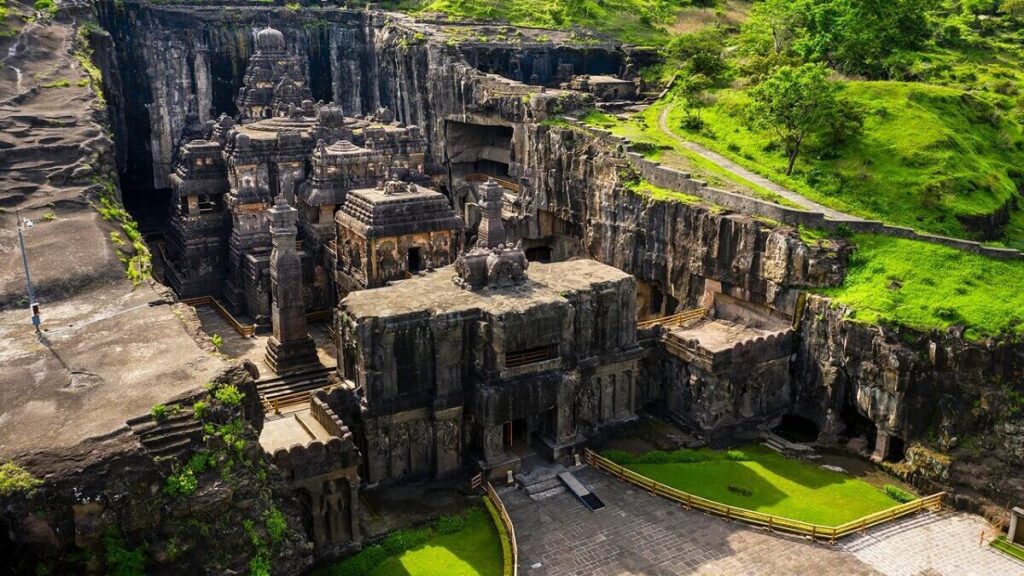
No monument in India prepares you for the Kailasa Temple. Carved from a single volcanic rock, it is the largest monolithic structure ever created by human hands wider than the Parthenon in Athens, and estimated to have required the removal of over 200,000 tonnes of rock.
Built under the Rashtrakuta king Dantidurga and completed under Krishna I in the 8th century CE, the Kailasa Temple represents Mount Kailash the mythical Himalayan abode of Lord Shiva. Every inch of its surface is carved with narrative panels, deity sculptures, and mythological scenes.
Key highlights inside the Kailasa Temple:
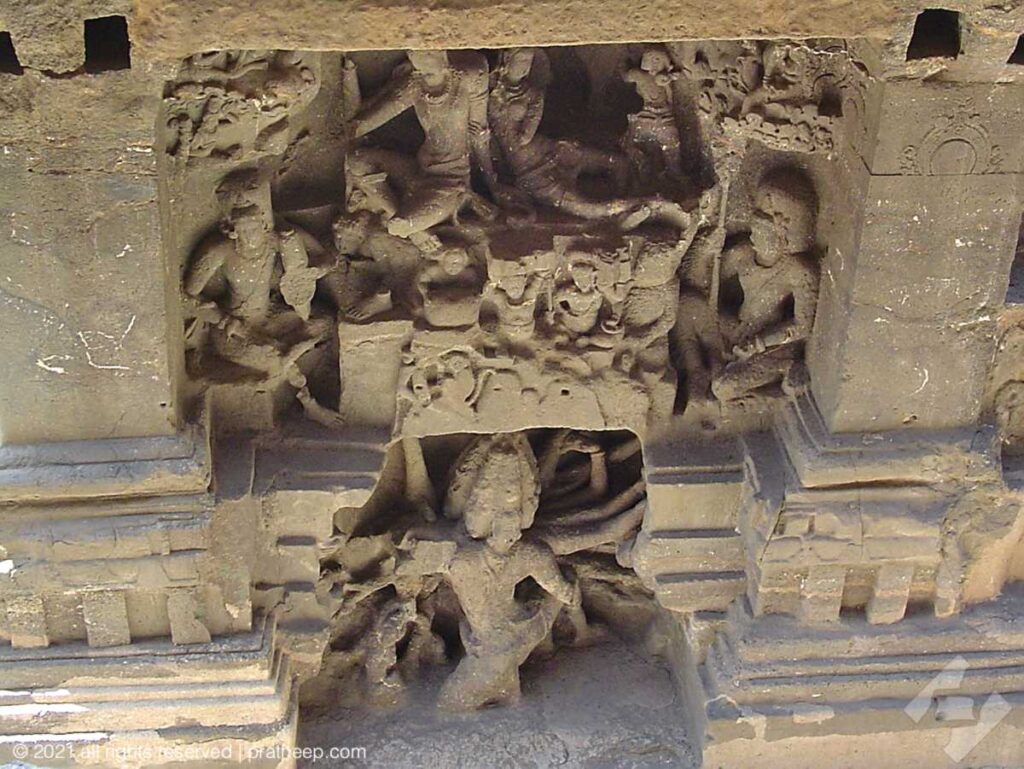
- Ravana lifting Kailash: A breathtaking 15-panel sculpture of Ravana attempting to uproot Mount Kailash while Shiva sits calmly above.
- Nandi Mandapa: A separate pavilion housing a massive Nandi bull, connected to the main shrine by a stone bridge.
- Shaivite friezes: Scenes from the Ramayana, Mahabharata, and Puranas carved in continuous narrative strips.
- Elephant base: The temple’s plinth is supported by rows of carved elephants a visual metaphor of the entire world resting on elephants.
Allow at least 60–90 minutes for Kailasa Temple alone. Walk the full perimeter, explore the galleries on either side, and descend into the courtyard to see the elephant base carvings. Most visitors only see the main tower don’t miss the side galleries.
UNESCO World Heritage status
Ellora was inscribed on the UNESCO World Heritage List in 1983 under three criteria: as a masterpiece of human creative genius, as an exceptional testimony to a cultural tradition, and for its association with living spiritual traditions. It remains one of the most significant heritage sites in all of Asia. The Archaeological Survey of India (ASI) and UNESCO jointly oversee conservation. Current preservation efforts include climate control and drainage systems, restricted access to fragile sections, and ongoing 3D mapping and digital documentation. Weathering of the volcanic basalt and heavy tourist footfall remain the primary conservation challenges.
How to reach Ellora Caves
By air
The nearest airport is Chhatrapati Sambhajinagar Airport (IXU), approximately 35 km from the caves. Direct flights operate from Mumbai, Delhi, Hyderabad, and Pune. From the airport, hire a taxi (approximately ₹600–800 to Ellora) or arrange through your hotel.
By train
Chhatrapati Sambhajinagar (Aurangabad) Railway Station is well-connected to Mumbai (Devgiri Express), Pune, Hyderabad, and Nagpur. From the station, take a local bus (every 30 minutes from the Central Bus Stand, ₹25–40) or hire a taxi (₹400–600 one way). Note: some buses stop at Ellora village, requiring a short 1–2 km walk to the caves.
By road
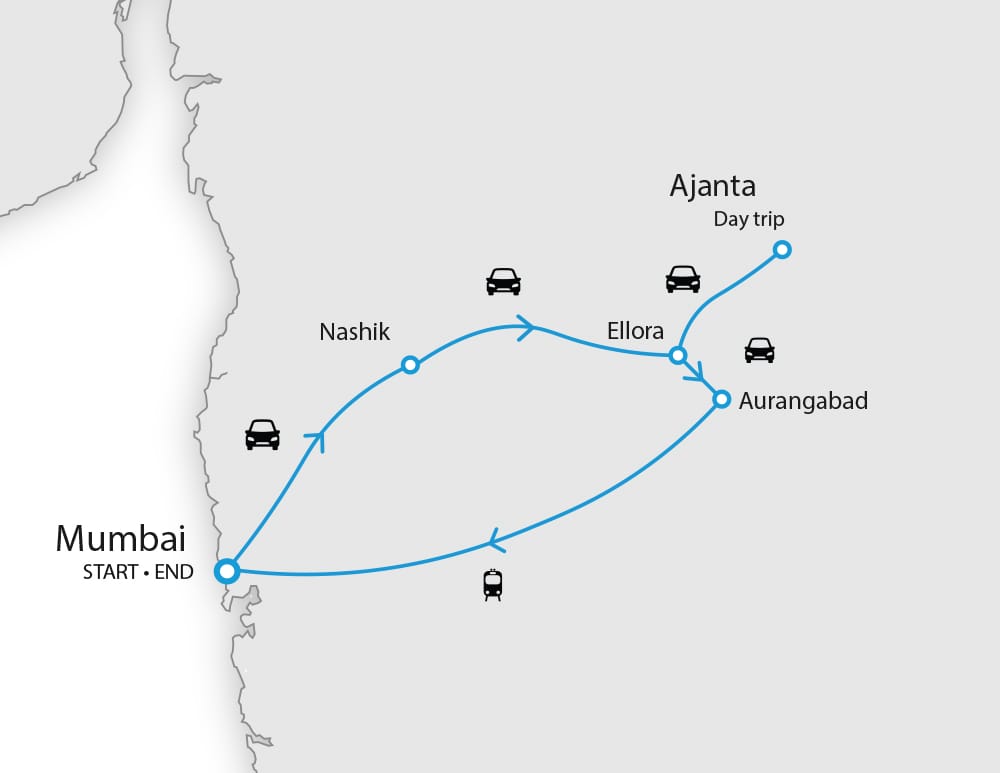
Ellora is 29 km from Aurangabad city centre on NH-52. The drive takes 35–45 minutes. Taxis, autorickshaws, and MSRTC state buses are all readily available. If you’re combining Ellora with Ajanta Caves, the two are approximately 100 km apart most travellers do Ajanta one day, Ellora the next.
Best time to visit Ellora
October to March is the ideal window. Days are pleasant (20–28°C), mornings are crisp, and the light is golden perfect for photography inside and outside the caves.
- October – November: Post-monsoon, caves look freshly washed, greenery all around. Excellent light.
- December – February: Peak tourist season, coolest temperatures. Book accommodation in advance.
- March: Warm but still manageable. Fewer crowds than December–January.
- April – June: Hot and dry. Visit only in early morning. Not recommended for children or elderly visitors.
- July – September: Monsoon season. Slippery paths make cave exploration hazardous. The site stays open but some areas are restricted. The surrounding hills are lush and dramatic some travellers enjoy this season for the atmosphere.
January and February weekends are very busy. If visiting during this period, arrive right at 9:00 AM Kailasa Temple can become extremely crowded by 11 AM
Photography and travel tips
- Flash photography is strictly prohibited inside all caves it damages ancient pigments and carvings. Use a camera with good low-light performance or a wide-aperture lens.
- Tripods require special permission from the ASI officer at the entrance apply on arrival.
- The best natural light for interior cave photography is between 10 AM and noon, when sunlight angles into the cave openings.
- Wear comfortable, closed-toe shoes. The site involves significant walking and uneven terrain.
- Carry water and snacks dining options near the caves are basic (MTDC canteen near the entrance, small stalls outside the gate).
- Video cameras (handheld) incur an extra ₹25 fee, payable at the ticket counter.
- Hire an ASI-approved guide at the ticket counter they carry official ID badges and typically charge ₹300–500 for a 2-hour guided tour.
- The site shuttle bus (₹22) runs between cave clusters use it on hot days or if you have limited time.
- Edibles are not allowed inside the cave complex. Finish meals before entering.
Nearby attractions
- Ajanta Caves (100 km): UNESCO-listed Buddhist caves famous for 2,000-year-old murals and frescoes. Combine with Ellora for a full heritage circuit.
- Grishneshwar Jyotirlinga (1 km from Ellora): One of the 12 sacred Shiva shrines, located within walking distance of the cave complex entrance.
- Daulatabad Fort (15 km): A dramatically situated medieval hill fort with a winding, trap-laden ascent great for adventure.
- Bibi Ka Maqbara (Aurangabad, 29 km): A Mughal-era mausoleum often called the ‘Taj of the Deccan’ worth including in an Aurangabad itinerary.
- Aurangabad Caves (3 km from city): A smaller group of rock-cut Buddhist caves, often overlooked but historically significant.
A well-planned 3-day itinerary: Day 1 Ajanta Caves. Day 2 Ellora Caves + Grishneshwar. Day 3 Aurangabad city (Bibi Ka Maqbara, Daulatabad Fort, Aurangabad Caves).
Frequently asked questions
What are the Ellora Caves’ opening hours?
The caves are open every day from 9:00 AM to 5:30 PM, except Tuesdays when the site is closed for maintenance. Last entry is at 5:00 PM.
How much is the entry fee for Ellora Caves?
Indian citizens and SAARC nationals pay ₹40. Foreign tourists pay ₹600. Children under 15 years of age enter free of charge. A video camera incurs an additional ₹25 fee.
Can I book Ellora Caves tickets online?
Yes. Tickets can be booked online through the ASI ticketing portal at asi.payumoney.com. Online booking is recommended for weekends and peak tourist season (December to February) to avoid queues.
How long do you need to visit Ellora Caves?
A short visit focusing on Kailasa Temple takes 2–3 hours. A half-day visit covering highlights from all three cave groups (Buddhist, Hindu, Jain) takes 4–5 hours. A full-day exploration with a guide takes 6+ hours. The site shuttle bus (₹22) helps cover the 2 km distance between cave clusters efficiently.
What is special about Ellora Caves?
Ellora is the only site in the world where Hindu, Buddhist, and Jain monuments coexist side by side, carved directly into basalt cliffs between the 6th and 10th centuries. The Kailasa Temple (Cave 16) is the largest monolithic rock-cut structure ever built wider than the Parthenon in Athens and requiring the excavation of an estimated 200,000 tonnes of rock.
How are Ellora Caves different from Ajanta Caves?
Ajanta Caves are exclusively Buddhist and are renowned for their ancient painted murals and frescoes. Ellora represents all three of India’s major ancient religions (Buddhism, Hinduism, Jainism) and is known for its rock-cut architecture and sculpture rather than paintings. Ajanta caves are slightly older, dating from the 2nd century BCE.
Is photography allowed inside Ellora Caves?
General photography with smartphones and cameras is permitted in most areas. Flash photography is strictly prohibited to protect ancient artwork. Tripods require special permission from the ASI officer. Video cameras require an additional ₹25 fee.
Which is the best cave to visit at Ellora?
Cave 16 (Kailasa Temple) is the must-see allow 60–90 minutes here alone. Among Buddhist caves, Cave 10 (Vishvakarma) is the most impressive. Among Jain caves, Cave 32 (Indra Sabha) is the highlight. If time allows, Cave 15 (Das Avatara) offers outstanding Vaishnavite sculpture.

Leave a Comment