
A Complete Guide to Amruteshwar Temple, Amruthapura
Amruteshwar Temple Amruthapura
If you drive just 67 kilometers north of the coffee-scented hills of Chikmagalur, past the bustling town of Tarikere and into the quiet heart of the Malnad region, you will find a village that time seems to have gently forgotten. This is Amruthapura.
While the world flocks to the grand temples of Belur and Halebidu to see the might of the Hoysala Empire, a smaller, more intimate masterpiece sits here in silence. It is the Amruteshwar Temple (often spelled Amrutesvara), a 12th-century marvel that doesn’t just show you history it tells you a story. Quite literally.
This isn’t just another temple visit; it is a journey into the mind of a medieval architect who dared to break the rules. From sculptures that read backwards to pillars that defy the technology of their time, the Amruteshwar Temple is a mystery carved in black soapstone.
In this comprehensive guide, we will explore the history, the architectural secrets, the legends, and the practical details you need to plan the perfect trip to this hidden Hoysala gem.
The History: A General’s Devotion (1196 CE)
To understand the soul of this temple, we must first rewind to the late 12th century. The year was 1196 CE. The Hoysala Empire was at its zenith under the rule of the illustrious King Veera Ballala II, a monarch who had expanded the kingdom’s borders and defeated the formidable Seuna and Chola dynasties.
Unlike many grand temples commissioned by kings to display their power, the Amruteshwar Temple was born from the devotion of a soldier. It was built by Amrutheshwara Dandanayaka, the commander-in-chief (Dandanayaka) of the Hoysala army.
The Brahminpuri Settlement
Historical records suggest that Amrutheshwara didn’t just build a temple; he built a community. Along with the shrine, he established a Brahminpuri (a settlement for scholars and priests) comprising 24 Brahmin families. These families were tasked with the upkeep of the temple and the study of the Vedas, turning Amruthapura into a vibrant hub of culture, religion, and education.
The Poet’s Stamp: Janna
The history of this site is not just recorded in dry archaeological texts; it is immortalized in poetry. Near the temple porch stands a large stone inscription a stele that is a treasure in itself. The verses on this stone were composed by Janna, one of the most celebrated poets of the Kannada language.
Janna was no ordinary scribe; he held the title of Kavichakravarti (“Emperor among Poets”) in the Hoysala court. His inscription here details the lineage of the Hoysala kings and praises the benevolence of Commander Amrutheshwara. It serves as a literary time capsule, blending the fluidity of poetry with the permanence of stone.
Architecture: The Star of the Malnad
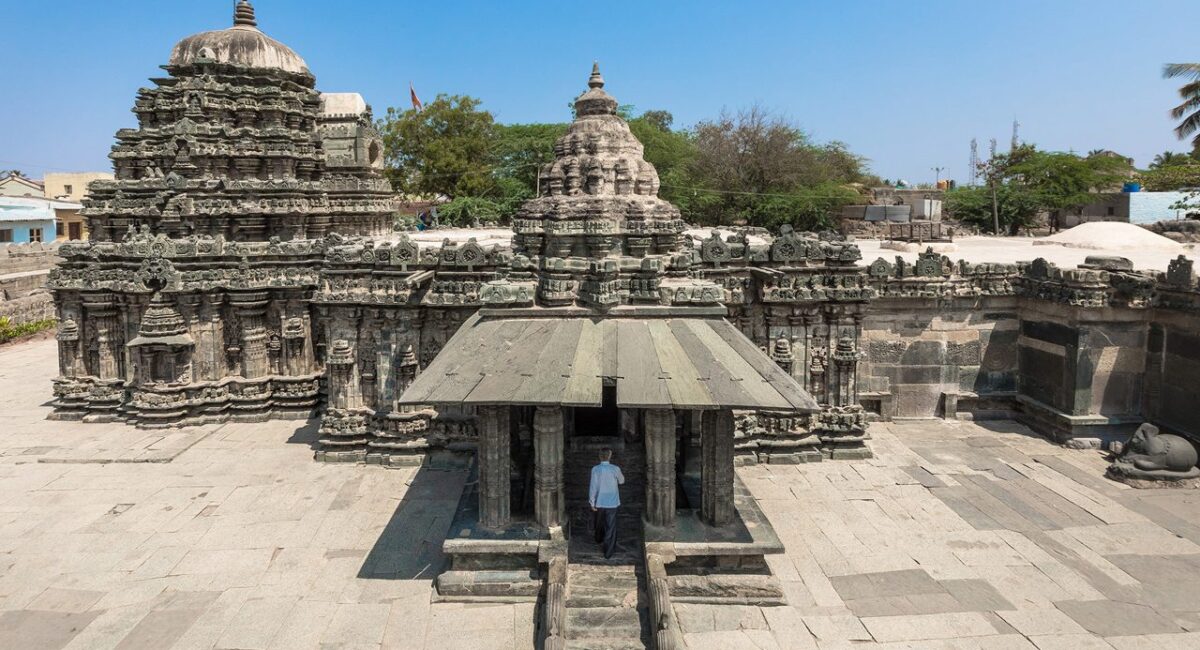
As you step through the temple gates, the first thing you notice is the layout. The Amruteshwar Temple is a classic example of Ekakuta architecture, meaning it features a single shrine (sanctum) topped with a tower (Vimana).
However, “simple” is not a word that applies here. The temple is built using the soft, malleable chloritic schist (soapstone), which allowed the Hoysala artisans to carve with the precision of a jeweler working on gold.
The Star-Shaped Design
Like many Hoysala structures, the sanctum is built on a Jagati (raised platform), but the temple plan itself follows a stellate (star-shaped) pattern. This is not just for aesthetics; the jagged, star-like projections increase the surface area of the outer walls, providing more canvas for the sculptors to work their magic. It also ensures that as the sun moves across the sky, different parts of the temple are highlighted by light and shadow, making the stone appear to “move” throughout the day.
The Open Mantapa
The temple features a wide, open Mantapa (hall) comprising 29 bays. From the outside, the parapet wall looks like a fortress of art, but inside, it is a forest of pillars.
The Mystery of the Lathe-Turned Pillars
This is where the engineering marvel of the Hoysalas becomes evident. The ceiling of the open mantapa is supported by rows of pillars that are perfectly circular and polished to a mirror-like finish.
Art historians and engineers are still fascinated by these lathe-turned pillars. In the 12th century, without modern electricity or industrial machines, these massive stones were mounted on a rotating mechanism (likely powered by elephants or groups of men) and chiseled while spinning. The result is a pillar with symmetrical rings so precise that you can run your fingernail through the grooves and feel no deviation. The black stone reflects the sunlight pouring in from the open sides, creating a dazzling effect.
The Sculptural Masterpiece: A Story on the Walls
While the pillars are impressive, the true genius of Amruteshwar lies in its outer walls. The parapet wall of the open mantapa features 140 large sculptural panels.
Unlike other Hoysala temples like Belur, where the carvings are often miniature and densely packed, the panels here are large, distinct, and designed to be read like a graphic novel. They depict scenes from the great Hindu epics: the Ramayana, the Mahabharata, and the Bhagavata Purana (Life of Krishna).
The Anti-Clockwise Anomaly
Here lies the temple’s greatest mystery. In Hindu tradition, devotees perform Pradakshina (circumambulation) in a clockwise direction keeping the deity to their right. Naturally, narrative sculptures on temple walls are arranged to unfold as you walk clockwise.
But at Amruteshwar, the architect broke the rule. On the South Wall, which features 70 panels depicting the Ramayana, the story flows in an anti-clockwise direction.
- If you walk the normal way, you will see the story backward: from Rama’s coronation back to his birth!
- To “read” the Ramayana correctly here, you must walk against the traditional flow.
Why? Historians are divided. Some believe it was a deliberate artistic choice to force the devotee to pause and re-engage with the temple. Others suggest it might have been a layout error that became a permanent feature. Regardless, it makes Amruteshwar unique in the world of Indian temple architecture.
Highlights of the Ramayana Panels:
- The Golden Deer: You can see the intricate carving of the deer (Maricha) distracting Sita.
- The War in Lanka: Detailed scenes of Vanaras (monkeys) battling the Rakshasas.
- Hanuman’s Trial: A vivid panel showing Ravana ordering the execution of Hanuman, while Vibhishana intervenes.
The Clockwise Tales (North Wall)
On the North Wall, the order returns to normal (clockwise). Here, you will find:
- 25 Panels of Krishna Leela: These depict the early life of Lord Krishna. Look for the charming scene of Krishna stealing butter, where a young Krishna is shown reaching into a pot while his mother Yashoda churns milk nearby. Another panel vividly shows him defeating the serpent Kalia.
- 45 Panels of the Mahabharata: These scenes are intense and dynamic. A standout panel is the Burning of the Lakshagriha (the House of Lacquer). You can see the flames licking the roof of the house while the Pandavas escape through a tunnel a terrifying moment captured beautifully in stone.
Inside the Sanctum: The 200-Year-Old Flame
Passing through the open mantapa, you enter the Closed Mantapa (Navaranga), which has nine bays. This area is darker, cooler, and more mystical.
The Ceiling Domes
Look up immediately. The ceiling of the closed mantapa is divided into deep, domed bays. These are the work of Ruvari Mallitamma, who would go on to become the most famous sculptor of the Hoysala era. It is believed that Mallitamma started his career here as a young apprentice. The domes are carved with complex floral and geometric patterns (lotus buds, banana flowers) that look like hanging lacework.
The Sanctum (Garbhagriha)
At the heart of the temple lies the sanctum sanctorum, housing the Shiva Linga.
- The Linga: It is said that this specific Linga was brought from the River Gandaki in Nepal (a river famous for its Saligram stones).
- The Eternal Lamp: Local priests and villagers will tell you about the “Nanda Deepa” inside the sanctum. Legend states that this oil lamp has been burning continuously for over 200 years. Devotees replenish the oil daily, ensuring the flame never dies. Whether fact or faith, the sight of that single flickering flame against the dark, ancient stone is deeply moving.
To the right of the Linga stands a beautiful idol of Sharada Devi (Saraswati), the goddess of wisdom, reinforcing the temple’s history as a center of learning.
Cultural Significance & Rituals
Amruteshwar is not a “dead” monument; it is a living place of worship. The deity, Lord Shiva, is worshipped here daily.
- Bilva Archana: The offering of Bilva leaves (sacred to Shiva) is a common ritual here.
- Aksharabhyasa: Given the presence of Sharada Devi and the temple’s history as a hub of scholars, many parents bring their young children here for Aksharabhyasa—the ceremonial initiation into education, where the child writes their first letter.
- Maha Shivaratri: If you visit during the festival of Shivaratri (usually February or March), the quiet village transforms. The temple is adorned with flowers and lights, and thousands of devotees flock for an all-night vigil, filling the air with chants of “Om Namah Shivaya.”
Travel Guide: Planning Your Visit
Ready to pack your bags? Here is everything you need to know to plan a smooth trip to Amruthapura.
Location & How to Get There
The temple is located in Amruthapura Village, Tarikere Taluk, Chikkamagaluru District, Karnataka.
- By Air: The nearest airport is Shivamogga (Shimoga) Airport (approx. 45 km). Alternatively, Mangalore International Airport is about 185 km away, and Bangalore International Airport is roughly 260 km away.
- By Train: The nearest railway station is Tarikere (approx. 10 km). You can take a train from Bangalore to Tarikere (Jan Shatabdi or Intercity Express) and then hire an auto-rickshaw or taxi to the temple.
- By Road:
- From Bangalore: Drive via NH 48 and NH 206 (approx. 260 km / 5 hours). The route is Bangalore -> Tumkur -> Tiptur -> Arsikere -> Tarikere -> Amruthapura.
- From Chikmagalur: It is a beautiful 67 km drive (approx. 1.5 hours) via the Lingadahalli road.
Best Time to Visit
- October to March: This is the winter season. The weather is pleasant, cool, and perfect for exploring the outdoor architecture without the harsh sun.
- Monsoon (June to September): The Malnad region is stunningly green during the rains. The black stone of the temple looks striking when wet. However, heavy rains can make travel slightly difficult.
- Summer (April to May): It can get quite warm, so if you visit then, try to reach the temple early in the morning (before 10 AM).
Temple Timings
- Open Daily: 6:00 AM to 6:00 PM.
- Entry Fee: Free.
- Photography: Allowed (usually free, but be respectful inside the sanctum).
Where to Stay
Amruthapura is a small village with no lodges. You should base yourself in one of the nearby towns:
- Tarikere (10 km): Basic budget lodges available.
- Chikmagalur (67 km): The best option for tourists. Offers luxury resorts, homestays, and hotels.
- Kemmannugundi (35 km): The Horticulture Department Guest House offers a stay amidst nature, but book in advance.
Nearby Attractions (Extend Your Trip)
Don’t just visit the temple and leave! The surrounding region is packed with natural wonders.
Bhadra Reservoir (Dam)
- Distance: ~15 km
- The massive Bhadra Dam creates a reservoir that looks like a calm, inland sea. It is a fantastic spot for a picnic. You can take a boat ride here (Jungle Lodges & Resorts operates a property nearby called the River Tern Lodge).
Kemmannugundi Hill Station
- Distance: ~35 km
- Known as the “Ooty of Karnataka,” this hill station was the summer retreat of the Mysore King Krishnaraja Wodeyar IV. Visit Z Point for a breathtaking sunset and stroll through the meticulously maintained Rose Garden.
Hebbe Falls
- Distance: ~45 km (requires jeep ride from Kemmannugundi)
- A massive two-tiered waterfall hidden inside a coffee estate. The water is believed to have medicinal properties.
Kalhatti Falls
- Distance: ~40 km
- A unique waterfall that cascades over a small Veerabhadra temple built into a rock gap. A perfect blend of nature and divinity.
Conclusion: Why Amruteshwar Matters
In a world of “must-see” lists and crowded tourist traps, the Amruteshwar Temple offers something rare: Solitude.
Here, you can stand alone in the open mantapa, surrounded by 800 years of history, with only the sound of the wind in the coconut palms and the distant chime of a temple bell. You can trace the path of the lathe-turned pillars with your fingers and wonder at the hands that made them. You can walk backward through the Ramayana and forward through the Mahabharata.
The Amruteshwar Temple is not just a monument to the Hoysala dynasty; it is a monument to the human spirit to the commander who sought peace after war, the poet who wrote in stone, and the sculptor who turned rock into lace.
So, the next time you are in Karnataka, take that detour from Tarikere. Turn towards Amruthapura. The stones have a story to tell, and they are waiting for you to listen.

Leave a Comment