
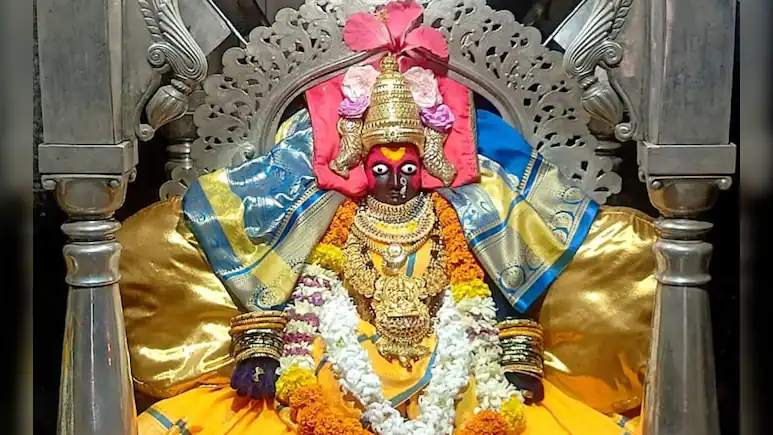
Yamai Devi Temple, Aundh
Yamai Devi Temple – Nestled amidst the picturesque hills of the Satara district in Maharashtra, the Yamai Devi Temple at Aundh stands as a beacon of faith, history, and architectural simplicity. More than just a place of worship, it is a spiritual anchor, particularly for the countless Marathi families who revere Shree Yamai Devi as their cherished Kul-Daiwat (family deity). This comprehensive article dives deep into the temple’s rich history, profound religious significance, architectural features, and practical information for pilgrims and history enthusiasts.
Unveiling the Legend: The Story of Yamai Devi Temple
The narrative surrounding Shree Yamai Devi is as compelling as it is central to the temple’s identity. The deity is widely revered as a powerful manifestation of Goddess Shakti, the divine feminine energy. Specifically, the Goddess at Aundh is often considered a combined or joint incarnation of Goddess Parvati and Renuka Devi (a form of Goddess Durga), and she is locally worshipped as a form of Bhairavi.
The Divine Test and the Origin of the Name
One of the most popular legends associated with the temple and its name traces back to the era of Lord Rama. The story, as recounted by local tradition, involves a divine play orchestrated by Goddess Parvati
The Doubt: During the period when Lord Rama was in anguish searching for his abducted wife, Sita, Goddess Parvati observed his deep sorrow. She questioned how an incarnation of Lord Vishnu (Rama) could experience such human pain and emotional distress.
The Assurance: Lord Shiva, her husband, assured her that Rama, though divine, was perfectly playing the role of a human being, and his pain was a natural part of that role.
The Examination: To test Rama’s divinity, Parvati decided to take the form of Sita and appeared before him in the forest.
The Revelation and Name: Lord Rama, recognizing the divine illusion instantly, addressed her not as his wife, but as a motherly figure, exclaiming: “Ye Mai!” (Marathi/local dialect for “Oh, Mother!”). He then confined her to that spot, and since then, the deity has been revered as Yamai Devi a name derived from the heartfelt exclamation, acknowledging her as the Divine Mother.
The Elder Sister of Tulja Bhavani
Significantly, Yamai Devi is also held to be the elder sister of Tulja Bhavani (the primary family deity for the Bhosale royal family and one of the most revered forms of Durga in Maharashtra). This belief stems from the association of Renuka (one of Yamai’s forms) with the ancient Krita Yuga and Tulja Bhavani with the Treta Yuga, thus establishing Yamai’s seniority in the timeline of divine incarnations. This relationship is underscored by the presence of a consecrated shrine dedicated to Yamai Devi even within the Tuljapur Tulja Bhavani temple complex.
The Majestic Location: Yamai Devi Temple Aundh
The primary and most significant shrine, referred to as the Mulpeeth (Original Seat), is the Yamai Devi Temple Aundh in the Khatav taluka of Satara district, Maharashtra. Its location adds immense spiritual and scenic value, situated atop a small hill overlooking the town of Aundh.
The Journey to the Summit
The temple’s hill-top location creates an atmosphere of spiritual ascent for the devotee. There are two main ways to reach the sacred shrine:
- The Steps of Devotion: A traditional path involves climbing the steps that begin at the base of the hill.15 This pilgrimage by foot is considered an act of great devotion, offering stunning views of the surrounding landscape as one ascends.
- The Modern Roadway: For comfort and convenience, a motorable road winds up the slopes, allowing vehicles to reach the summit. Ample parking is now available at the top, making the temple accessible to all, including the elderly and physically challenged.
A Symbol of Mahishasur Mardini
The principal idol of Yamai Devi inside the temple is a striking and powerful sculpture.
- The Idol: Carved from black stone, the idol is impressive, standing at nearly two meters high. The Goddess is depicted in a commanding, cross-legged sitting position (Lalitāsana).
- Iconography: She is a form of Mahishasur Mardini, the vanquisher of the buffalo demon. Beneath her seat, the heads of a human and a buffalo are symbolically carved, representing the defeat of the demon Aundhasur. She is typically adorned with a Kiriṭa (crown), earrings, necklaces, and other traditional ornaments. Her four hands hold distinct weapons and symbols: a pellet drum (Damarū) and a sword in her right hands, and a trident and a drinking bowl/skull cup in her left hands, aligning her with the powerful aspects of Bhairavi.
- The Golden Crown: A powerful testament to the temple’s enduring importance and the continuous patronage of its royal family is the magnificent 7-kilogram solid gold kalash (crown) installed on the pinnacle of the temple by the present head of the former ruling PantPratinidhi family, Gayatreedevi Pantpratinidhi.
Architecture and Historical Patronage
The town of Aundh and its temple have been inextricably linked with the PantPratinidhi family, who were the former rulers of the Aundh Princely State, for many centuries. Their patronage has ensured the preservation and continuous development of the complex.
Temple Architecture
The architecture of the temple, believed to date back to the 15th-16th century CE, is noted for its relative simplicity and lack of ostentatious ornamentation, especially when compared to other major Maharashtrian temples.
- The Layout: Eschewing the complex, multi-segmented structure of traditional temples (like the vāhanamaṇḍapa or mukhamaṇḍapa), the Yamai Devi Temple comprises a single, expansive hall supported by four substantial pillars and twelve half-pillars.
- The Sanctum: The area resembling the garbhagṛha (sanctum sanctorum) is situated in the western part of this hall, where the magnificent idol of the Goddess resides.
- Associated Deities: The main deity is flanked by the image of Bhairava to her right, and a depiction of another goddess (likely Bhairavi) to her left, symbolizing the complementary aspects of Shiva and Shakti. The temple premises also include the head of the defeated demon Aundhasur, a well-carved Nandi bull, and a Shivling, establishing the presence of the Shaivaite tradition alongside the Shakta worship.
The Shri Bhavani Museum: A Cultural Gem
A unique feature of the Yamai Devi Aundh complex is the presence of the Shri Bhavani Museum, which is housed on the middle section of the temple hill. Established from the private collection of the Maharajas of Aundh, the museum serves as a cultural repository that elevates the site beyond mere religious significance.
- Collection Highlights: The museum is renowned for its collection of masterpieces by noted 19th and 20th-century Indian artists, including M. V. Dhurandhar, Baburao Painter, Madhav Satwalekar, and, most famously, Raja Ravi Varma.
- Global Art: It also boasts a piece of international significance: the famous “Mother and Child” stone structure by the renowned British artist Henry Moore.
- Accessibility: Visitors can easily reach the museum building by both the steps and the road that leads to the summit.
Beyond the Mulpeeth: The Yamai Uppeethas
The reverence for Shree Yamai Devi is not confined to the Aundh hilltop. The Goddess is widely worshipped across Maharashtra, Karnataka, and Andhra Pradesh, with dozens of shrines dedicated to her.35 In Maharashtra, the original seat at Aundh (Mulpeeth) is complemented by several major subsidiary shrines, known as Uppeethas (or Peethas).
These Uppeethas are considered as sacred and significant as the original seat and were established for the purpose of destroying evil forces and ensuring the welfare of devotees. They represent the extended spiritual domain of the Goddess.
| Sr. No. | Shrine Name | Location (Taluka, District) |
| 1. | Shree Mulpeeth Yamai Devi Devasthan | Aundh, Khatav, Satara (The Original Seat) |
| 2. | Shree Jagdamba Yamai Devi Devasthan | Rashin, Karjat, Ahmednagar |
| 3. | Shree Yamai Devi Devasthan | Jyotiba Dongar (Wadi Ratnagiri), Panhala, Kolhapur |
| 4. | Shree Yamai Devi Devasthan | Mardi, North Solapur, Solapur |
| 5. | Shree Yamai Devi Devasthan | Kanherasar, Khed, Pune |
| 6. | Shree Yamai Devi Devasthan | Shivri, Purandar, Pune |
| 7. | Shree Yamai Devi Devasthan | Kavathe Yamai, Shirur, Pune |
| 8. | Shree Sakharagadnivasini Ambabai – Yamai Devi Devasthan | Kinhai, Koregaon, Satara |
| 9. | Shree Yamai Devi Devasthan | Hingangav, Paranda, Dharashiv (Osmanabad) |
| 10. | Shree Yamai Devi Devasthan | Hippargarav, Umarga, Dharashiv (Osmanabad) |
| 11. | Shree Yamai Devi Devasthan | Mahalung, Malshiras, Solapur |
| 12. | Shree Yamai Devi Devasthan | Koregaon, Barshi, Solapur |
Pilgrimage and Visitor Information
Visiting the Yamai Devi Temple at Aundh is an experience that combines deep reverence with cultural appreciation.
Darshan and Pooja Timings
The temple is open daily for devotees, though timings can vary slightly. It is always best to confirm with local sources before a visit.
- General Temple Timings: Approximately 06:00 AM to 08:30 PM on all days of the week.
- Aarti and Pooja: Specific rituals are performed in the morning and evening.
Best Time to Visit
While the temple is accessible year-round, the most pleasant time to visit the region is during the Winter Season (September to February), when the weather is cool and conducive for climbing the steps and enjoying the hilltop views. The Monsoon season (June to September) transforms the surrounding hills into a lush green paradise, offering a different but equally beautiful experience.
Religious Protocols and Dress Code
As a major religious site, the temple follows certain customs:
- Dress Code: Visitors are typically requested to adhere to a traditional and formal dress code. For men, this includes a shirt and trousers or traditional attire like a dhoti or pyjama. For women, a saree, half-saree with a blouse, or a churidar with an upper cloth is generally preferred. Modesty is paramount.
- Conduct: Devotees are expected to bathe and wear clean clothes before entering the temple and to respect the ancient customs and co-pilgrims. Smoking, drinking, and chewing tobacco/betel leaves are strictly prohibited within the temple premises.
Frequently Asked Questions (FAQ) about Yamai Devi Temple
| Question | Answer |
| Where is the main Yamai Devi Temple located? | The primary temple, or Mulpeeth, is the Yamai Devi Temple Aundh, situated atop a hill in the Aundh town of the Khatav taluka, Satara district, Maharashtra. |
| Who is Yamai Devi? | Yamai Devi is a highly revered Hindu Goddess in Maharashtra, considered a powerful manifestation of Shakti and a joint incarnation of Goddess Parvati and Renuka Devi. She is the Kul-Daiwat (family deity) for many Marathi families. |
| What is the significance of the temple’s idol? | The 2-meter high black stone idol depicts the Goddess in a commanding cross-legged pose (Lalitāsana), a form of Mahishasur Mardini. The idol features four hands holding traditional weapons and is adorned with a golden crown on the temple’s pinnacle. |
| How can I reach the Aundh Temple? | You can reach the temple by climbing the traditional steps from the base of the hill or by driving up the motorable road, which has parking available at the top. |
| What else can I see at the temple complex? | The complex houses the Shri Bhavani Museum, which features a remarkable collection of paintings by Indian masters like Raja Ravi Varma and international sculpture like Henry Moore’s “Mother and Child.” |
| Is Yamai Devi related to Tulja Bhavani? | Yes, Yamai Devi is traditionally regarded as the elder sister of Tulja Bhavani. A shrine to Yamai Devi is also consecrated within the Tuljapur temple complex. |
Leave a Comment