


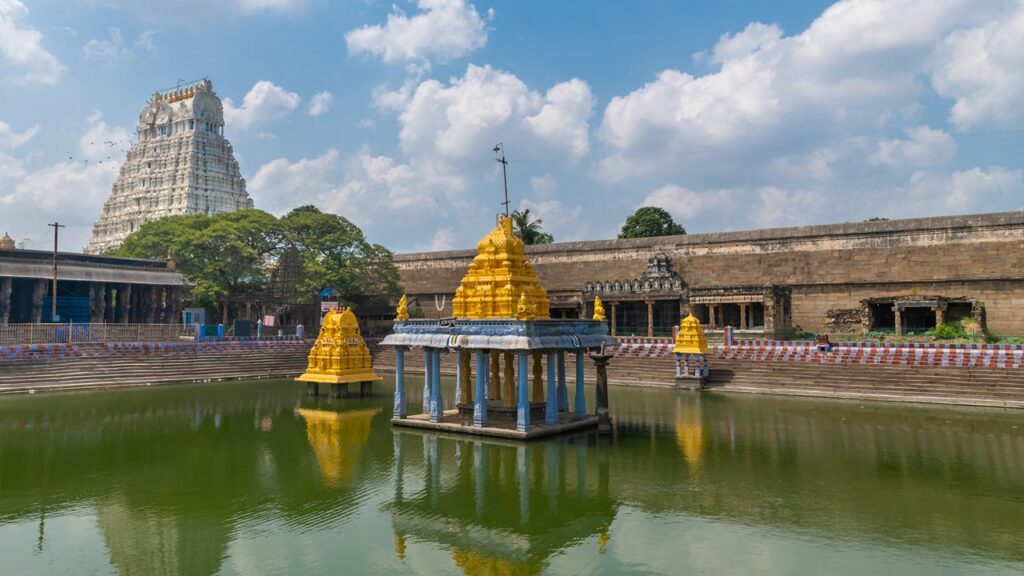
Introduction: The Spiritual Bastion of Kanchipuram
Kanchipuram, often referred to as the ‘City of a Thousand Temples,’ is anchored by three primary spiritual pillars: the Kamakshi Amman Temple (Shakti), the Ekambareswarar Temple (Shiva), and the magnificent Varadharaja Perumal Temple (Vishnu). Known among devotees as Hastigiri or Attiyuran, this sacred site is one of the most prominent Divya Desams the 108 holy abodes of Lord Vishnu mentioned in the works of the Alwars (poet-saints).
Standing as a testament to the confluence of Vedic philosophy and Dravidian artistic brilliance, the Varadharaja Perumal Temple is not merely a place of worship but a living museum of South Indian history. For the Sri Vaishnavite community, it is one of the ‘Mumurtivasam’ (three most important temples), alongside Srirangam and Tirupati. This article delves into the profound spiritual, architectural, and historical layers of this monumental temple, offering a definitive guide for researchers and pilgrims alike.
The Importance of Varadharaja Perumal Temple
The Varadharaja Perumal Temple is unique because it represents the Satyavrata Kshetra, the “Land of Truth.” While Srirangam is regarded as the Bhogamandapam (place of enjoyment) and Tirupati as the Pushpamandapam (place of flowers), Kanchipuram is revered as the Tiyagamandapam (place of sacrifice).
It is here that Lord Vishnu is believed to have manifested in response to Lord Brahma’s penance, bestowing boons upon his devotees. The temple’s sanctity is magnified by its association with Ramanujacharya, the great philosopher-saint of Vishishtadvaita, who performed daily services here before moving to Srirangam.
Meaning and Symbolism of “Varadharaja”
The name Varadharaja is a compound of two Sanskrit words: Varadha (one who grants boons) and Raja (King). Thus, He is the “King among Boon-Givers.”
The deity is also called Devaperumal, emphasizing His supreme godhead. The temple itself is situated on a small hillock known as Hastigiri. In Sanskrit, Hasti means elephant and Giri means hill. Symbolically, this refers to the elephant Gajendra, whom Lord Vishnu saved from the crocodile, or alternatively, to the four elephants supporting the cardinal directions where Brahma performed his sacrifice.
Detailed Mythological Legends
Brahma’s Ashvamedha Yagna
According to the Brahmanda Purana, Lord Brahma, the Creator, wished to perform a grand sacrifice (Yagna) to purify himself. He chose Kanchipuram as the most sacred spot on earth. However, his consort, Saraswati, was angry because the Yagna was being performed without her presence (due to a previous disagreement).
To disrupt the ritual, Saraswati took the form of the Vegavathi River and flowed with torrential force to drown the sacrificial fire. Lord Vishnu, at Brahma’s request, lay across the path of the river as a dam. Recognizing her husband, the river subsided. Upon the successful completion of the Yagna, Lord Vishnu emerged from the fire (Punya Koti Vimanam) in His radiant form as Varadharaja.
Indra’s Curse and the Golden/Silver Lizards
One of the most popular legends involves the two sons of Sage Gautama, who were cursed to become lizards for their negligence in a ritual. They performed penance at Kanchipuram and were eventually liberated by the grace of Varadharaja Perumal. To commemorate this, the temple features two lizards one covered in gold and the other in silver on the ceiling of a small chamber. It is believed that touching these lizards washes away one’s accumulated sins and provides relief from Doshams.
The Athi Tree Origin
The original idol of the temple was carved from the wood of the Athi (Fig) tree. This deity, known as Athi Varadar, was the primary object of worship for centuries until it was decided to submerge the idol in the temple tank (Ananthasaras) for protection during historical invasions.
Historical Evolution: From Cholas to the British
The Varadharaja Perumal Temple is an architectural palimpsest, with layers of construction spanning over a millennium.
- Chola Period (9th–13th Century): The core sanctum and many of the inner shrines were expanded under the Medieval Cholas. Inscriptions from the reign of Kulothunga Chola I and Vikrama Chola record generous land grants to the temple.
- Vijayanagara Empire (14th–17th Century): Most of the temple’s current grandeur is credited to the Vijayanagara kings. They built the massive gopurams (towers) and the iconic 100-pillared hall. Their influence is visible in the intricate carvings of yalis and equestrian soldiers.
- The Nayaks: The Tanjore and Madurai Nayaks continued the patronage, adding detailed murals and refining the decorative elements of the mandapams.
- Colonial Era: During the Carnatic Wars, the temple served as a strategic fortress. Interestingly, Robert Clive of the British East India Company is said to have gifted a precious necklace (Clive Maharkandi) to the deity, which is still worn by the Lord during the Garuda Sevai festival.
Architectural Analysis: A Dravidian Masterpiece
The temple complex covers a sprawling 23 acres and is an exemplary model of the Dravidian style of architecture.
The Gopurams and Prakarams
The temple features seven outer enclosures (prakarams), though only some are accessible to the public. The main entrance is marked by a majestic 7-tiered Rajagopuram standing over 130 feet tall.
The 100-Pillared Hall (Nooru Kaal Mandapam)
This is a pinnacle of Vijayanagara artistry. Each pillar is carved out of a single granite stone, featuring intricate depictions of the Ramayana, Mahabharata, and various avatars of Vishnu. The corners of the hall feature massive stone chains carved from a single block of stone—a feat of engineering that continues to baffle modern architects.
The Vimana
The sanctum sanctorum is crowned by the Punya Koti Vimana. Unlike the towering gopurams, the Vimana is relatively small but covered in gold plating, signifying its supreme sanctity.
The Legend of Athi Varadar
The most enigmatic aspect of the Varadharaja Perumal Temple is Athi Varadar.
Why is He Submerged?
The original wooden idol was placed in a silver casket and submerged in the Ananthasaras tank to protect it from the Mughal invasions led by Aurangzeb’s generals. A new stone idol was brought from the Padma Giri hills in Udayarpalayam to ensure the continuity of worship.
The 40-Year Cycle
The Athi Varadar idol is brought out for public worship only once every 40 years. This event, known as the Athi Varadar Vaibhavam, lasts for 48 days. During the first 24 days, the deity is kept in a reclining posture (Sayana Kolam), and for the remaining 24 days, in a standing posture (Nindra Kolam).
- Last Darshan: 2019 (Attracted over 10 million devotees).
- Next Expected Darshan: 2059.
Daily Rituals and Agamic Practices
The temple follows the Pancharatra Agama, one of the two primary streams of Vaishnavite temple rituals. The daily routine is strictly governed by these ancient scriptures:
- Viswaroopam (Early Morning): Opening of the sanctum and the first viewing.
- Thiruvaradhanam: Elaborate puja involving the offering of flowers, incense, and food (Prasadam).
- Satrumurai: Recitation of the Nalayira Divya Prabandham (Tamil hymns) by the temple priests.
The offerings here are famous, particularly the Kanchipuram Idli, a spicy, steamed delicacy flavored with pepper, ginger, and cumin, prepared in large bamboo baskets.
Major Festivals
| Festival | Month (Tamil/English) | Significance |
| Brahmotsavam | Vaikasi (May/June) | The grandest 10-day festival. |
| Garuda Sevai | During Brahmotsavam | The Lord rides the golden Garuda; attracts lakhs of people. |
| Vaikunta Ekadashi | Margazhi (Dec/Jan) | Opening of the “Gate to Heaven.” |
| Ther Thiruvizha | During Brahmotsavam | The massive temple chariot procession. |
| Float Festival | Thai (Jan/Feb) | Deities taken on a raft in the Ananthasaras tank. |
Role in Sri Vaishnavism
The Varadharaja Perumal Temple is a cornerstone of the Vishishtadvaita school of thought.
- Ramanujacharya: It was here that Ramanuja served his guru, Yadavaprakasa, and later Tirukachi Nambi. Legend says Ramanuja used to fetch water daily from a well (Salaikinaru) for the Lord’s bath.
- The Alwars: The temple has been glorified in the hymns of Bhoothathalvar, Peyalvar, and Thirumangai Alvar. These hymns form part of the Nalayira Divya Prabandham, which is considered the “Dravida Veda.”
- Vedanta Desika: The famous philosopher-poet composed the Varadharaja Panchasath in praise of the Lord here.
Temple Inscriptions and Historical Records
There are over 350 inscriptions within the temple complex. These serve as a historical ledger of South India. They document:
- Donations of gold, cattle, and land by kings like Raja Raja Chola I.
- The political stability provided by the Vijayanagara Empire.
- Social structures, tax exemptions, and the judicial system of the medieval era.
Tourism and Practical Information
Temple Timings
- Morning: 6:00 AM to 12:30 PM
- Evening: 3:30 PM to 8:30 PM
- Note: Timings may extend during festival days.
How to Reach
- By Air: The nearest airport is Chennai International Airport (MAA), located approximately 65 km away.
- By Rail: Kanchipuram has its own railway station, well-connected to Chennai, Chengalpattu, and Tirupati.
- By Road: Kanchipuram is highly accessible via the Chennai-Bangalore Highway. Frequent buses ply from Chennai (Koyambedu CMBT).
Best Time to Visit
The ideal time to visit is between October and March when the weather is pleasant. For those wishing to witness the grandeur of festivals, the Vaikasi Brahmotsavam (May/June) is the most significant time, though it can be quite hot.
Nearby Temples to Visit
- Ekambareswarar Temple: Representing the element Earth (Prithvi Lingam).
- Kamakshi Amman Temple: The focal point of Shakti worship in Kanchipuram.
- Kailasanathar Temple: The oldest structural temple in Kanchipuram, famous for Pallava architecture.
- Ulagalantha Perumal Temple: Featuring a massive idol of Lord Vamana/Trivikrama.
Frequently Asked Questions (FAQ)
1. What is the significance of the lizard in Kanchipuram Varadharaja Perumal Temple?
The gold and silver lizards represent the liberation of two disciples of Sage Gautama from a curse. Devotees touch them to seek relief from astrological doshams and chronic illnesses.
2. When is the next Athi Varadar festival?
The next Athi Varadar Vaibhavam is scheduled for the year 2059, following the 40-year cycle of bringing the deity out of the temple tank.
3. Is there a dress code for the temple?
Yes, traditional attire is recommended. Men are encouraged to wear dhotis or formal trousers (avoiding shorts), and women are expected to wear sarees or suits with dupattas.
4. Can we take photos inside the temple?
Photography is generally prohibited inside the sanctum sanctorum, but you can photograph the outer prakarams and the 100-pillared hall (check for local signage or permits).
5. How much time is needed for Darshan?
On weekdays, Darshan can take 1–2 hours. During festivals or weekends, it can range from 3 to 6 hours.
Conclusion: A Living Legacy
The Varadharaja Perumal Temple is more than a religious site; it is a repository of India’s collective memory. From the silent depths of the Ananthasaras tank where Athi Varadar rests, to the vibrant chants of the Divya Prabandham echoing through the granite corridors, the temple offers a profound sense of continuity. Whether you are a seeker of spiritual solace, a lover of ancient art, or a student of history, a visit to this ‘Satyavrata Kshetra’ is an essential journey into the heart of Indian civilization.