


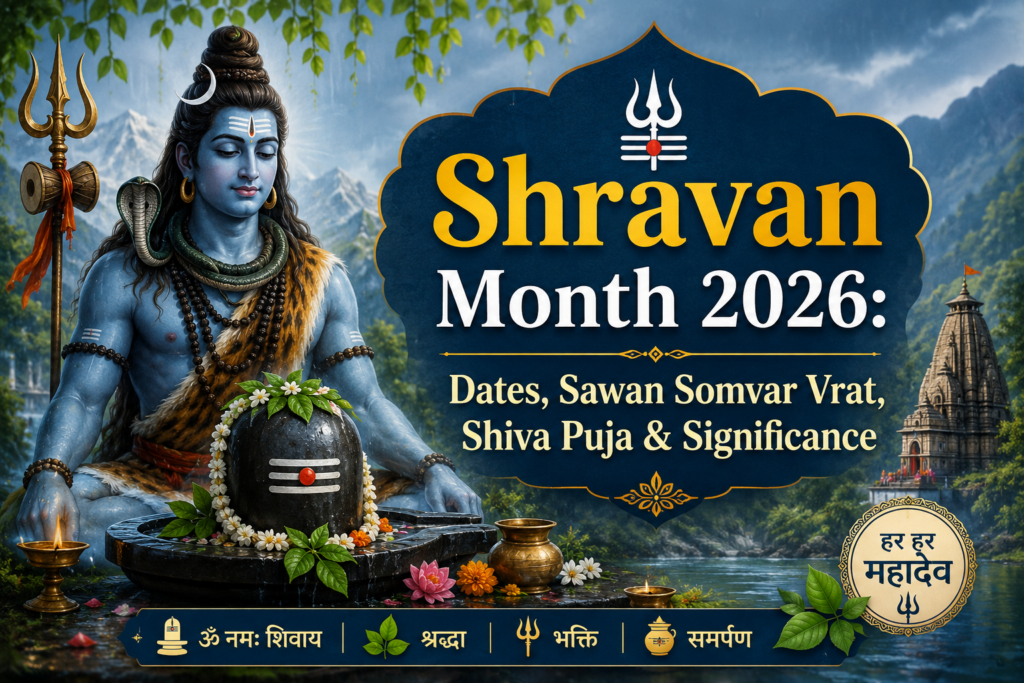
What is Shravan Month? (Sawan Maas)
Shravan Maas also lovingly called Sawan is the fifth month of the Hindu lunar calendar and the most sacred month of the entire year. Dedicated entirely to Lord Shiva (Mahadev), this month falls during the heart of the monsoon season, typically between July and August. The rains symbolise purification, renewal, and the boundless grace of Bholenath washing away the sins of his devotees.
Every year, millions of Shiva bhakts across India, Nepal, and around the world observe fasts, perform Rudrabhishek, chant mantras, and visit Jyotirlinga shrines during this divine month. From Kanwar Yatris carrying holy Gangajal on their shoulders to women observing Mangala Gauri Vrat for their husbands’ well-being Shravan is a month of total surrender to Mahadev.
Why is It Called “Shravan”?
The month is named after the Shravan Nakshatra (constellation). The Shravan Nakshatra governs the sky on Purnima (full moon day) during this month and so the month takes its name from this star. The Shravan Nakshatra is ruled by Lord Vishnu, yet the entire month is consecrated to Lord Shiva a beautiful union of the two supreme aspects of the Divine.
Why is Shravan Dedicated to Lord Shiva?
The spiritual reason goes back to the great cosmic event of Samudra Manthan the churning of the ocean by gods (Devas) and demons (Asuras). When the terrible poison Halahala emerged from the depths, threatening to destroy all of creation, no one had the power to stop it. Lord Shiva alone stepped forward, drank the poison, and held it in his throat turning it blue. This is why He is called Neelkanth (the blue-throated one).
This divine sacrifice happened in the month of Shravan. Ever since, devotees pour water, raw milk, and Bilva leaves over the Shiva Linga to cool and soothe the Lord a tradition that lives on in every Jalabhishek performed today.
Additionally, Goddess Parvati observed intense penance (Tapasya) during Shravan to win Lord Shiva as her husband. Her devotion was rewarded and Shiva accepted her. This is why married women and young girls observe special fasts in Shravan, praying for a loving spouse and a blessed married life.
Shravan Month 2026 Start & End Dates
Due to differences in the Hindu lunar calendar systems followed across India, Shravan 2026 falls on slightly different dates in North India versus South and West India. Both are equally valid and spiritually significant.
North India Dates (Purnimanta Calendar)
Followed in: Rajasthan, Uttar Pradesh, Madhya Pradesh, Punjab, Himachal Pradesh, Uttarakhand, Chhattisgarh, Bihar, Jharkhand, and Delhi NCR
| Date | Day | |
|---|---|---|
| Shravan Begins | 30 July 2026 | Thursday |
| Shravan Ends | 28 August 2026 | Friday |
South & West India Dates (Amavasyant Calendar)
Followed in: Maharashtra, Gujarat, Goa, Andhra Pradesh, Karnataka, Telangana, and Tamil Nadu
| Date | Day | |
|---|---|---|
| Shravan Begins | 13 August 2026 | Thursday |
| Shravan Ends | 11 September 2026 | Friday |
Nepal Dates (Bikram Sambat 2083)
| Date | Day | |
|---|---|---|
| Saun Begins | 16 July 2026 | Thursday |
| Saun Ends | 16 August 2026 | Sunday |
Note for Devotees: The dates differ because North India follows the Purnimanta calendar (month ends on Purnima) while South and West India follow the Amavasyant calendar (month ends on Amavasya). The spiritual significance and rituals are identical in both systems.
Shravan Somvar (Monday) Vrat Dates 2026
Every Monday during Shravan called Shravan Somvar is considered the most auspicious day to worship Lord Shiva. The belief is that worshipping Shiva on a Somvar in Shravan multiplies the merit of prayers a thousand-fold. There are 4 Shravan Somvars in 2026.
Somvar Dates North India
| Somvar | Date | Day |
|---|---|---|
| 1st Shravan Somvar | 3 August 2026 | Monday |
| 2nd Shravan Somvar | 10 August 2026 | Monday |
| 3rd Shravan Somvar | 17 August 2026 | Monday |
| 4th Shravan Somvar | 24 August 2026 | Monday |
Somvar Dates South & West India (Maharashtra, Gujarat)
| Somvar | Date | Day |
|---|---|---|
| 1st Shravan Somvar | 17 August 2026 | Monday |
| 2nd Shravan Somvar | 24 August 2026 | Monday |
| 3rd Shravan Somvar | 31 August 2026 | Monday |
| 4th Shravan Somvar | 7 September 2026 | Monday |
Festivals & Special Days in Shravan Month 2026
Shravan is not just about Somvar fasts the entire month is packed with sacred occasions, each carrying its own spiritual potency.
| Festival / Vrat | Date (North India) | Significance |
|---|---|---|
| Hariyali Teej | 3 August 2026 | Celebration of Shiva–Parvati union; observed by women for a happy marriage |
| Hariyali Amavasya (Shravan Amavasya) | 12 August 2026 | Pitru Tarpan, tree planting, ancestral offerings |
| Nag Panchami | 17 August 2026 | Worship of serpent deities; seeking protection from Nag Dosha |
| Simha Sankranti | 17 August 2026 | Sun enters Simha (Leo) Rashi; auspicious for Surya worship |
| Shravana Putrada Ekadashi | 23 August 2026 | Vrat for blessing of progeny; dedicated to Lord Vishnu |
| Varalakshmi Vrat | 28 August 2026 | Observed by married women for prosperity and family well-being |
| Raksha Bandhan | 28 August 2026 | Bond of love and protection between siblings |
| Shravan Purnima | 28 August 2026 | Full moon of Shravan; Gayatri Jayanti; Partial Lunar Eclipse |
🌑 Special for 2026: Shravan Purnima on August 28 aligns with a Partial Lunar Eclipse. Devotees should check local Panchang timings for the Sutak period and perform Raksha Bandhan rituals accordingly. This is a rare astronomical event unique to Shravan 2026.
Mangala Gauri Vrat (Every Tuesday in Shravan)
Every Tuesday of Shravan is observed as Mangala Gauri Vrat by married women for the health, longevity, and well-being of their husbands. Goddess Mangala Gauri a form of Parvati is worshipped with 16 Upachara Puja, offering fruits, flowers, sindoor, and home-made sweets.
Mangala Gauri Vrat dates in 2026 (North India):
- 4 August 2026
- 11 August 2026
- 18 August 2026
- 25 August 2026
Significance & Spiritual Importance of Shravan Maas
According to the Shiva Purana and Skanda Purana, worship performed during Shravan yields results that are manifold compared to any other month. The texts state that even a simple offering of Bilva Patra and water to the Shiva Linga during Shravan can wash away the sins of many births.
Here is why devotees believe Shravan is the supreme month for spiritual practice:
- Direct access to Mahadev: It is said that Lord Shiva himself is more approachable during Shravan than at any other time.
- Removal of fear of untimely death (Akaal Mrityu): Sincere worship during Sawan is believed to remove the planetary combinations that cause sudden or untimely death.
- Fulfillment of wishes: The month is considered the best time to pray for marriage, children, career, and peace of mind.
- Liberation from the cycle of rebirth: Dedicated Shravan worship is said to accelerate one’s spiritual progress toward Moksha.
The Story of Neelkanth Why We Pour Water on the Shiva Linga
During the great churning of the cosmic ocean (Samudra Manthan), gods and demons sought the nectar of immortality (Amrit). But before Amrit appeared, the ocean released Halahala a poison so deadly it threatened to incinerate the universe. The gods turned to Lord Shiva in desperation.
With boundless compassion, Mahadev drank the poison. Goddess Parvati, seeing the danger, grabbed his throat to prevent it from reaching his body turning his throat blue. This is how Lord Shiva earned the name Neelkanth (Neel = blue, Kanth = throat).
To this day, devotees pour cold water, milk, curd, honey, and Gangajal over the Shiva Linga during Shravan an act of devotion to soothe the Lord who sacrificed himself for all of creation.
Shravan Fasting Rules Somvar Vrat Niyam
Observing the Shravan Somvar Vrat is one of the most powerful spiritual practices a devotee can undertake. Here are the key rules:
Who Can Observe the Vrat?
The Shravan Somvar fast can be observed by men, women, and young adults. Married women observe it for the long life of their husbands. Unmarried girls observe it to receive a good husband. Men observe it for health, prosperity, and spiritual merit.
How to Begin
- Wake up before sunrise during Brahma Muhurta (approximately 4:00–5:30 AM)
- Take a bath and wear clean, preferably white or light-coloured clothing
- Make a sankalp (vow) before the Shiva Linga or an image of Shiva, stating your intention to observe the Vrat
- The fast begins at sunrise and can be broken after sunset
What to Eat on Shravan Somvar Vrat
Allowed foods (Satvik / Vrat items):
- Fruits of all kinds
- Sabudana (Tapioca pearls) khichdi, vada, kheer
- Sendha Namak (Rock salt) the only salt permitted during vrat
- Rajgira (Amaranth) atta, laddoo, chikki
- Singhare ka atta (Water chestnut flour) puri, halwa
- Kuttu ka atta (Buckwheat flour) puri, dosa
- Milk, curd, lassi, buttermilk, chaas
- Dry fruits, coconut, peanuts
- Potatoes and sweet potatoes (cooked simply)
Foods to avoid:
- All grains wheat, rice, dal, and lentils
- Regular table salt (use rock salt instead)
- Onion and garlic (strictly prohibited in all Shravan fasting)
- Non-vegetarian food (strictly prohibited throughout all of Shravan month, not just on Mondays)
- Alcohol and tobacco
Many devotees observe a complete vegetarian diet throughout the entire Shravan month not just on Mondays. Avoiding meat, fish, and eggs throughout Shravan is considered highly meritorious.
When to Break the Fast
The fast is traditionally broken in the evening, after performing the Pradosh Kaal Puja (during sunset). Offer prasad to Lord Shiva, then take the first bite.
Shiva Puja Vidhi in Shravan 2026 Step-by-Step
Daily Shravan Puja (Nitya Puja)
A simple daily Shiva Puja during Shravan can be performed by every devotee at home:
- Wake up early ideally during Brahma Muhurta
- Bathe and wear clean clothes white, saffron, or light yellow are auspicious
- Clean the Puja space and place the Shiva Linga or Shiva image
- Offer Panchamrit Abhishek pour milk, curd, honey, sugar, and ghee over the Shiva Linga, followed by clean water or Gangajal
- Apply Vibhuti (sacred ash) on the Shiva Linga and on your own forehead
- Offer Bilva Patra (Bel Leaves) always offer 3 leaves joined at the stem; ensure they are unbroken. Bilva is the most beloved offering to Shiva
- Offer flowers white flowers, dhatura, aak (Madar), and Ketaki (though Ketaki should be avoided according to some traditions)
- Light a ghee diya and incense (dhoop)
- Chant Shiva mantras (see below)
- Offer prasad fruits, panchamrit, or dry sweets
Rudrabhishek Puja The Supreme Shravan Ritual
Rudrabhishek is the most elaborate and spiritually powerful Shiva puja performed during Shravan. A trained Pandit recites the Sri Rudram the ancient Vedic hymn from the Krishna Yajurveda while performing a ritual bathing (Abhishek) of the Shiva Linga with sacred substances.
Substances used in Rudrabhishek:
| Substance | Benefit |
|---|---|
| Gangajal (Ganga water) | Purification and liberation |
| Panchamrit (Milk, Curd, Honey, Sugar, Ghee) | Health, prosperity, and fulfillment of wishes |
| Sugarcane juice | Sweet blessings and longevity |
| Coconut water | Peace and removal of obstacles |
| Rose water | Love and harmony in relationships |
| Bilva Patra | Removal of all sins |
| Rudraksha | Moksha and divine protection |
| Bhasma (Sacred ash) | Detachment and spiritual wisdom |
Rudrabhishek performed on each Shravan Somvar is believed to grant blessings equivalent to performing a major Yajna. Many devotees book a Pandit for home Rudrabhishek during Sawan.
Shiva Mantras to Chant During Shravan
1. Panchakshari Mantra (The Five-Syllable Mantra)
ॐ नमः शिवाय Om Namah Shivaya
This is the supreme mantra of Shiva. Chant 108 times daily using a Rudraksha mala. Even one sincere repetition during Shravan is said to be immeasurably powerful.
2. Maha Mrityunjaya Mantra (The Great Death-Conquering Mantra)
ॐ त्र्यम्बकं यजामहे सुगन्धिं पुष्टिवर्धनम्। उर्वारुकमिव बन्धनान् मृत्योर्मुक्षीय मामृतात्॥
Om Tryambakam Yajamahe Sugandhim Pushtivardhanam Urvarukamiva Bandhanan Mrityor Mukshiya Maamritat
Meaning: “We worship the Three-Eyed Lord who is fragrant and who nourishes all beings. May He liberate us from death for the sake of immortality, just as the cucumber is severed from bondage to the creeper.”
Chanting this mantra 108 times daily during Shravan is believed to heal illness, remove the fear of death, and protect the family. Many devotees complete 1,25,000 (Sawa Lakh) repetitions during the entire month as a Japa Anushthana.
3. Shiva Dhyan Mantra
कर्पूरगौरं करुणावतारं संसारसारं भुजगेन्द्रहारम्। सदावसन्तं हृदयारविन्दे भवं भवानीसहितं नमामि॥
Karpura Gauram Karunavataram Samsara Saram Bhujagendra Haram Sada Vasantam Hridaya Aravinde Bhavam Bhavani Sahitam Namami
Day-wise Worship Guide for Shravan 2026
Each day of Shravan Maas has a special significance:
| Day | Deity | Significance |
|---|---|---|
| Monday (Somvar) | Lord Shiva | The most important day Somvar Vrat, Rudrabhishek, Jalabhishek |
| Tuesday (Mangalwar) | Mangala Gauri (Goddess Parvati) | Mangala Gauri Vrat for women |
| Wednesday (Budhwar) | Lord Vithal (Vishnu) | Chanting Vishnu Sahasranama |
| Thursday (Guruvar) | Lord Vishnu & the Guru | Reading Vishnu Purana, Guru Vandana |
| Friday (Shukravar) | Goddess Lakshmi | Varalakshmi Puja, Lakshmi Stotram |
| Saturday (Shanivar) | Shani Dev (Saturn) | Shani Puja, charitable deeds, oil donations |
| Sunday (Ravivar) | Surya Dev (Sun God) | Surya Arghya, Aditya Hridayam |
Kanwar Yatra 2026 — The Sacred Pilgrimage of Shravan
Kanwar Yatra is one of the largest spiritual processions in the world, observed during Shravan. Devotees called Kanwariyas walk bare-footed to the banks of the holy rivers primarily the Ganga at Haridwar, Devprayag, or Sultanganj to collect holy water (Gangajal) in a decorated bamboo pole called a Kanwar, which they carry on their shoulders.
They then walk hundreds of kilometres to their local Shiva temples and pour the Gangajal on the Shiva Linga, completing their offering before the auspicious Shravan Somvars.
In 2026, the Kanwar Yatra will be especially active during July 30 – August 10 in North India. Devotees planning the Yatra should arrange for accommodation, medical support, and travel well in advance.
Why You Should Visit a Jyotirlinga Temple in Shravan 2026
The 12 Jyotirlinga temples are the most sacred abodes of Lord Shiva on Earth. Visiting a Jyotirlinga during Shravan is considered to be among the greatest acts of spiritual merit a devotee can perform. Here are a few with special relevance for devotees in Maharashtra and nearby regions:
- Trimbakeshwar (Nashik, Maharashtra) On the banks of the Godavari; famous for Rudrabhishek and Kumbh Mela
- Bhimashankar (Pune district, Maharashtra) Surrounded by dense forest; one of the most serene Jyotirlingas
- Grishneshwar (Aurangabad/Sambhaji Nagar, Maharashtra) Near the Ellora Caves; one of the 12 Jyotirlingas
- Somnath (Gujarat) First and most revered Jyotirlinga; on the shore of the Arabian Sea
- Kashi Vishwanath (Varanasi) A visit here during Shravan is believed to grant Moksha
Common Questions About Shravan 2026
Q: When does Shravan 2026 start in North India? A: Shravan 2026 starts on Thursday, 30 July 2026 in North India (UP, Rajasthan, MP, Bihar, Delhi, Punjab, etc.)
Q: When does Shravan 2026 start in Maharashtra and South India? A: Shravan 2026 starts on Thursday, 13 August 2026 in Maharashtra, Gujarat, and South India.
Q: How many Mondays are there in Shravan 2026? A: There are 4 Shravan Somvars in 2026.
Q: Can we eat non-veg during Shravan month? A: No. Consuming meat, fish, eggs, or any non-vegetarian food during the entire Shravan month is considered inauspicious and is strongly discouraged.
Q: Can we cut hair and nails during Shravan? A: Many devotees avoid cutting hair and nails on Tuesdays and Saturdays throughout Shravan as a mark of reverence. Some strictly avoid it throughout the entire month.
Q: Can we use onion and garlic during Shravan? A: Onion and garlic are considered Tamasic (energy-dulling) foods and are avoided during all Shravan fasts and by many devotees throughout the entire month.
Q: What is the difference between Shravan and Sawan? A: Shravan and Sawan refer to the same month. “Sawan” is the colloquial, widely-used name in Hindi-speaking North India, while “Shravan” is the Sanskrit name used in scriptures and in South India.
Q: Is there a Lunar Eclipse during Shravan 2026? A: Yes a Partial Lunar Eclipse falls on 28 August 2026, which coincides with Shravan Purnima and Raksha Bandhan. Devotees should check local Panchang for the Sutak period and plan Raksha Bandhan rituals accordingly.
Q: Which day is most important in Shravan month? A: Shravan Somvar (Monday) is the most important day. Additionally, Nag Panchami, Hariyali Teej, Putrada Ekadashi, and Shravan Purnima (Raksha Bandhan) are major occasions.
Shravan 2026: A Month to Transform Yourself
Shravan Maas is not merely a month of rituals it is an invitation. An invitation from Mahadev himself to step back from the noise of the world, to simplify, to purify, and to reconnect with what is eternal. Whether you observe a strict month-long fast or simply light a diya and chant Om Namah Shivaya each morning every act of devotion reaches Bholenath.
As the monsoon rains pour down and the earth turns green, let this Shravan 2026 be your month of inner renewal. May Lord Shiva’s blessings wash away all sorrow, illness, and obstacles from your life.
🔱 Har Har Mahadev! Jai Bholenath! 🔱
Published on kirtankar.com | Last updated: May 2026 For more Shiva bhajans, kirtans, and puja vidhi, explore the full collection at kirtankar.com