


The Silence of the Infinite: An Introduction to Padmanabhaswamy
There is a specific kind of silence that exists within the granite walls of the Sree Padmanabhaswamy Temple in Thiruvananthapuram. It isn’t the absence of sound for you can always hear the distant chanting of Vedic hymns and the rhythmic clinking of traditional oil lamps but rather a silence of time itself. As you step onto the cool stone floors, leaving the humid bustle of Kerala’s capital behind, you aren’t just entering a place of worship; you are stepping into a living vault of human faith, royal integrity, and an enigma that has captivated the global imagination.
The Padmanabhaswamy temple is more than just a landmark; it is the heartbeat of a city that was literally named after it (Thiruvananthapuram translates to ‘The City of Lord Anantha’). Known to the world as the “Richest Temple in India,” and indeed the world, its true wealth lies not in the subterranean gold that made international headlines, but in the layers of history, the intricate Dravidian-meets-Kerala architecture, and the profound spiritual energy that radiates from the sanctum sanctorum.
Whether you are a devotee seeking the grace of Lord Vishnu, a history buff unraveling the threads of the Travancore Dynasty, or a curious traveler drawn by the whispers of the mysterious “Vault B,” this temple offers a journey that defies a simple weekend visit. It is an experience of the infinite.
A Tapestry of Time: The Historical Background of Padmanabhaswamy
History in India is rarely linear; it is a spiral where legends and facts entwine. While the current structure of the Padmanabhaswamy temple in Kerala reached its zenith in the 18th century, its origins are ancient, mentioned in the Puranas and the Sangam literature of the Tamil Alwars (Saints) dating back between the 6th and 9th centuries.
For centuries, the temple was managed by the Ettara Yogam (a council of eight and a half members), but the temple we see today is largely the vision of King Marthanda Varma, the founder of the modern state of Travancore. In 1750, in an act of unprecedented humility and political genius known as Thrippadi Danam, Marthanda Varma dedicated his entire kingdom to the Lord. He surrendered his crown at the feet of Padmanabhaswamy and declared himself and his descendants as Padmanabha Dasas servants of the Lord.
This act ensured that the wealth of the kingdom and the temple became inseparable, yet the King ruled only as a regent for the divine. This historical turning point is why, even today, the relationship between the royal family of Travancore and the temple remains deeply personal and spiritually guarded.
The Legend of the Forest of Peepal Trees
Every great temple has a “Sthala Purana” (local legend), and Padmanabhaswamy’s is as poetic as it is profound. Legend tells of a hermit named Divakara Muni (some versions say Vilvamangalam Swamiyar) whose intense penance moved the Lord. Vishnu appeared to him as a mischievous child, eventually leading the sage on a chase to the Ananthankadu forest.
There, the child disappeared into a massive Ilappa (Mahua) tree. The tree fell and transformed into the massive form of Lord Vishnu, stretching for miles. The sage, overwhelmed, prayed that the Lord shrink so he could behold Him. The Lord obliged, shrinking to the size of three times the length of the sage’s staff. This is the origin of the massive reclining idol that occupies the main shrine today, still situated at the spot where the Ananthankadu forest once stood.

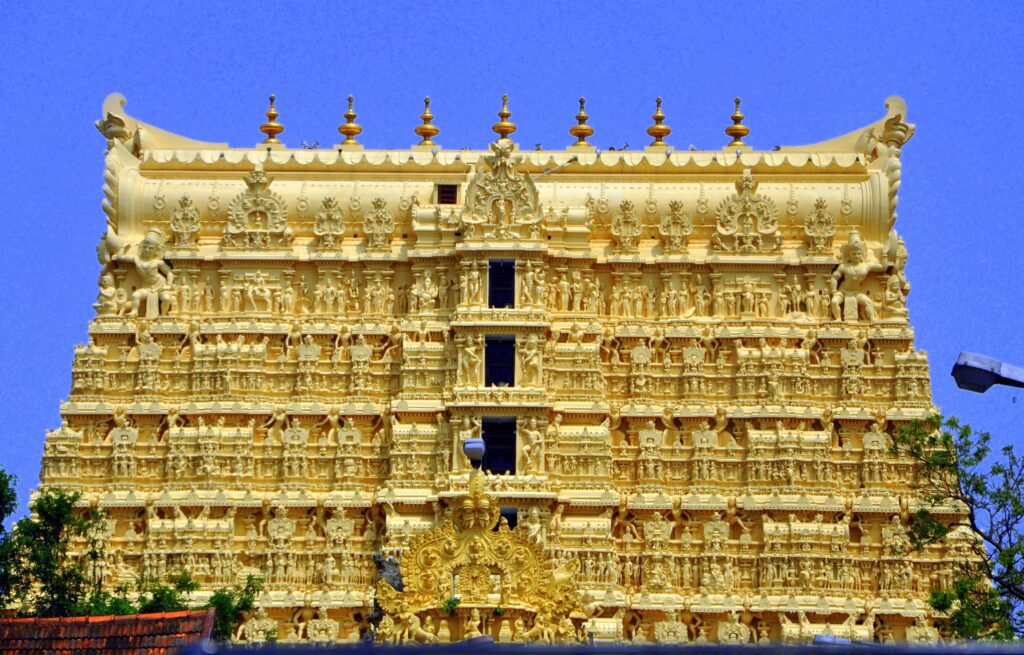
Architectural Brilliance: Where Kerala Meets Dravidian Grandeur
Architecturally, the Padmanabhaswamy Temple is a rare hybrid. While most temples in Kerala feature the sloped, tiled roofs designed to withstand the monsoon, Padmanabhaswamy boasts a massive, seven-tier Gopuram (gateway tower) that reflects the Dravidian style of neighboring Tamil Nadu.
The 1000-Pillar Hall
One of the most striking features is the Kulasekhara Mandapam, often called the “Aayiram Kaal Mandapam” or the Hall of a Thousand Pillars. Built with high-quality granite, it features intricate carvings that seem to breathe. If you tap some of these pillars, they produce musical notes—a testament to the acoustic mastery of ancient Indian artisans.
The Sculptural Detail
As you walk through the corridors, look up. The ceilings are adorned with carvings of deities and floral motifs. The “Navagraha Mandapa” features the nine planets carved into the ceiling, ensuring that the cosmic alignment of the temple is perfect. The sheer scale of the granite work, transported from miles away without modern machinery, remains an engineering marvel that leaves architects baffled even today.
The Reclining Vishnu: Understanding Anantha Shayana
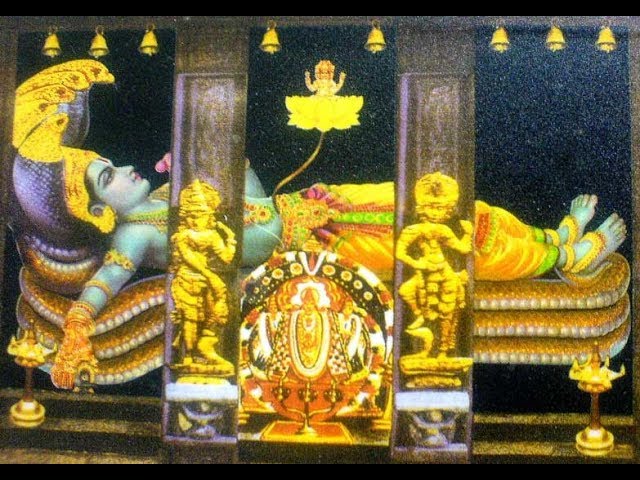
The spiritual core of the temple is the idol of Lord Vishnu in the Anantha Shayana posture eternal yogic sleep. Here, Vishnu reclines on the coiled body of the five-headed serpent, Anantha (or Shesha), who represents the infinite nature of time.
This isn’t just a statue; it is a masterpiece of ancient craftsmanship. Known as Katusarkara Yogam, the idol is not made of stone or metal, but a special Ayurvedic paste consisting of 12,008 Saligrams (sacred stones from the Gandaki River in Nepal) and hundreds of medicinal herbs.
The Three Doors
The idol is so massive (18 feet long) that it cannot be viewed through a single door. Devotees must view the Lord through three separate doors:
- The First Door: Reveals the face of the Lord and the hand hovering over a Shiva Linga, signifying the unity of the Divine.
- The Second Door: Shows Lord Brahma emerging from a lotus that grows from Vishnu’s navel (Padmanabha literally means “One with a Lotus Navel”).
- The Third Door: Offers a view of the Lord’s feet, the ultimate refuge for the devotee.

The Richest Temple: Vaults, Gold, and Global Mystery
In 2011, the world’s eyes turned to Thiruvananthapuram when a Supreme Court-ordered inventory of the temple’s subterranean vaults (Kallaras) revealed a staggering fortune. Gold coins from the Roman Empire, solid gold idols, bags of diamonds, and ancient jewelry were discovered, with some estimates placing the value at over $20 billion.
However, the real “mystery” lies in Vault B.
Legend and local belief claim that Vault B is protected by a divine curse or “Naga Bandham” (the spell of the serpent). It is said that only a high-level tantric priest chanting the Garuda Mantra can safely open it. While skeptics call it folklore, the royal family and many devotees maintain that the vault should remain untouched to preserve the spiritual equilibrium of the temple. This blend of unimaginable physical wealth and untouchable spiritual mystery makes Padmanabhaswamy a subject of endless fascination.
Rituals, Festivals, and the Rhythms of Worship
The spiritual life of the Sree Padmanabhaswamy Temple is governed by strict Vedic protocols. The daily routine begins long before sunrise with the Nirmalyam, where the previous day’s flowers are removed, and the Lord is bathed.
The Alpashy and Painkuni Festivals
Twice a year, the temple celebrates major festivals. The highlight is the Aarat (holy bath) procession. The titular Maharaja of Travancore still walks at the head of this procession, carrying a silver sword, leading the deities to the Shangumugham Beach for a ritual dip in the Arabian Sea. Interestingly, the Thiruvananthapuram International Airport even halts flight operations during this time to allow the procession to cross the runway a rare instance where modern aviation bows to ancient tradition.
The Strict Dress Code: What You Need to Know
To maintain the sanctity of the space, the temple enforces a traditional dress code that is non-negotiable.
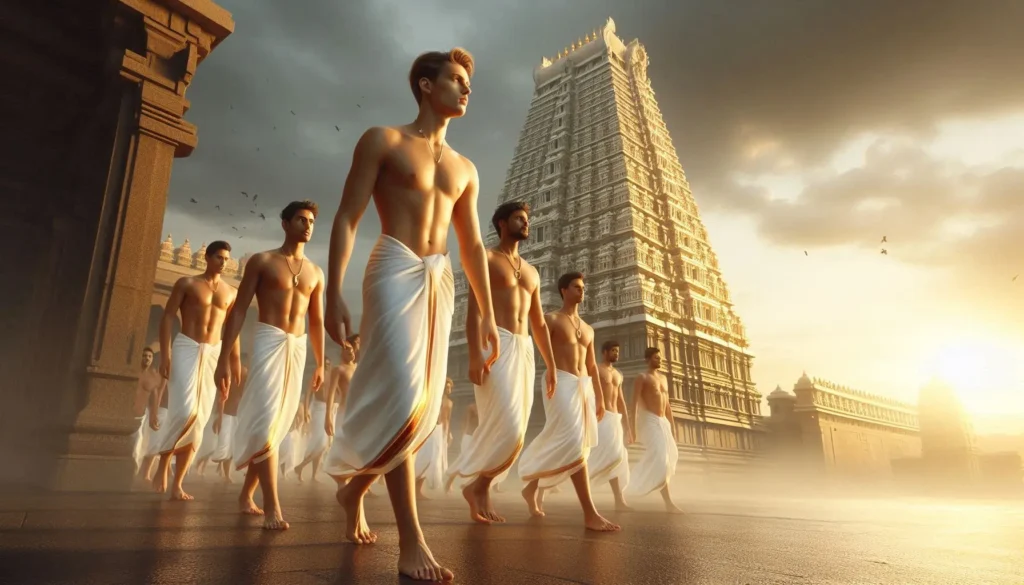
- Men: Must wear a Mundu (dhirt/veshti) around the waist and remain bare-chested. You can carry a small shawl (Angavastram).
- Women: Must wear a Saree, Set-Mundu (Kerala traditional dress), or a long skirt and blouse.
- Pro Tip: If you are wearing pants or leggings, you can rent or buy a simple white dhoti at the entrance to wrap over your clothes.

Visiting Guide: Planning Your Pilgrimage
If you are planning a visit to the Padmanabhaswamy temple in Kerala, timing is everything.
- Timings: The temple is open for Darshan in slots. Typically, morning hours are 3:30 AM to 7:20 AM and 8:30 AM to 12:00 PM. Evening hours are 5:00 PM to 7:20 PM. Note that these timings change during festivals.
- Best Season: October to February is ideal, as the Kerala weather is pleasant.
- Location: Situated in East Fort, Thiruvananthapuram. It is easily accessible by taxi or auto-rickshaw from any part of the city.
- Electronic Items: Mobiles, cameras, and even smartwatches are strictly prohibited inside. Use the secure locker facilities available outside the East Fort entrance.
Cultural Identity and the “Soul” of Trivandrum
For a Malayali, Padmanabhaswamy is more than a religious icon; he is the guardian of the land. The temple’s influence permeates the city’s culture, from its classical music festivals to its traditional crafts. Even the “Onam” festival, celebrated across Kerala, has deep roots in the legends associated with the Vamana avatar of Vishnu, closely linked to the temple’s lore.
The temple serves as a silent witness to the transition of Kerala from a collection of warring principalities to a modern, literate state, all while holding onto its core spiritual values.
Lesser-Known Facts About Padmanabhaswamy
- The Golden Lily Tank: The temple tank, Padma Theertham, is said to be the spot where the lotus of creation first bloomed.
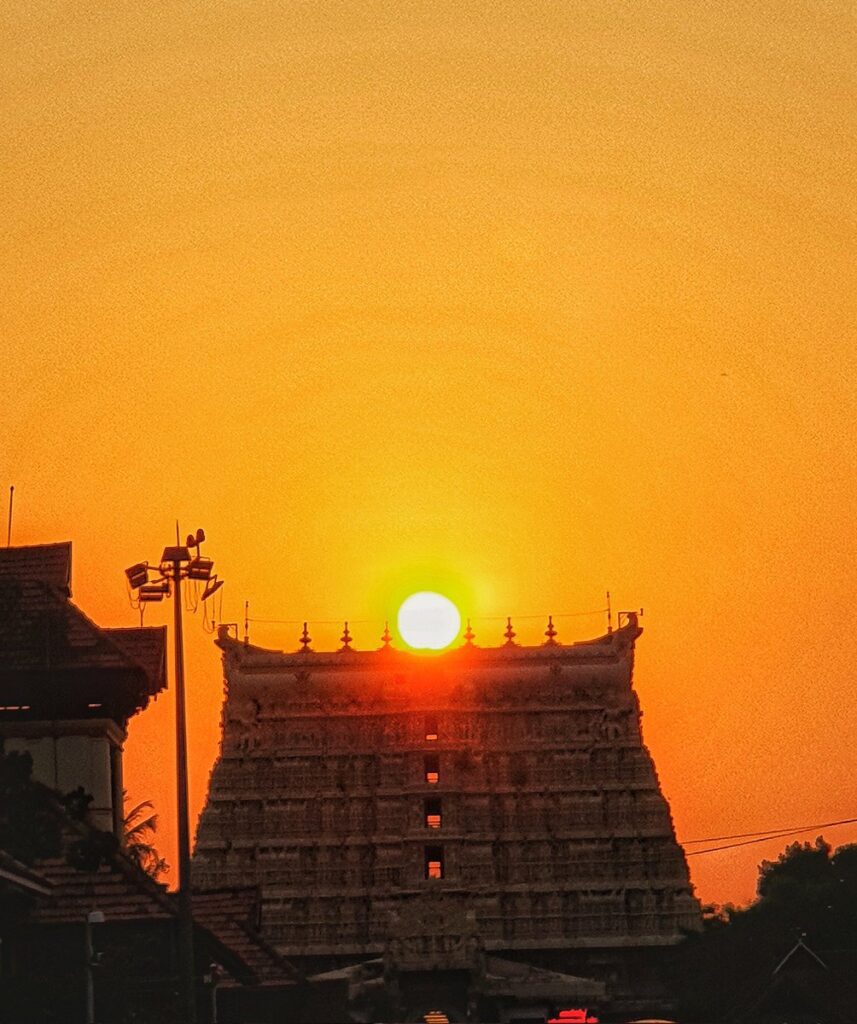
- The Shadow Mystery: The main Gopuram is built such that on the equinox, the sun passes exactly through the middle of the temple’s openings.
- Ottakkal Mandapam: The single-stone platform in front of the deity is carved out of a massive granite block three feet thick. Only the Maharaja and certain priests are allowed to prostrate on this stone.
- The Eternal Lamp: There is a “Khedda Vilakku” (lamp) inside the sanctum that has been kept burning for centuries.

FAQ: Frequently Asked Questions
1. Is the temple open to non-Hindus? Currently, according to traditional custom, only those who profess the Hindu faith are allowed inside the temple premises.
2. How long does it take for Darshan? On a normal day, it takes about 1 to 2 hours. During festivals or holidays, it can take 4 to 5 hours. There are “Special Darshan” tickets available for faster entry.
3. Is the gold on display for the public? No, the gold and treasures found in the vaults are kept in highly secure underground chambers and are not available for public viewing.
4. Why is Vault B not opened? The opening of Vault B is restricted due to a combination of religious beliefs, the “Naga Bandham” legend, and pending legal/administrative decisions regarding the safety of the structure.
5. Can I take photos outside the temple? Yes, you can take photos of the stunning exterior and the Gopuram from the outside gate and the Padma Theertham tank area.
Conclusion: A Meeting with the Eternal
As you exit the temple, the warmth of the Kerala sun hits your face, and the sounds of the modern world slowly return. Yet, something remains a sense of having touched something ancient, something larger than the sum of its gold or granite.
The Padmanabhaswamy temple is a reminder that in a world of constant change, there are anchors of faith that remain unmoved. Whether you come for the history, the architecture, or a moment of quiet prayer, the Lord reclining on the serpent of time offers a simple, silent message: that the greatest wealth one can possess is the peace found within.