
The Kaveri River in India: The Golden Mother of the South

To call the Kaveri River in India merely a body of water is to miss its soul. For millions of people across Karnataka and Tamil Nadu, she is Kaveriamma (Mother Kaveri) a goddess who washes away sins, a lifeline that turns arid plains into emerald rice bowls, and a volatile beauty who has birthed empires, wars, and poetry for millennia.
Known as the “Ganges of the South” (Dakshina Ganga), the Kaveri is one of the seven holy rivers of India. Unlike the Himalayan rivers that rely on melting glaciers, the Kaveri is a resilient, rain-fed river that rises and falls with the moods of the monsoon.
In this definitive guide, we will travel the entire 800-kilometer course of the river. We will explore the Kaveri river map mentally, stand atop its massive dams, wander through the fertile Kaveri Delta, and uncover the secrets of this ancient waterway that continues to shape the destiny of South India.
The Birth of a Goddess: Origin and Mythology
The story of the Kaveri begins high in the misty peaks of the Western Ghats, in the Kodagu (Coorg) district of Karnataka.
The Location: Talakaveri
The official Kaveri river location of origin is Talakaveri, situated on the Brahmagiri range at an elevation of approximately 1,341 meters (4,400 ft) above sea level. It is not a roaring waterfall but a small, sacred tank (Kundike) fed by an underground spring. From this humble beginning, a mighty river is born.
The Legend of Agastya and the Crow
Why is the Kaveri so sacred? The most popular legend involves the great Sage Agastya and Lord Ganesha. According to the Skanda Purana, Sage Agastya held the river in his water pot (Kamandala) to protect her during a severe drought. However, the land needed water desperately. Lord Ganesha, sensing the need, took the form of a crow and tipped the pot over. The water spilled out and flowed down the hill as the River Kaveri.
- Ponni: In Tamil literature, she is often called Ponni (“The Golden One”), a reference to the fine, golden silt she deposits, which brings wealth and prosperity to the farmers.
Tula Sankramana: The Miracle Spring
Every year in mid-October (the first day of the Tula month), a phenomenon called Theerthodbhava occurs at Talakaveri. At a specific auspicious time, the water in the small tank bubbles up and overflows. Thousands of pilgrims gather to witness this, believing that Goddess Kaveri herself is reappearing to bless the land.
Did You Know? The Kaveri is one of the few rivers in India that flows into the Bay of Bengal but originates so close to the Arabian Sea just about 80 km away yet it chooses to traverse the entire breadth of the peninsula to the east.
A Mental Map: Tracing the Course of the Kaveri
Since we cannot look at a satellite image right now, let’s visualize the Kaveri river map through words. Her journey is a dramatic three-act play.
Act I: The Rocky Plateau (Karnataka)
After leaving Talakaveri, the river flows swiftly through the hills of Coorg, flanked by dense rainforests and coffee plantations. It enters the Mysore Plateau, where it widens. Here, it performs a unique geographical feat: it splits to form two massive river islands—Srirangapatna and Shivanasamudra.
- Key Feature: The river here is rocky and turbulent, perfect for the mahseer fish and the mugger crocodile.
Act II: The Plunge (The Border)
As it leaves the Karnataka plateau, the Kaveri drops dramatically. At Shivanasamudra, it splits into the Gaganachukki and Bharachukki falls (the second largest waterfall in India). It then winds through a narrow, forested gorge at Mekedatu (Goat’s Leap) before crashing into Tamil Nadu at Hogenakkal Falls.
Act III: The Fertile Plains (Tamil Nadu)
Once it passes the Mettur Dam, the river sheds its wild nature. It widens significantly, flowing past Erode and Karur. By the time it reaches Tiruchirappalli (Trichy), it is a colossal, slow-moving water body. At the Grand Anicut, it splits into numerous distributaries, fanning out to create the massive Kaveri Delta before emptying into the Bay of Bengal at Poompuhar.
The Veins of the River: Major Tributaries
A river is only as strong as the waters that feed it. The Kaveri system is complex, with major tributaries joining from both the left and right banks.
Left Bank Tributaries
These rivers flow from the north and join the Kaveri on her left side.
- Harangi River: Rising in the Pushpagiri hills of Coorg, this is the first major tributary. It is vital for the coffee growers of the region.
- Hemavati River: A crucial lifeline for the Hassan district. The massive Gorur Dam is built across it. The Hemavati brings significant volume to the Kaveri before it reaches the KRS Dam.
- Shimsha River: Originating in Tumakuru, this river marks one of the few tributaries that flow through the drier distincts before joining the Kaveri near Shivanasamudra.
- Arkavathy River: Historically the water source for Bengaluru (via the Thippagondanahalli Reservoir). Today, it is largely dried up due to encroachment but remains a significant geographical tributary.
Right Bank Tributaries
These rivers originate from the southern Western Ghats and are often perennial, fed by the heavy Kerala monsoons.
- Lakshmana tirtha: Originates in the Brahmagiri range (Iruppu Falls). Legend says Lakshmana shot an arrow into the ground to fetch water for Rama here.
- Kabini River (Kapila): One of the most important tributaries. It rises in the Wayanad district of Kerala. The Kabini brings massive amounts of water during the monsoon and is famous for the wildlife corridor (tigers and elephants) along its banks.
- Bhavani River: Known as the “second lifeline” of Tamil Nadu. It rises in the Nilgiris and joins the Kaveri at Bhavani town (Kooduthurai). The confluence is considered a Triveni Sangam (holy confluence).
- Noyyal River: Flows through Coimbatore and Tiruppur. Unfortunately, this river is famous today for carrying textile pollution into the Kaveri.
- Amaravati River: Flows through the Anamalai Hills and joins the Kaveri in Karur district. It is famous for the largest population of mugger crocodiles in its reservoir.
Engineering Marvels: Dams on the Kaveri River
Controlling the volatile Kaveri has been an obsession for kings and engineers for centuries. Today, the dam on Kaveri river network is the backbone of South Indian agriculture.
1. Grand Anicut (Kallanai) – The Ancient Wonder
- Built: ~2nd Century AD by Chola King Karikalan.
- Location: Near Tiruchirappalli, Tamil Nadu.
- Significance: This is one of the oldest water-diversion structures in the world still in use. Built with unhewn stone, it splits the river into four streams (Kollidam, Kaveri, Vennar, Puthu Aru), essentially creating the Delta. It is a marvel of ancient engineering that modern British engineers studied to understand how to build dams on sandy riverbeds.
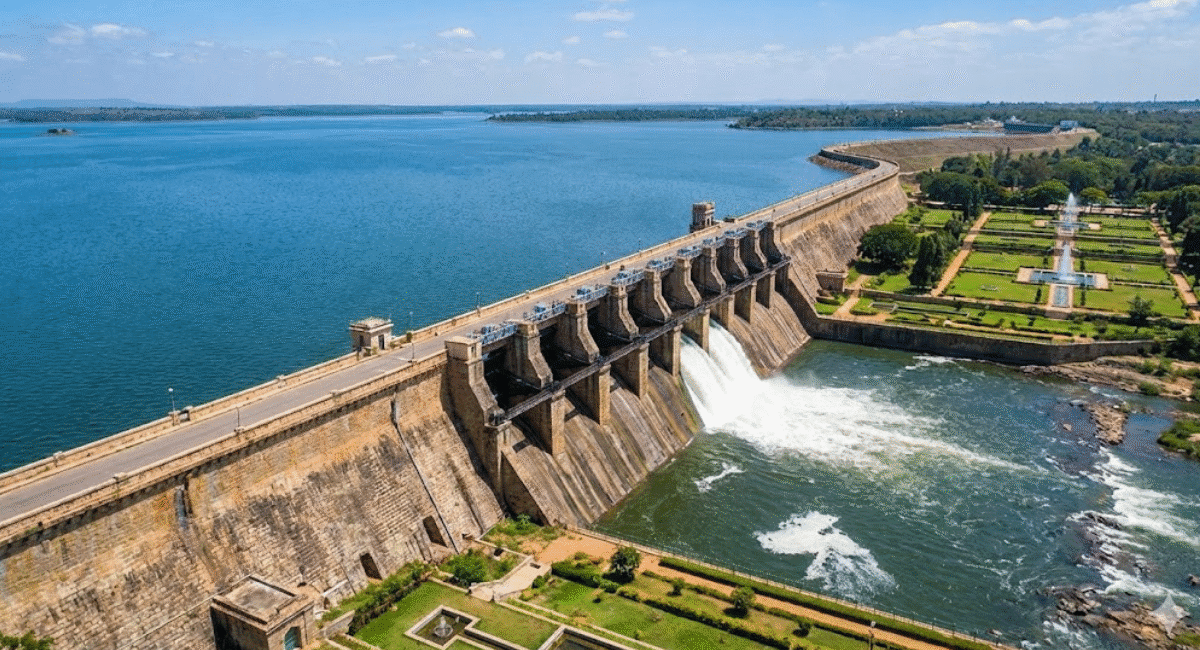
2. Krishna Raja Sagara (KRS) Dam
- Built: 1911–1932.
- Location: Mandya District, Karnataka.
- Significance: Designed by the visionary Sir M. Visvesvaraya for the Wodeyar kings of Mysore. It was built using “surkhi” (a lime and brick powder mortar) instead of cement. It provides drinking water to Mysore and Bengaluru and irrigates the Mandya sugar belt.
- Tourism: The famous Brindavan Gardens are located at the foot of this dam.
3. Mettur Dam (Stanley Reservoir)
- Built: 1934.
- Location: Salem District, Tamil Nadu.
- Significance: This is one of the largest dams in India. It serves as the “tap” for the Kaveri Delta. The release of water from Mettur on June 12th every year is a highly anticipated event that dictates the sowing of the Kuruvai crop in the delta. It also houses a major hydroelectric power station.
4. Kabini Dam
- Location: Near HD Kote, Karnataka.
- Significance: While technically on the Kabini tributary, it is integral to the Kaveri system. Its backwaters are a world-renowned wildlife destination.
5. Upper Anicut (Mukkombu)
- Location: Near Trichy.
- Significance: A regulator built by the British (Sir Arthur Cotton) in the 19th century, inspired by the Grand Anicut. It regulates water flow into the Kollidam river to prevent flooding in the delta.
The Kaveri Delta: The Rice Bowl of Tamil Nadu
When people search for “Kaveri Delta,” they are looking at the agricultural heart of Tamil Nadu. This region, primarily covering Thanjavur, Tiruvarur, and Nagapattinam districts, is a flat, fertile plain created by millennia of silt deposition.
The Distributary Network
Once past Trichy, the Kaveri is no longer a single river. It fans out into a spiderweb of smaller rivers and canals:
- Kollidam (Coleroon): The northernmost and largest branch, mainly used as a flood carrier.
- Vennar and Vettar: The primary irrigation channels that feed the paddy fields.
- Arasalar, Kaveri, and Kudamurutti: Smaller branches that snake through the villages.
Agricultural Seasons (The Rhythm of the Delta)
Farming here isn’t a job; it’s a culture timed to the river’s flow.
- Kuruvai (Short-term): Sown in June/July immediately after Mettur water release. This is a critical crop for farmers’ cash flow.
- Samba (Long-term): Sown in August/September. This is the main crop, harvested in January around the Pongal festival. It relies heavily on the Northeast Monsoon.
- Thaladi: A follow-up crop grown in fields where Kuruvai was harvested.
Current Crisis: The Delta is facing a “double whammy.” The sea level is rising, pushing saltwater inland, while the river flow is decreasing, preventing fresh water from pushing the salt back. This salinization is a major threat to the “Rice Bowl.”
Tourism Trail: Must-Visit Spots Along the Kaveri
For travelers, the Kaveri offers a mix of spirituality, adventure, and history. Here is a curated “River Trail” itinerary.
Stop 1: Coorg (The Origin)
- Do: Visit the Talakaveri temple for panoramic views of the Western Ghats.
- Stay: In a coffee estate homestay in Madikeri.
- Adventure: Visit Dubare Elephant Camp. Here, you can cross the river in a boat and watch elephants bathing in the Kaveri. River rafting here is popular during the monsoon (July-Sept).
Stop 2: Srirangapatna (The Island Fortress)
- See: The Ranganathaswamy Temple (one of the largest in Karnataka) and Tipu Sultan’s Summer Palace (Daria Daulat Bagh), both located on the river island.
- Birding: Just nearby is the Ranganathittu Bird Sanctuary. Take a boat ride to see Painted Storks, Pelicans, and the large population of Marsh Crocodiles basking on the rocks.
Stop 3: Shivanasamudra Falls
- Experience: Witness the river split into Gaganachukki and Bharachukki falls. The best time to visit is July to October.
- History: This site housed Asia’s first major hydroelectric power station (1902), which powered the Kolar Gold Fields.
Stop 4: Hogenakkal Falls (The Niagara of India)
- Experience: Located on the border, the river flows through carbonatite rocks (some of the oldest in the world).
- Uniques: Take a ride in a Coracle (round basket boat). You can buy freshly caught river fish which locals will fry for you right on the bank. Enjoy an oil massage from the local masseurs on the river rocks.
Stop 5: Srirangam (The Temple Island)
- See: The Sri Ranganathaswamy Temple in Trichy is the largest functioning Hindu temple complex in the world. It sits on an island formed by the Kaveri and Kollidam rivers. The spiritual aura here is unmatched.
Stop 6: Thanjavur (The Cultural Capital)
- See: The Brihadeeswarar Temple (Big Temple), a UNESCO World Heritage site. Though not right on the river bank, the temple and the Chola empire were built entirely on the wealth generated by the Kaveri Delta.
Stop 7: Poompuhar (The End)
- See: The point where the river meets the sea. Once a bustling ancient port city of the Cholas (described in the epic Silappatikaram), it is now a quiet beach town with a museum dedicated to its sunken history.
Ecological Biodiversity: Flora and Fauna
The Kaveri river basin is a biodiversity hotspot.
- The Mahseer: The Kaveri is home to the “Hump-backed Mahseer,” one of the wildest freshwater game fish in the world. It is currently critically endangered and found in the deep pools of the Cauvery Wildlife Sanctuary.
- Cauvery Wildlife Sanctuary: A protected area spanning Karnataka and Tamil Nadu. It is one of the best places to see the Grizzled Giant Squirrel, Four-horned Antelope, and wild elephants descending to the river to drink.
- Otters: The river has a healthy population of Smooth-coated Otters, often seen playing in groups near Ranganathittu and upstream of KRS.
- Flora: The banks are lined with Arjuna trees (Terminalia arjuna) and Jamun trees, whose roots bind the soil and prevent erosion.
The Water Dispute: A Brief Overview
No article on the Kaveri is complete without addressing the conflict. The Kaveri water dispute dates back to agreements made in 1892 and 1924 between the Madras Presidency and the Princely State of Mysore.
- The Core Issue: Karnataka (upper riparian) claims it was historically disadvantaged and needs water for its dry districts and rapidly growing Bengaluru. Tamil Nadu (lower riparian) claims its farmers have relied on the river for centuries and have “prescriptive rights.”
- Current Status: In 2018, the Supreme Court of India delivered a final verdict, allocating specific volumes of water to Karnataka, Tamil Nadu, Kerala, and Puducherry. The Cauvery Water Management Authority (CWMA) now oversees the monthly release of water, aiming to depoliticize the issue.
Environmental Threats and Conservation
Despite being worshipped, the Kaveri is dying.
Major Threats
- Sand Mining: Illegal extraction of river sand has deepened the riverbed, lowered groundwater tables, and destroyed the natural filtration system of the river.
- Pollution: Industrial effluents from textile hubs like Tiruppur and Erode have turned stretches of the river (especially the Noyyal tributary) into toxic drains.
- Deforestation: The loss of tree cover in the Coorg catchment area means the soil no longer holds water. This leads to “flash floods” during rain and “bone dry” riverbeds in summer.
Conservation Efforts
- Cauvery Calling: A massive movement launched by Sadhguru and the Isha Foundation. The goal is to plant 242 crore trees in the river basin through agroforestry. This aims to increase water retention in the soil and revive the river’s flow.
- Rally for Rivers: A precursor campaign that focused on policy changes to protect riverbanks.
- State Action: Both state governments have begun strict crackdowns on sand mining and are investing in sewage treatment plants (STPs) to prevent raw sewage from entering the river.
Conclusion: Why the Kaveri Matters
The Kaveri is not just a resource; it is a civilization. From the Kodava warrior clans in the west to the Chola architects in the east, the river has shaped the identity of the south.
Today, as climate change makes monsoons erratic, the Kaveri is more vulnerable than ever. Visiting her, understanding her geography, and respecting her fragility is the first step in saving her. Whether you are a tourist looking for the perfect waterfall, a pilgrim seeking redemption, or a student of geography, the Kaveri has a story for you.
Next time you drink a cup of filter coffee (likely grown in Coorg) or eat a plate of Sambar rice (likely grown in Thanjavur), remember: You are tasting the blessings of the Kaveri.
Frequently Asked Questions (FAQ)
Q: Which is the largest tributary of the Kaveri River? A: The Bhavani River is often cited as the largest in terms of water contribution, though the Kabini is also a massive contributor during the monsoon.
Q: Where can I see the Kaveri River map in real life? A: The best places to see the river’s expanse are the viewpoints at Mettur Dam, the cliff at Hogenakkal, and the bathing ghats at Srirangam.
Q: Is the Kaveri River safe for swimming? A: In upper reaches like Coorg (Dubare), it is relatively safe in designated shallow zones. However, at Hogenakkal and deep gorges like Mekedatu, it is extremely dangerous due to hidden currents and crocodiles. Always follow local warnings.
Q: What is the best time to visit the Kaveri Delta? A: The best time is November to February. The weather is pleasant, the heat is manageable, and the paddy fields are a lush, vibrant green.
Q: How many states does the Kaveri flow through? A: It flows through two states (Karnataka and Tamil Nadu) and drains the basins of Kerala and the Union Territory of Puducherry.

Leave a Comment