
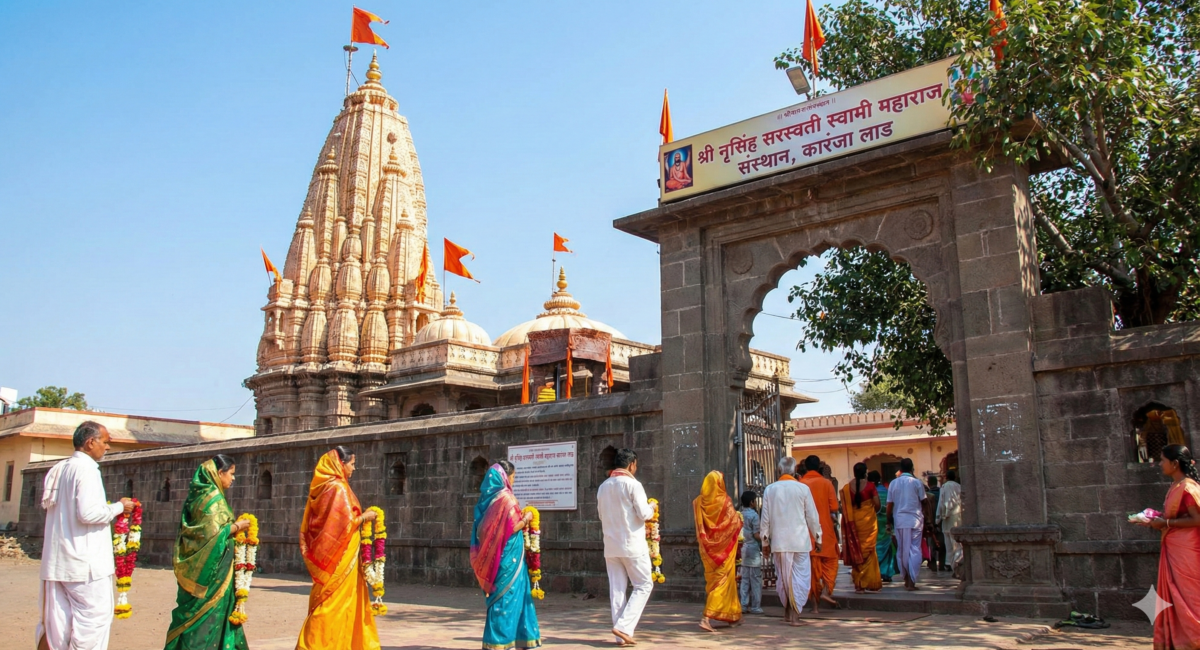
Karanja Lad India: The Holy Birthplace of Shri Nrusimha Saraswati
Karanja Lad India is not merely a town on the map of the Washim district in Maharashtra; it is a spiritual powerhouse known as a Siddha Kshetra. For followers of the Datta Sampradaya, this land is sacred ground, revered as the Janmasthan (Birthplace) of the second Datta Avatar, Shri Nrusimha Saraswati Swami Maharaj (1378–1459 AD).
While often called the “Kashi of Jainism” due to its rich Jain heritage, for the Bhakti marga (path of devotion), Karanja Lad India represents the fulfillment of a divine promise where the Lord descended to revive the Vedic way of life in the Kali Yuga.
The Divine History: Why Karanja Lad is Sacred
To understand the significance of Karanja Lad India, one must look back to the 14th century. The story connects Pithapuram in Andhra Pradesh to this dry plateau of Vidarbha. In his previous incarnation as Shripad Shrivallabha, the Lord promised a woman named Ambika that he would be born as her son in her next life to remove her suffering.
That promise was kept in Karanja. In 1378 AD (Shaka 1300), in the home of the pious couple Madhava and Amba-Bhavani, the child Narahari was born.
The Miracle of “OM” and The Silence
Unlike ordinary children, the infant Narahari did not cry at birth. Instead, the Shri Guru Charitra records that he uttered the primordial sound “OM”. Following this, he retreated into a profound silence for seven years.
This silence was not a disability but a divine state of Turiya (absorption in the Self). It was only when his parents, distressed by his silence, agreed to perform his Upanayana (thread ceremony) that the boy spoke again.
The Explosion of Vedic Knowledge
The most defining moment in the spiritual history of Karanja Lad India occurred during this thread ceremony. As soon as his mother offered him the first Bhiksha (alms), the seven-year-old boy recited the Rigveda. With the second and third handfuls, he recited the Yajurveda and Samaveda.
This miracle, known as the Veda-Vistar, proved that he was not a mere mortal, but the Veda-Murti (Embodiment of Knowledge).
Shri Guru Mandir: The Heart of Karanja
Today, the ancestral home of the Avatar has been transformed into the magnificent Shri Nrusimha Saraswati Swami Maharaj Sansthan, popularly known as the Guru Mandir.
The Gabhara (Sanctum Sanctorum)
When you visit the temple, you are walking on history. The Gabhara stands on the exact spot of the Kale family house where the Avatar was born.
- The Deity: The central idol is the Utsav Murti of the Swami.
- The Padukas: Behind the idol lie the Nirguna Padukas, representing the formless presence of the Guru.
- Atmosphere: The sanctum maintains strict Vedic purity. The silence inside is heavy and meditative, offering a stark contrast to the noise of the outside world.
The Sacred Audumbar Tree
No Datta Kshetra is complete without an Audumbar tree. The tree at Karanja Lad India is believed to be a living witness to the Avatar’s childhood. Devotees perform Pradakshina (circumambulation) here, and many claim to have had spiritual experiences or Sakshatkar (visions) in its shade.
Daily Rituals and Aarti Timings
For pilgrims visiting Karanja Lad India, timing is everything. The temple treats the Deity as a living King (Rajopchar).
| Time | Ritual | Significance |
| 04:30 AM | Kakad Aarti | The awakening of the Lord with the sound of the conch (Shankha-naad). |
| 05:30 AM | Darshan Opens | The temple opens for Mukh-Darshan. |
| 08:30 AM | Abhishek | Ritual bathing of the Padukas with Rudra chanting. |
| 12:00 PM | Madhyan Aarti | The Noon Worship, highly significant as Dattatreya loves “Madhyanha Bhiksha”. |
| 07:00 PM | Dhoop Aarti | Evening prayers with incense. |
| 09:00 PM | Shej Aarti | The lullaby for the Lord before the temple closes. |
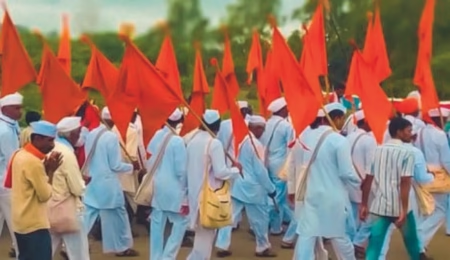
Note: Thursdays (Guruwar) feature a grand Palkhi Seva (palanquin procession) with bhajans and dancing, a must-see for any Kirtankar.
Karanja Lad: The “Kashi of Jainism”
While famous for the Datta Mandir, Karanja Lad India is also a syncretic town. It is home to three major Bhatarakas (seats of authority) of Digambar Jainism. The Chandraprabha Temple and the Sahasrakuta Temples (housing over 1000 miniature idols) showcase exquisite woodwork and glass mosaics, proving the town’s history of religious harmony.
Natural Heritage: Rishi Talav and Bembla River
The spirituality of Karanja Lad India extends to its water bodies:
- Rishi Talav: A tank created by Sage Karanj to end a drought. The water is believed to have healing properties similar to the Ganges.
- Bembla River: Originating here, this river is believed to flow underground for miles before emerging, symbolizing the “Gupta” (hidden) nature of spiritual knowledge.
How to Reach Karanja Lad India
Located in the Vidarbha region, the town is now easily accessible thanks to modern infrastructure.
- By Road (Samruddhi Mahamarg): The new expressway has a dedicated exit for Karanja Lad, drastically reducing travel time from Mumbai and Pune.
- By Train: The nearest broad-gauge station is Murtizapur (32 km), but Akola Junction (65 km) offers better connectivity to major Indian cities.
- By Air: The nearest international airport is Nagpur (228 km).
Accommodation: Where to Stay
- Bhakta Niwas: Located opposite the temple. Highly recommended for devotees who want to attend the early morning Kakad Aarti.
- Hotels: Options like Hotel Gurukrupa are available near the bus stand for families seeking AC rooms.
Conclusion
A visit to Karanja Lad India is a journey back to the source. It is where the silence of the Absolute became the sound of the Vedas. For the readers of kirtankar.com, standing before the Shikhar of the Guru Mandir is not just sightseeing it is answering the call of the Guru who promised, “Whenever you remember me, I shall be there.”
Leave a Comment