


Satyanarayan Puja at home: The Satyanarayan Puja is one of the most revered and popular rituals in Hinduism, dedicated to Lord Vishnu in his form as Satyanarayan the embodiment of Truth (Satya) and the Supreme Being (Narayana). Unlike many other complex Vedic rituals that require priests and elaborate arrangements, the Satyanarayan Puja is unique because it is simple, adaptable, and can be performed by anyone, anywhere, and at any time.
Whether you are seeking peace, prosperity, the removal of obstacles, or simply wish to express gratitude to the Divine, this puja is a powerful spiritual tool. This comprehensive guide will walk you through the complete Satyanarayan Puja Vidhi at home, including the list of necessary items (Samagri), the significance of the ritual, and a summary of the sacred Katha.
Significance and Benefits of Satyanarayan Puja
Before diving into the steps, it is essential to understand why this puja is performed. The word “Satyanarayan” is a confluence of two words: “Satya” (Truth) and “Narayana” (The Preserver). By performing this puja, devotees acknowledge that Truth is the highest form of the Divine.
Key Benefits:
- Removal of Obstacles: It is believed to clear hurdles in one’s career, marriage, or personal life.
- Peace and Harmony: The vibrations from the chanting and the Katha bring domestic bliss and mental peace.
- Health and Wealth: Devotees often perform this puja to invite prosperity and good health into their homes.
- Spiritual Purification: Listening to the Katha purifies the mind and washes away past sins.
When to Perform: While the puja can be done on any day, the following times are considered highly auspicious:
- Purnima (Full Moon Day): The most powerful day for this ritual.
- Ekadashi: The 11th day of the lunar cycle.
- Sankranti: The transition of the Sun into a new zodiac.
- Special Occasions: Housewarming (Griha Pravesh), weddings, or achieving a major milestone.
Satyanarayan Puja Samagri List (Essentials)
To ensure a smooth flow of the ritual, gather these items beforehand.
Basic Setup:
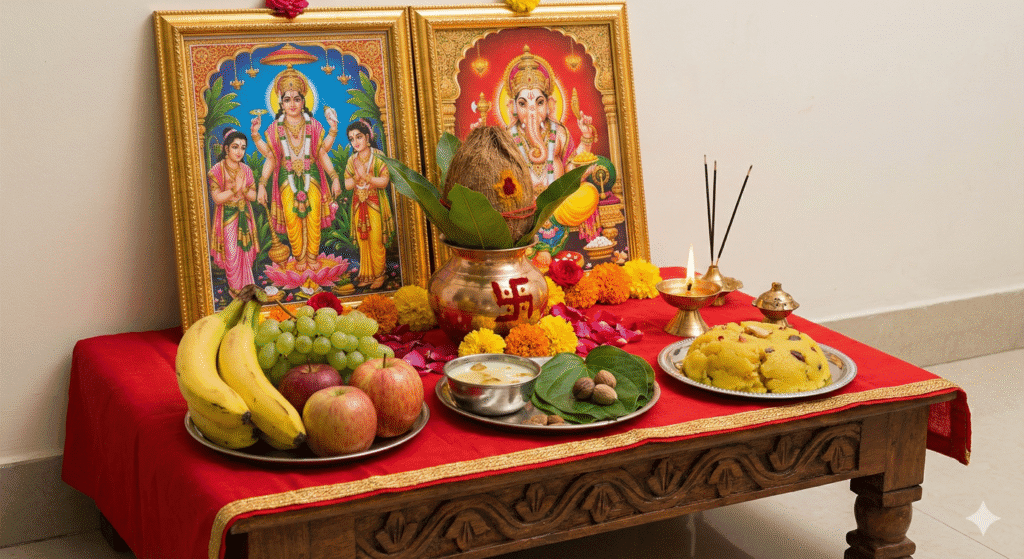
- A wooden chowki (low table) or altar.
- Yellow or Red cloth (to cover the chowki).
- Idol or photo of Lord Satyanarayan (or Lord Vishnu) and Lord Ganesha.
- A Kalash (copper or brass pot).
- Mango leaves (5-7).
- A coconut (for the Kalash).
Puja Offerings:
- Flowers: Yellow marigolds, rose petals, and a garland. Tulsi leaves are mandatory for Vishnu worship.
- Fruits: 5 types of seasonal fruits (Bananas are essential).
- Betel leaves and nuts (Paan and Supari).
- Sweets: Modak or Laddoos (for Ganesha).
- Panchamrit: A holy mixture of Milk, Curd (Yogurt), Ghee, Honey, and Sugar.
- Prasad (Sheera/Sapac): A special offering made of roasted semolina (rava), sugar, ghee, milk, and bananas.
Ritual Items:
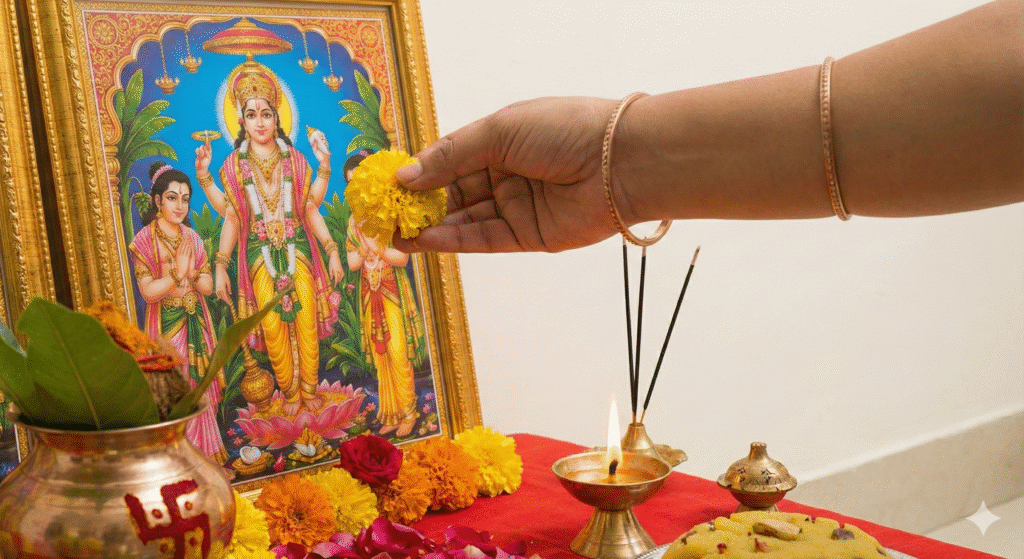
- Turmeric (Haldi) and Vermilion (Kumkum).
- Sandalwood paste (Chandan).
- Akshat (Unbroken rice grains).
- Incense sticks (Agarbatti) and Camphor (Kapur).
- Ghee lamp (Diya).
- Two coconuts (one for the Kalash, one to offer).
- Coins (for offering).
Step-by-Step Satyanarayan Puja Vidhi
Follow these steps to perform the puja with devotion. If you do not know the specific Sanskrit mantras, you can chant “Om Namo Bhagavate Vasudevaya” or simply pray with a pure heart in your own language.
Step 1: Purification and Sankalp (Vow)
- Cleanse: Bathe and wear clean, traditional attire. Clean the puja area and create a simple Rangoli at the spot where the altar will be placed.
- Achaman: Take a spoon of water in your right palm and sip it three times, chanting:
- Om Keshavaya Namaha
- Om Narayanaya Namaha
- Om Madhavaya Namaha
- Wash your hands with the fourth spoon saying Om Govindaya Namaha.
- Lighting the Lamp: Light the ghee lamp and incense sticks. This symbolizes the removal of darkness and ignorance.
- Sankalp: Take some water, rice (Akshat), and a flower in your right palm. Close your eyes and state your name, your family’s names, the date, and your intention for the puja (e.g., “I am performing this puja for the well-being of my family”). Drop the contents into a plate.
Step 2: Ganapati Puja
No Hindu ritual begins without invoking Lord Ganesha, the remover of obstacles.
- Place a small idol of Ganesha or a betel nut (symbolizing Ganesha) on a betel leaf filled with rice.
- Apply Haldi and Kumkum.
- Offer a red flower and Durva grass.
- Offer a sweet (Modak or Laddoo).
- Mantra: Om Gan Ganapataye Namaha. Pray that the puja proceeds without any hurdles.
Step 3: Kalash Sthapana (Varuna Puja)
The Kalash represents the universe and the water element (Varuna).
- Fill the copper pot with clean water.
- Add a coin, a betel nut, a flower, and a pinch of turmeric into the water.
- Place 5 or 7 mango leaves at the mouth of the pot.
- Place a coconut (wrapped in a red cloth or with a red thread tied around it) on top of the leaves.
- Apply Chandan and Kumkum on the Kalash.
- Invoke Lord Varuna by chanting: Om Varunaya Namaha.
Step 4: Vishnu/Satyanarayan Invocation
- Place the photo or idol of Lord Satyanarayan on the center of the altar.
- Dhyana (Meditation): Visualize Lord Vishnu with four arms, holding the Conch, Discus, Mace, and Lotus, smiling benevolently.
- Abhishekam (Bathing): If you have a metal idol, bathe it with Panchamrit first, then with clean water. If using a photo, sprinkle a few drops of water and Panchamrit using a flower.
- Vastra and Janeu: Offer a piece of cloth (Moli thread) and the sacred thread (Janeu) to the Lord.
- Tilak: Apply Sandalwood paste (Chandan) and Kumkum on the forehead of the deity.
Step 5: Archana (Offerings)
- Flowers: Offer a garland and loose flowers. Ensure you offer Tulsi leaves (Holy Basil) as Lord Vishnu loves Tulsi.
- Mantra: Om Namo Bhagavate Vasudevaya or Om Satyanarayanaya Namaha.
- Incense and Lamp: Show the incense stick and the lighted lamp to the deity in a clockwise motion.
- Naivedya (Food Offering): Offer the fruits, the special Sheera Prasad, and the betel leaves/nuts. Pour a small spoon of water around the food plate to symbolically offer it to the Lord.
Step 6: The Navagraha Puja (Optional)
If you have time, you can invoke the nine planets (Navagrahas) by offering Akshat (rice) and flowers to nine betel nuts placed on a bed of rice, asking for their favorable influence. If short on time, you can skip this and proceed to the Katha.
The Satyanarayan Katha (Story)
The most crucial part of the puja is listening to the Satyanarayan Katha. It is divided into five chapters. You should read this aloud or listen to a recording. Here is a brief summary of the five chapters:
Chapter 1: The Origin Sage Narada travels to Earth and sees human suffering. He asks Lord Vishnu for a remedy. Lord Vishnu reveals the “Satyanarayan Vrata,” stating that anyone who performs this puja with devotion will overcome all sorrows, attain prosperity on Earth, and reach salvation (Moksha) after death.
Chapter 2: The Poor Brahmin A poor Brahmin in Kashi was wandering in search of food. Lord Vishnu appeared as an old man and advised him to perform the Vrata. The Brahmin did so with whatever little he begged that day. Consequently, he became wealthy and attained liberation. Seeing him, a woodcutter also performed the puja and was blessed with great wealth.
Chapter 3: The Merchant (Sadhu Baniya) A merchant named Sadhu vowed to perform the puja when he would be blessed with a child. He had a daughter named Kalavati. However, he postponed the puja until her marriage. After her marriage, he left for business. Because he broke his promise, he was imprisoned falsely in a foreign land. Back home, his wife performed the puja. Lord Vishnu, pleased, ensured the merchant’s release.
Chapter 4: The Divine Warning On his way back, the merchant again lied to the Lord (disguised as a mendicant) about the cargo in his boat, saying it was just leaves. The Lord made it so. Realizing his mistake, the merchant apologized and performed the puja. Later, when he reached home, his daughter rushed to meet him without eating the Puja Prasad. Her boat (with her husband) sank. The Lord announced that she must eat the Prasad first. She did so, and her husband was saved.
Chapter 5: King Tungadhwaj King Tungadhwaj went hunting and saw cowherds performing the Satyanarayan Puja. Out of pride, he refused the Prasad they offered. Following this, he lost his kingdom and sons. Realizing his arrogance was the cause, he returned, partook in the puja with the cowherds, and accepted the Prasad. He eventually regained everything.
Conclusion of Katha: These stories symbolize that one must not ignore the Divine Truth, must keep their promises, and must not let ego stand in the way of devotion.
Step 7: Havan (Optional) and Aarti
- Havan: Some families perform a small Havan (fire ritual) chanting Om Satyanarayanaya Swaha 108 times, offering ghee and sesame seeds into the fire. This is optional for a simple home puja.
- Aarti: Stand up and perform the Aarti of Lord Satyanarayan and Lord Vishnu. Sing “Jai Jagdish Hare” or “Jai Lakshmi Ramana.”
- Ring the bell and clap your hands in rhythm.
- Ensure everyone present participates.
Step 8: Pushpanjali and Pradakshina
- Pushpanjali: Take flowers in your hands and offer them to the Lord’s feet, asking for forgiveness for any mistakes committed during the puja (Kshama Prarthana).
- Mantra: Mantra hinam, Kriya hinam, Bhakti hinam Janardana… (Oh Lord, I may lack the correct mantras or actions, but please accept my devotion).
- Pradakshina: Turn around in a clockwise direction three times in your spot to symbolize circumambulation of the universe.
Step 9: Prasad Distribution
- Mix the Prasad offered to the deity with the rest of the prepared Sheera.
- Distribute it to everyone present. It is mandatory to consume the Prasad.
- Take the blessings of the elders in the house.
How to Make the Satyanarayan Prasad (Sheera)
The specific Prasad, often called Sapac or Sheera, is vital.
- Ingredients: 1 cup Rava (Semolina), 1 cup Sugar, 1 cup Ghee, 1 cup Milk (or as needed), and 1 cup of sliced Bananas. (The ratio 1:1:1:1 is traditional).
- Method: Roast the rava in ghee until golden brown. Add warm milk and cook until soft. Add sugar and stir until it melts. Finally, add the sliced bananas and cardamom powder. Offer this to the Lord while it is warm and fresh.
Conclusion
Performing the Satyanarayan Puja at home is a beautiful way to ground your family in spiritual tradition. It requires sincerity more than perfection. By following this Vidhi, you invite the positive energies of Truth and Preservation into your home, ensuring that your family remains protected, prosperous, and peaceful.
Whether you are facing a difficult time or celebrating a joyous one, the door to Lord Satyanarayan is always open. Om Namo Bhagavate Vasudevaya.