


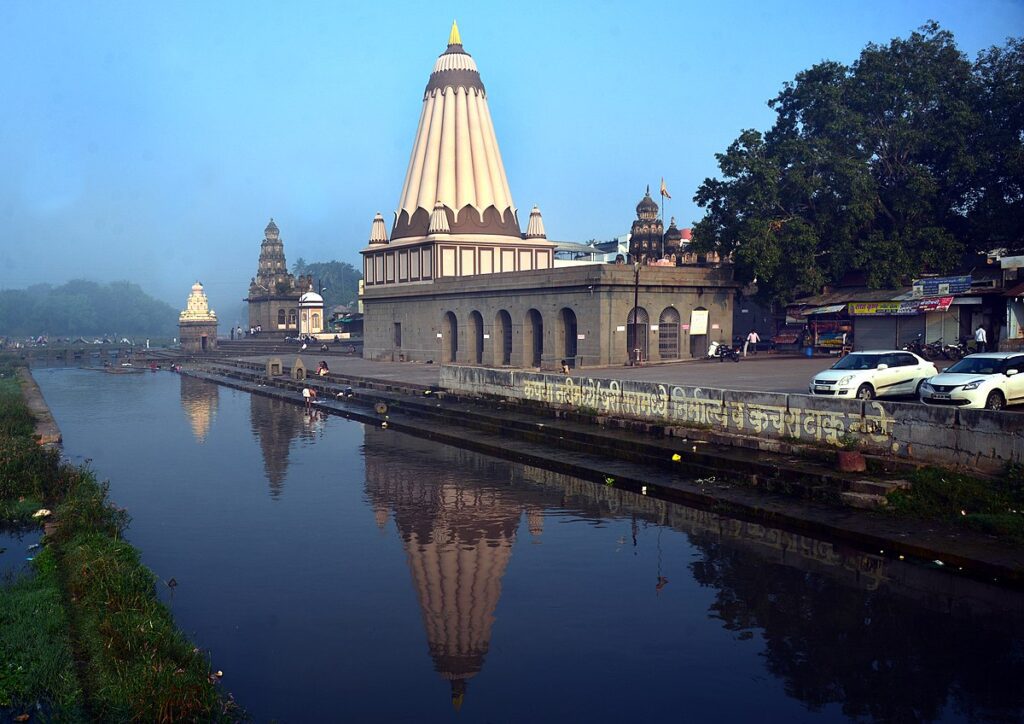
Introduction: The Sentinel of the Krishna River
The cultural topography of Maharashtra is defined by a deep interplay between geography, divinity, and statecraft. In the Satara district, the town of Wai stands as a preeminent example of this synthesis, holding the moniker “Dakshin Kashi” or the Varanasi of the South due to its density of sacred structures and its symbiotic relationship with the Krishna River. At the heart of this spiritual ecosystem lies the Dholya Ganpati Mandir, a temple that is not merely a place of worship but a monumental assertion of 18th-century Maratha engineering, artistic vision, and religious resilience.
Constructed in 1762 by Sardar Ganpatrao Bhikaji Raste, the temple is situated on the Ganpati Ghat, serving as the primary interface between the town of Wai and the holy waters of the Krishna. The temple is renowned primarily for its presiding deity, a colossal monolithic idol of Lord Ganesha, which stands ten feet tall and eight feet wide. The sobriquet “Dholya” translating from Marathi as “fat” or “grand” encapsulates the physical imposition of the deity, yet it belies the intricate theological and architectural sophistication that characterizes the site.
Historical Genesis and Geopolitical Landscape
The Maratha Confederacy and Post-Panipat Reconstruction
To fully appreciate the significance of the Dholya Ganpati Mandir, one must situate its construction within the volatile political climate of 18th-century India. The year of the temple’s commissioning, 1762, is historically pivotal. It falls immediately after the Third Battle of Panipat (1761), a cataclysmic event where the Maratha forces suffered a devastating defeat. In the aftermath of such geopolitical trauma, the construction of a monument of this scale costing a staggering Rs. 1.5 lakhs at the time and taking ten years to complete signals a profound resilience and a deliberate effort to re-establish cultural and spiritual order.
The Maratha Empire, particularly under the Peshwas, utilized temple building not just as an act of piety but as a projection of state power and stability. Wai, located on the strategic route between the capital Satara and the thriving city of Pune, became a focal point for this architectural renaissance. The town, anciently known as “Virat Nagari” during the Mahabharata era, was reimagined in the 18th century as a center of Sanskrit learning and Brahmanical culture, a transformation largely driven by the patronage of powerful Sardar families like the Rastes.
The House of Raste: Architects of Wai’s Grandeur
The primary patron of the Dholya Ganpati Mandir was Sardar Ganpatrao Bhikaji Raste, a figure of immense influence within the Maratha administrative hierarchy. The Raste family was not merely a noble lineage; they were kin to the Peshwas. Gopikabai, the daughter of Bhikaji Raste, was married to Balaji Bajirao (Nanasaheb Peshwa), the effective ruler of the Maratha Empire. This matrimonial alliance cemented the Raste family’s status and provided them with the resources and political mandate to transform Wai into a cultural capital.
Sardar Ganpatrao Bhikaji Raste’s vision for Wai extended beyond individual structures. He was instrumental in developing the urban fabric of the town, commissioning ghats, wadas (mansions), and temples that created a cohesive riverine landscape. The construction of the Dholya Ganpati Mandir was the crown jewel of this urban project. By placing the temple on the very edge of the river, Raste integrated the natural sanctity of the Krishna with the built environment, ensuring that the Raste legacy would be irrevocably tied to the spiritual life of the town. The Raste family’s continued association with the region, including the nearby Nana Phadnavis Wada in Menavali, highlights a broader network of Maratha aristocratic patronage that defined the architectural aesthetics of the Deccan in the late 18th century.
The Spiritual Lineage: From Virat Nagari to Dakshin Kashi
Wai’s identity is layered with mythological and historical sediment. The local lore identifies Wai as the ancient “Virat Nagari,” the capital of King Virat where the Pandavas spent their thirteenth year of exile (Agyatvas) in the Mahabharata. This mythological association imbues the land with a pre existing sanctity, making it a “Teertha Kshetra” (pilgrimage site) long before the Maratha period.
The transformation of Wai into “Dakshin Kashi” (Varanasi of the South) was a deliberate cultural project. Just as Kashi (Varanasi) is defined by its ghats along the Ganges and its density of Shiva temples, Wai was developed with seven major ghats along the Krishna and over 100 temples. The Dholya Ganpati Mandir acts as the spiritual gateway to this precinct. Being the first major temple encountered upon entering the town, it functions as the “Siddhidata” (Bestower of Success), blessing the pilgrim before they proceed to the Shiva temples like Kashi Vishweshwar. The juxtaposition of a massive Ganpati temple with a massive Shiva temple (Kashi Vishweshwar) mirrors the Shaiva-Ganapatya synthesis common in Maratha theology, creating a holistic religious environment for the devotee.
Architectural Engineering and Hydraulic Design
Site Selection and Riverine Dynamics
The choice of location for the Dholya Ganpati Mandir directly on the Ganpati Ghat of the Krishna River presented significant engineering challenges. The Krishna River, fed by the torrential monsoon rains of the Sahyadri mountains (Mahabaleshwar), is prone to dramatic swelling. A structure built on the active floodplain required a foundational stability that could withstand not only the hydrostatic pressure of the rising water but also the scouring velocity of the current.
The architects of 1762 demonstrated a sophisticated understanding of hydrology. They did not attempt to fight the river; instead, they designed the temple to coexist with it. The temple stands on a high plinth, integrated into the stone steps of the ghat, which acts as a buffer zone during minor floods. However, it is the structural design of the temple’s rear wall that stands as a testament to indigenous engineering genius.
The Hydrodynamic “Boat-Shaped” Wall
The most critical architectural feature of the Dholya Ganpati Mandir is its rear exterior wall, the side that faces the oncoming river current. Unlike standard rectangular temples which present a flat surface to the water thereby taking the full brunt of the flow and risking structural failure the rear of the Dholya Ganpati temple is constructed in a triangular, prow-like shape.
This “boat-shaped” or “fish-shaped” design functions as a hydrodynamic cutwater. When the river floods, this pointed structure cleaves the water, diverting the flow smoothly around the flanks of the temple. This significantly reduces the drag coefficient and the pressure exerted on the masonry. By streamlining the flow, the design minimizes turbulence and erosion at the foundation, ensuring that the temple remains stable even when the waters of the Krishna rise to submerge the ghats. This feature highlights a pragmatic synthesis of form and function, where religious architecture adapts to environmental realities.
Materiality and Structural Resilience
The temple is constructed primarily of black basalt, the indigenous stone of the Deccan Traps. Basalt is renowned for its hardness and durability, making it an ideal material for a structure exposed to the elements and river water. The masonry utilizes large dressed stone blocks, likely fitted with iron clamps or lime mortar, a technique typical of the Maratha period (often referred to as a variation of the Hemadpanthi style, though Dholya Ganpati shows distinct Peshwa-era evolutions like the Shikara style).
The entire temple complex is paved with stone, creating a unified monolithic base that prevents soil erosion underneath the structure. The walls are thick, providing thermal insulation for the interior and structural mass to resist the river’s force. The meticulous craftsmanship is evident in the fact that the temple has stood relatively unscathed for over 250 years, requiring little in the way of major structural intervention despite its precarious location on a flood-prone riverbank.
Spatial Configuration: Sabhamandap and Garbhagriha
The temple follows a traditional spatial hierarchy but on a grand scale.
- The Sabhamandap (Assembly Hall): This is a spacious outer hall characterized by arches on three sides. These arches provide an openness that connects the sacred space with the public space of the ghats. Devotees standing in the hall can view the river, integrating the worship of the idol with the worship of nature. The stone pillars and arches reflect the “Maratha Baroque” influence, which favors sturdy, repetitive forms over the delicate intricacy of earlier styles.
- The Garbhagriha (Sanctum Sanctorum): The inner sanctum is a vast, cavernous space designed to house the colossal idol. The roof of the sanctum soars to a height of approximately 80 feet, the highest of all temples in Wai. This verticality draws the eye upward, creating a sense of celestial reach. Interestingly, visitors often note the substantial empty space around the idol.3 This spatial clearance is crucial for air circulation and lighting in a stone structure, preventing the humidity of the river from damaging the idol or making the air stagnant.
The Shikhara (Spire)
The temple is crowned by a striking Shikhara (spire) that rises 24 meters (approx. 78 feet) from the ground. The Shikhara follows the regional style of the Deccan, characterized by a curvilinear outline adorned with miniature spire motifs (urusringas). The height of the Shikhara serves a functional purpose as a landmark; it is visible from a distance, guiding pilgrims towards the ghats. The aesthetic of the spire, combined with the boat-shaped base, creates a unique architectural profile that is distinct to Wai.
Iconography and Theological Significance
The Monolithic Maha Ganpati
The raison d’être of the temple is the “Maha Ganpati” idol. Carved from a single block of black basalt, the idol is a monolith of staggering proportions: 10 feet in height and 8 feet in width. It is this sheer volume that led to the popular name “Dholya Ganpati.” In Marathi, “Dholya” colloquially means “fat” or “corpulent,” but in the context of the deity, it signifies “The Great” or “The Immense”.
The idol depicts Lord Ganesha in a seated posture, exuding a sense of stability and calm. The deity is painted in the traditional vermilion (shendur) color, which is believed to enhance the spiritual vibration of the idol and protect the stone. The “happy” and “positive” expression of the deity is frequently noted by devotees, distinguishing it from the more severe or tantric forms of Ganesha found in other shrines.
The Symbolic Landscape of the Idol
The iconography of the Dholya Ganpati is rich in symbolism.
- Lambodara (Big Bellied): The massive belly of the idol, emphasized by its 8-foot width, represents the universe. In Hindu theology, Ganesha contains all the cosmos (Brahmanda) within him. Thus, the “fatness” is a metaphysical attribute representing the containment of all existence, past, present, and future.
- The Crescent Backdrop: The idol is framed by a crescent-shaped stone backdrop that stands over nine feet high. This frame accentuates the silhouette of the deity and adds to the visual impact of the sanctum.
- Ornamentation: The deity is adorned with a “Yajnopavita” (sacred thread) carved directly into the stone torso. During daily worship, the idol is dressed in silk pitambars and decorated with floral garlands, which stand out vividly against the orange hue of the sindoor.
4.3 The Legend of the Growing Idol
A persistent oral tradition in Wai asserts that the Dholya Ganpati idol is alive and continuously growing. Local elders often recount that the idol appeared smaller in their childhood. While geological science confirms that basalt does not expand in this manner, the legend speaks to the “Jagrut” (awakened) nature of the deity in the minds of the devotees.
Several theories explain this perception:
- The “Emergence” Narrative: Some legends suggest that the idol was found in situ during excavation and was revealed rather than carved, leading to a belief that it is “swayambhu” (self-manifested) and dynamic.2
- Architectural Illusion: The vastness of the sanctum and the empty space left around the idol 3 may create an optical illusion where the idol seems to dominate the space more as one approaches, or the space was intentionally left to accommodate the “growth” faith.
- Devotional Psychology: For the faithful, the expanding influence of the deity in their lives is projected onto the physical form of the idol.
Rituals and Worship
The Dholya Ganpati is an active center of worship, following a rigorous daily schedule.
- Daily Timings: The temple is generally open from 5:30 AM to 9:00 PM or 10:00 PM.
- Aarti: The major daily ritual is the Aarti. The Morning Aarti (approx. 7:30 AM) and the Evening “Mahamangal” Aarti (approx. 8:00 PM) are the peak times for darshan. The evening Aarti is particularly atmospheric, with the sound of bells resonating across the river and lamps reflecting in the dark waters of the Krishna.
- Abhishek: The ritual bathing (Abhishek) is performed in the morning (6:00 AM – 7:15 AM). Due to the idol’s size and sindoor coating, full water immersion is not done daily on the main idol in the same way as smaller metal idols; instead, ritual procedures appropriate for large sindoor-coated idols are followed.
- Naivedya: The offering of food occurs in the afternoon (approx. 1:30 PM), during which the sanctum may be temporarily closed.
The Sacred Geography: Wai as “Dakshin Kashi”
The Concept of the Southern Kashi
Wai’s designation as “Dakshin Kashi” is not merely a laudatory title but a functional description of its urban and religious layout. Like Varanasi (Kashi) in the North, Wai is defined by a river that is considered a goddess (Ganga in Kashi, Krishna in Wai) and a concentration of Shiva temples along its banks. The presence of over 100 temples in a relatively small town creates a high density of sacred space.
The Temple Network
The Dholya Ganpati Mandir does not exist in isolation. It is part of a specific liturgical circuit.
- Kashi Vishweshwar Mandir: Located directly opposite or adjacent to the Dholya Ganpati on the same ghat complex is the Kashi Vishweshwar Mandir, a grand Shiva temple. A fascinating lithological link exists between the two: the massive Nandi (bull) idol at the entrance of the Shiva temple is said to be carved from the same stone boulder that yielded the Dholya Ganpati idol.2 This physical connection reinforces the spiritual brotherhood of the two deities.
- Other Key Temples: The precinct includes the Dhundi Vinayak (11th century), Ganpati Aali Ghat temples, Gangapuri Ghat temples, and the Rokdoba (Hanuman) temple.
- The Seven Ghats: The riverfront is divided into seven specific ghats: Ganpati Ghat (home to Dholya Ganpati), Gangapuri, Madhi Aali, Brahmanshahi, Dharmapuri, Bhimkund Aali, and Ramdoh Aali.3 Each ghat has its own cluster of shrines and specific ritual functions, with Ganpati Ghat being the most visited and central.
The Krishna River: The Goddess Krishnamai
The river Krishna is revered here as “Krishnamai” (Mother Krishna). She is the lifeblood of the town and the primary reason for its sanctity.
- Krishnamai Utsav: A unique festival celebrated in Wai is the Krishnamai Utsav. Held on the ghats, this festival involves the worship of the river goddess. It is a community-driven event that includes feasts and cultural programs. The festival is said to celebrate the victory of Shivaji Maharaj over Afzal Khan, attributed to the blessings of the river goddess invoked by a local priest, Shendye Shastri.
- Ecological Spirituality: The temple’s boat-shaped wall is a physical manifestation of the respect for the river’s power. The “Utsav” is a cultural manifestation of gratitude for the river’s bounty. This intertwining of ecology and theology makes Wai a case study in traditional environmental ethics.
Cultural and Modern Impact
Wai in Bollywood: The Cinematic Backdrop
In the last two decades, Wai has transformed from a quiet pilgrimage town into a bustling film production hub. The scenic beauty of the Dholya Ganpati temple, with its stone steps leading down to the river and the dramatic hills in the background, has attracted major Bollywood directors.
- Notable Films: Blockbusters like Swades, Gangaajal, Omkara, Dabangg, Chennai Express, and Singham have been shot in Wai.
- The Visual Appeal: The Dholya Ganpati temple often features in these films as the quintessential Indian temple, representing tradition and rural purity. The “Ganpati Ghat” is frequently used for scenes depicting village gatherings, romantic interludes, or dramatic confrontations.
- Impact: This exposure has led to a new category of “film tourism.” Visitors now come to Wai not just to pray but to stand where their favorite actors stood. While this brings economic revenue to local businesses (hotels, restaurants), it also creates challenges regarding crowd management and the commercialization of a sacred space.
Visitor Experience and Logistics
For the prospective visitor, Wai offers a blend of spiritual solace and historical exploration.
Table 1: Key Travel Logistics
| Parameter | Details |
| Location | Guruwar Peth, Ganpati Aali, Wai, Satara, Maharashtra 412803 |
| Nearest City | Satara (35 km), Pune (88 km), Mumbai (230 km) |
| Best Time to Visit | October to February (Winter); Monsoon for nature lovers |
| Temple Timings | 5:30 AM to 9:00 PM (Daily) |
| Entry Fee | Free |
| Parking | Available near the Ghat (Paid/Free); crowded on weekends |
| Photography | Prohibited inside the Sanctum; allowed on the Ghats |
Architectural and Historical Fact Sheet
| Feature | Description |
| Name | Dholya Ganpati Mandir (Maha Ganpati) |
| Construction Year | 1762 AD |
| Patron/Builder | Sardar Ganpatrao Bhikaji Raste |
| Cost of Construction | Rs. 1,50,000 (in 1762 currency) |
| Construction Duration | Approx. 10 Years |
| Idol Material | Monolithic Black Basalt |
| Idol Dimensions | 10 ft Height x 8 ft Width |
| Key Architectural Feature | Hydrodynamic “Boat-Shaped” rear wall for flood diversion |
| Sanctum Height | Approx. 80 feet |
| Spire (Shikhara) Height | 24 meters |
| Associated Deity | Lord Ganesha (Maha Ganpati) |
| River | Krishna River (Krishnamai) |
| Festivals | Ganesh Chaturthi, Ganesh Jayanti, Krishnamai Utsav |
Nearby Attractions in the “Dakshin Kashi” Circuit
| Attraction | Description | Distance from Dholya Ganpati |
| Kashi Vishweshwar Mandir | Grand Shiva temple with the “brother” Nandi of Dholya Ganpati. | 50 meters (Walking distance) |
| Menavali Ghat (Nana Wada) | Historic mansion of Nana Phadnavis and movie location. | 3 km |
| Dhom Dam | Scenic dam backwaters offering boating and camping. | 9 km |
| Mandhradevi Kalubai | Hilltop temple of Goddess Kalubai. | 12 km |
| Panchgani | Famous hill station. | 12 km |
| Mahabaleshwar | Origin of Krishna River and hill station. | 32 km |
Conclusion
The Dholya Ganpati Mandir is a testament to the enduring spirit of the Maratha people. Born from the political resilience of the post-Panipat era, engineered with a profound respect for the forces of nature, and sustained by centuries of devotion, it stands as a unique landmark in India’s heritage.
For the historian, the temple offers a window into the Raste family’s patronage and the urbanization of Wai. For the architect, the boat-shaped wall provides a timeless lesson in sustainable, context-aware design. For the devotee, the colossal “Dholya” form of the Lord offers a comforting, all-encompassing divine presence. As Wai continues to evolve balancing its ancient identity as “Dakshin Kashi” with its modern role as a cinematic backdrop the Dholya Ganpati Mandir remains its steadfast anchor, watching over the flow of the Krishna just as it has for over two and a half centuries.