


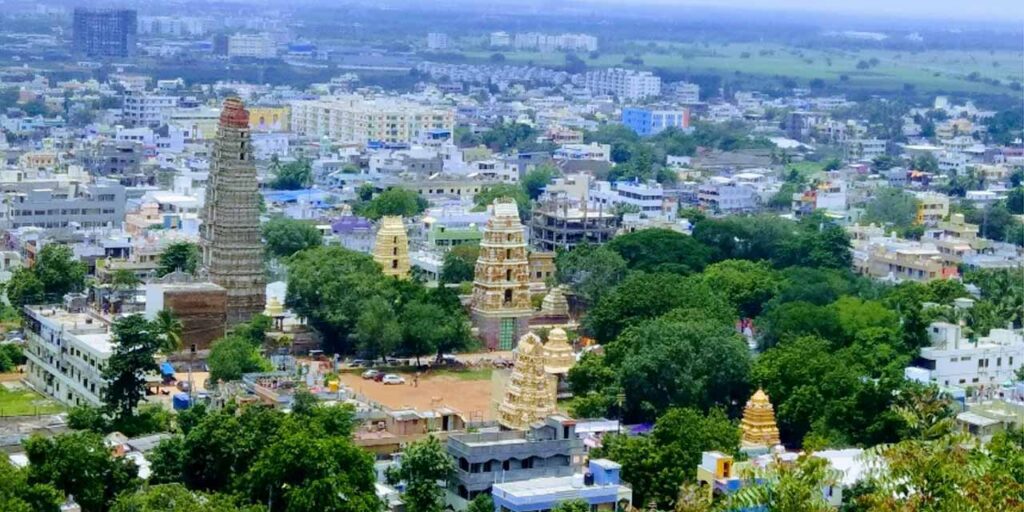
The first light of dawn over the Krishna River delta does not merely illuminate a landscape; it awakens a geological and spiritual sentinel that has watched over Andhra Pradesh for millennia. As you approach from the Vijayawada-Guntur highway, the horizon is dominated by a singular, conical volcanic hill Mangalagiri, the ‘Auspicious Hill.’ There is an inexplicable shift in the air here; the scent of jasmine from local markets mingles with the faint, sweet aroma of jaggery water (Panakam) and the rhythmic, percussive clatter of handlooms.
Mangalagiri is not just a geographical coordinate in the Guntur district; it is a living palimpsest where Vedic antiquity, Buddhist silence, medieval Vaishnava fervor, and the clinical precision of 21st-century healthcare coexist. To understand Mangalagiri is to understand the soul of the Andhra heartland a place where the past is not a memory, but a vibrant, breathing reality that shapes the future of the Amaravati capital region.
Mangalagiri in the Tapestry of Indian Sacred Geography
In the vast cosmological map of Bharatavarsha, certain landforms are recognized as Swayambhu—self-manifested anchors of divine energy. Mangalagiri holds a pre-eminent position within the Narasimha Kshetra circuit of South India. While the rugged peaks of Ahobilam represent the fierce, multi-faceted nature of the Fourth Avatar, and Yadagirigutta embodies the meditative aspect, Mangalagiri is unique for its “Formless Presence.”
The hill itself is considered an embodiment of Lord Narasimha. Geologically, it is an extinct volcano, a fact that local lore has elegantly transformed into a theological narrative. The tradition of offering jaggery water to the deity who possesses no idol but only a wide-open mouth in the rock—is seen as a symbolic cooling of the volcanic fire. Within the broader Vaishnava tradition, it is one of the eight Mahakshetram (Great Sacred Places), serving as a bridge between the Krishna-Godavari delta’s agrarian wealth and the spiritual liberation sought by seekers for centuries.
Archaeological Strata: From Buddhist Silence to Vaishnava Glory
Before the bells of the Lakshmi Narasimha temple echoed through the valley, Mangalagiri was a silent witness to the profound philosophical shifts of the Deccan.
The Pre-Buddhist and Satavahana Foundations
Archaeological surveys in the vicinity suggest that the region around mangalagiri guntur was a hub of activity as early as the Megalithic period. However, it was during the Satavahana era that the area gained prominence. Situated near the ancient city of Dharanikota, Mangalagiri sat on a vital trade route connecting the inland kingdoms to the sea.
The Buddhist Influence
The proximity to Amaravati and Guntupalli meant that Mangalagiri was once enveloped in Buddhist thought. Epigraphic evidence suggests that the hill might have housed monastic retreats. As Mahayana Buddhism flourished in the Krishna valley, the hill’s natural caves provided the perfect seclusion for monks. The transition from Buddhist influence to Brahmanical revival was seamless here; the sanctity of the hill remained constant, even as the nomenclature of the divine evolved.
Medieval Patronage: The Cholas and Vijayanagara
The structural temples we see today are the result of centuries of royal patronage. Inscriptions from the Chola period and later, the profound contributions of the Vijayanagara Emperors, particularly Sri Krishnadevaraya, elevated the temple’s status. The Gali Gopuram (Wind Tower), a staggering eleven-story structure, stands as a testament to the architectural ambition of the 19th-century local chieftains (Vasireddy Venkatadri Nayudu), who sought to touch the heavens in honor of the Lord.
Panakala Swamy Temple: The Theology of the Formless
The heart of mangalagiri india beats within the rock-cut sanctum of the Panakala Narasimha Swamy temple halfway up the hill. Unlike any other major shrine in India, the primary deity here has no anthropomorphic form.
The Mystery of the Panakam Ritual
The defining feature of this temple is the offering of Panakam (a mixture of water, jaggery, black pepper, and cardamom). When the priests pour this liquid into the mouth of the deity, a distinct gurgling sound is heard, as if the Lord is actually drinking. Tradition dictates that only half of the offered liquid is accepted by the deity, while the remaining half is returned as Prasadam.
Remarkably, despite the massive quantities of jaggery used daily, there is a total absence of ants or flies within the temple precincts—a phenomenon that defies simple biological explanation and strengthens the faith of the thousands who visit.
Mangalagiri Panakala Swamy Temple Timings
For the modern pilgrim, timing is essential. The Panakala Swamy temple follows a strict schedule:
- Morning Darshan: 7:00 AM to 3:00 PM.
- Note: The temple usually closes in the afternoon because, according to legend, the Lord is offered Panakam only during the day; the evenings are reserved for the Devatas (celestial beings) to perform their worship.
The Lakshmi Narasimha Swamy Temple (Foot of the Hill)
While the hill shrine is about the “Auspicious Power,” the temple at the base is about “Auspicious Grace.” Here, the Lord is enshrined with Goddess Rajya Lakshmi. The iconography is intricate, representing the Soumya (peaceful) form of Narasimha after his fury was quenched.
The Handloom Civilization: Mangalagiri Pattu Sarees
One cannot speak of Mangalagiri without the tactile language of its textiles. The town is a living workshop, a place where the “click-clack” of the pit loom is the background score of daily life.
The Logic of the Warp and Weft
Mangalagiri pattu sarees and cotton fabrics are distinguished by their lack of woven designs on the main body of the fabric. Instead, the focus is on:
- Nizam Borders: Thick, gold thread (Zari) borders with geometric patterns.
- Micro-Checks: Subtle textures created through specialized dyeing and weaving techniques.
- Durability: The high thread count makes Mangalagiri cotton uniquely resilient and crisp.
Geographical Indication (GI) and Global Reach
Recognized with a GI tag, the Mangalagiri weaving tradition is protected heritage. It is a socio-economic engine that supports thousands of families. In an era of fast fashion, Mangalagiri has found a niche among global connoisseurs who value the “slow cloth” movement. The dyes used are increasingly eco-friendly, and the designs are evolving to include contemporary aesthetics while maintaining the traditional integrity of the weave.
AIIMS Mangalagiri: A New Chapter in Healthcare
In the last decade, the profile of mangalagiri has undergone a seismic shift. The establishment of the All India Institute of Medical Sciences (AIIMS) has turned this pilgrimage town into a national hub for medical excellence.
Why Mangalagiri?
The strategic location perfectly positioned between Vijayawada and Guntur—made it the ideal choice for a premier healthcare institution. AIIMS Mangalagiri is not just a hospital; it is a catalyst for urban growth. It has brought in a demographic of highly skilled doctors, researchers, and students from across India, creating a cosmopolitan layer over the traditional town.
The Healthcare Ecosystem
The presence of AIIMS has spurred the growth of ancillary services, pharmacies, diagnostic centers, and specialized clinics. It has bridged the gap in tertiary healthcare for the coastal Andhra region, ensuring that world-class medical intervention is accessible to the common man.
The Green Lung: Mangalagiri Eco Park and Natural Spaces
Amidst the spiritual and industrial bustle, the mangalagiri eco park serves as a vital sanctuary. Nestled at the base of the hills, it offers a space for reflection and recreation.
- Biodiversity: The park is home to several indigenous species of flora and a variety of birdlife, making it a favorite for local naturalists.
- Urban Respite: For the residents of the burgeoning Amaravati region, the park provides a necessary “green lung,” balancing the concrete expansion with environmental consciousness.
- The Hill Trek: For the adventurous, the climb up the 600+ steps to the Panakala Swamy temple is as much a physical workout as it is a spiritual journey, offering panoramic views of the lush green fields of the Krishna delta.
Climate and Living: Weather in Mangalagiri
Understanding the weather in mangalagiri is crucial for both pilgrims and potential residents. The region experiences a tropical climate, deeply influenced by its proximity to the Bay of Bengal.
Seasonal Breakdown
- Summer (March to June): Can be intense, with temperatures often crossing 40°C. This is when the Panakam ritual feels most symbolic, offering a “cooling” respite.
- Monsoon (July to October): The region receives significant rainfall. The hills turn a vibrant emerald, and the air is washed clean.
- Winter (November to February): This is the peak season. The mangalagiri weather becomes pleasant, with temperatures ranging from 18°C to 30°C, making it ideal for temple visits and exploring the weaving clusters.
Infrastructure and Connectivity
The logistical importance of Mangalagiri cannot be overstated. It is a node where history meets the highway.
Modern Accessibility
- Pincode: The mangalagiri pincode is 522503.
- Rail: Mangalagiri railway station sits on the Vijayawada-Guntur section, ensuring easy access for travelers from across the South.
- Road: Located on NH-16 (the Chennai-Calcutta highway), it is one of the most well-connected towns in Andhra Pradesh.
- Air: The Vijayawada International Airport (Gannavaram) is a mere 35-40 minute drive away.
The Amaravati Vision: Mangalagiri as a Pillar of the Future
In the master plan for the Amaravati Capital Region, Mangalagiri is designated as a key zone for institutional and commercial growth. Its transition from a “temple town” to a “smart city component” is a fascinating case study in urban development.
The integration of high-speed rail, improved road networks, and the planned IT corridors nearby ensures that Mangalagiri will not remain a relic of the past. Instead, it is becoming the heart of a new, decentralized urban model where spirituality, heritage, and high-tech infrastructure exist in a symbiotic loop.
Conclusion: The Eternal Auspiciousness
Mangalagiri is a place where the mundane and the miraculous walk hand in hand. You see it in the eyes of a weaver meticulously counting threads, in the steam rising from a cup of Panakam, and in the gleaming corridors of AIIMS. It is a town that has mastered the art of continuity.
Whether you come as a devotee seeking the blessings of the Formless Lord, a connoisseur of fine silks, or a professional looking to settle in the new heart of Andhra Pradesh, Mangalagiri offers a sense of arrival. It is a hill that has seen empires rise and fall, yet it remains—steadfast, auspicious, and eternally relevant.
Frequently Asked Questions (FAQs)
1. What is the significance of the “Panakam” at Mangalagiri?
Panakam is a sacred drink made of jaggery and pepper. At the Panakala Swamy temple, it is offered to the Lord who “drinks” it through a rock opening. It symbolizes the cooling of the deity’s ferocity and is a unique ritual in the Vaishnava world.
2. How can I reach Mangalagiri from Vijayawada?
Mangalagiri is approximately 12 km from Vijayawada. You can reach it via local buses, taxis, or the local train. The drive via NH-16 takes about 20-25 minutes.
3. What are the best Mangalagiri pattu sarees to buy?
Look for the GI-tagged authentic Mangalagiri pattu sarees, characterized by their Nizam borders and heavy Zari work. Traditional shops in the main bazaar area offer the best variety directly from the weavers.
4. Is AIIMS Mangalagiri fully functional?
Yes, AIIMS Mangalagiri is functional with OPD services, IPD services, and undergraduate medical courses. It is one of the premier healthcare institutions in the state.
5. What is the Mangalagiri pincode?
The primary pincode for Mangalagiri town is 522503.
6. What are the timings for the Mangalagiri Panakala Swamy Temple?
The temple is open for Panakam offerings from 7:00 AM to 3:00 PM. The Lakshmi Narasimha temple at the foot of the hill remains open until 8:00 PM.
7. Can we climb the Mangalagiri hill by car?
No, the path to the Panakala Swamy temple involves climbing approximately 600 steps. There is no motorable road to the hilltop shrine.
8. What is the best time to visit Mangalagiri?
The winter months, from November to February, are the most pleasant for visiting temples and exploring the town.
9. Are there any good hotels in Mangalagiri?
While there are local guesthouses, many visitors prefer staying in Vijayawada or Guntur, which offer a wider range of luxury and budget accommodations just 20 minutes away.
10. Why is the Gali Gopuram famous?
The Gali Gopuram of the Lakshmi Narasimha temple is one of the tallest in India, standing at 153 feet with 11 stories. It was built by Raja Vasireddy Venkatadri Nayudu.
11. Is Mangalagiri part of the new capital, Amaravati?
Yes, Mangalagiri is a key constituent of the Amaravati Capital Region and is being developed as a major institutional and residential hub.
12. What is the weather like in Mangalagiri today?
The weather is generally tropical. It is advisable to check a real-time weather app for daily updates, but expect warmth and humidity for most of the year.
13. What are the nearby attractions to Mangalagiri?
Nearby attractions include the Undavalli Caves, Prakasam Barrage, Kanaka Durga Temple in Vijayawada, and the ancient Buddhist site of Amaravati.
14. What makes Mangalagiri handlooms unique?
The uniqueness lies in the fine count of the cotton and the distinctive ‘Nizam’ border, which is achieved through a specific weaving technique that gives the fabric a shimmering, durable finish.
15. Is there an entry fee for the Mangalagiri Eco Park?
Yes, there is a nominal entry fee for the Eco Park, which is used for the maintenance of the greenery and facilities.