


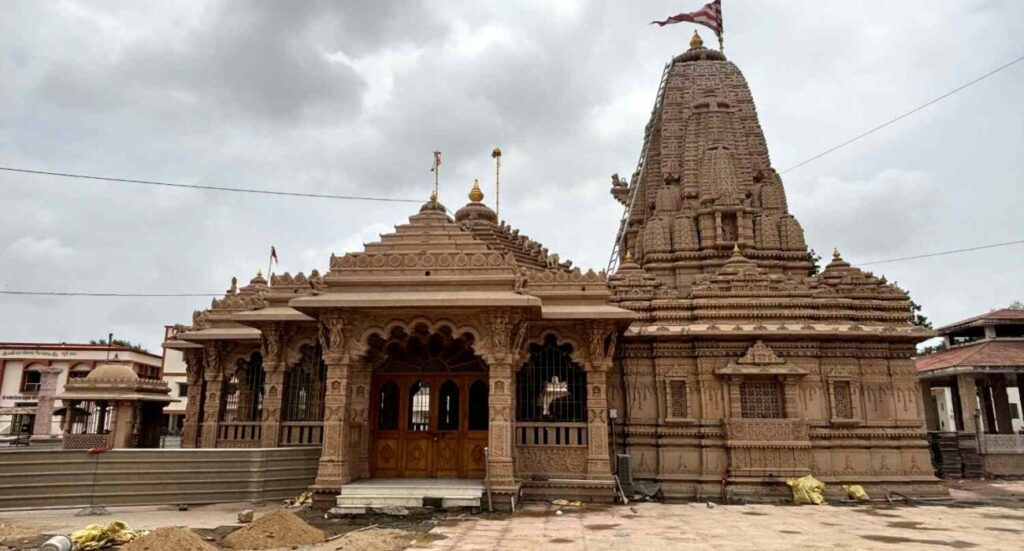
Ashapura Mata Temple
The Eternal Vow: Etymology and Spiritual Meaning of Ashapura Mata
Ashapura Mata (Sanskrit: आशापुरा, Āśāpūrā; Gujarati: આશાપુરા) is a deeply revered Hindu goddess, primarily central to the religious landscape of Western India, encompassing the states of Gujarat and Rajasthan. Her divine identity is rooted in her very name. The term “Ashapura” directly translates to “She who fulfills hopes and desires,” immediately symbolizing her fundamental role as a compassionate deity who grants the genuine wishes of her devoted adherents . This characteristic function has cemented her status across multiple generations and diverse communities.
Theologically, Ashapura is regarded as a powerful incarnation of Devi or Shakti, the fundamental divine feminine energy in Hinduism. She is often conceptualized as a form of Goddess Durga, signifying her protective and destructive power against evil, or as Annapurna Devi, emphasizing her role in nourishing and sustaining her devotees. This theological polysemy where she manifests attributes of multiple cosmic energies is critical to her widespread veneration. She is also specifically considered an expansion of Goddess Shakambhari Devi, further linking her to the preservation of life and vegetation, particularly relevant in the semi-arid regions of Kutch and Rajasthan where her primary worship is centered. The collective veneration of this multifaceted form, known simply as Ashapura Maa, underscores her adaptability and universal maternal power.
The enduring belief in her capacity to fulfill desires has made the worship of Ashapura Mata highly pragmatic, aligning her blessings with worldly stability, protection of dharma (righteousness), and the destruction of negative forces . This blend of protective ferocity and maternal nourishment is key to her widespread appeal as a guardian deity.
The Geographic Heart: Introducing Mata no Madh, the Primary Ashapura Mata Temple
While numerous shrines exist across India, the most historically significant and spiritually paramount structure is the Ashapura Mata Temple located in the remote village of Mata no Madh, situated in the Lakhpat taluka of Kutch district, Gujarat. The name Mata no Madh literally translates to “The Mother’s Dwelling” or “The Mother’s Hermitage,” signifying its status as the original or principal seat of the deity in the Kutch region.
This shrine holds immense cultural and political weight as it serves two crucial roles: it is universally recognized as the Desh Devi (Goddess of the Land) for the entire Kutchi region, and it is simultaneously the ancestral Kuldevi (family deity) of the powerful Kutchi Jadeja Rajput dynasty, which historically governed the state. The dual nature of her worship patron of the state and clan deity of the rulers makes the temple the spiritual anchor of Kutch. The shrine’s influence extends far beyond the Jadeja clan, however, as she is also recognized as the Kuldevi for other important communities, including the Bhanushali, Gosar, and Poladia communities in Kutch, as well as the Karad Vanias and Patels of Charotar.
Scope and Authority: Ashapura Mata as Kuldevi and Unifying Force
The geographical spread and the diverse lineage of her devotees demonstrate that the cult of Ashapura Mata is deeply interwoven with the political and mercantile history of Western India. Her patronage extends dramatically across Gujarat, Rajasthan, and Madhya Pradesh.
The theological ability of the goddess to be conceptually linked to multiple divine forms, namely Durga, Annapurna, and Shakambhari, is a vital factor in her broad appeal. This theological flexibility ensures that her spiritual portfolio is inherently tied to the stability and prosperity of the arid and politically volatile regions she guards. Her divine function appeals to the warrior classes through her Durga aspect (destruction of evil and protection of territory), to the mercantile classes through her Annapurna aspect (ensuring prosperity and trade), and to the general populace through her link to Shakambhari (assuring the survival of the land). This adaptability allows her to function as a pragmatic, non-sectarian deity whose efficacy transcends specific caste or sectarian interests, thereby establishing her authority across a wide cross-section of society as a profoundly unifying regional deity.
Theological Roots and Iconic Representation of Ashapura Maa
The Forms of the Mother: Ashapura in the Shakta Pantheon
The identity of Ashapura Mata is intrinsically connected to the wider Hindu tradition of Shaktism, where the Devi is venerated as the supreme energy. Her historical lineage often traces back to the ancient Chauhan dynasty of Rajasthan. The original focus of her worship is believed to be traceable back almost 1300 years or more at Sambhar, the base of the Songara Chauhan rulers of Shakambhari. This ancestral connection places her deeply within the historical religious geography of the region.
The iconography of Goddess Ashapura often follows traditional Shakta motifs, yet maintains a distinct regional flavor. She is generally depicted as multi-armed, symbolizing her immense power to handle multiple threats simultaneously, often holding weapons such as a trident, sword, and bow all tools representing her power to destroy evil and protect righteousness. She is typically seated on a lion (vahana), which represents her inherent courage, fearlessness, and formidable power. Her standard divine attire is red, and she wears a tilak (forehead mark), signifying energy, power, and her divine maternal aspect.
The Visual Signature: The Unique Idol with Seven Pairs of Eyes
Within the main Ashapura Mata Temple at Mata no Madh, the idol presents several unique visual characteristics that distinguish it from other Durga or Devi forms. The central deity is a large, six-foot-tall, red-painted stone image, broad at the base and tapering to a point, vaguely resembling a human form.
The most notable feature of this primary idol, distinguishing it across the entire regional pantheon, is the presence of seven pairs of eyes, totaling fourteen eyes. This Saptaksha (seven-eyed) form is interpreted by devotees as symbolizing her omnipresence and omniscient ability to witness and address the hopes, desires, and pleas of all those who seek her refuge. The seven eyes can be symbolically understood as her awareness across seven planes of existence or her power to monitor and respond to her followers globally and universally. This feature reinforces her epithet as the ultimate Wish-Fulfiller, as she is depicted as watching over every aspect of her devotees’ lives and the land she protects.
The Legend of Imperfection: Devchand and the Partially Manifested Idol
The origin story of the specific idol residing at Mata no Madh provides a profound lesson in the relationship between divine instruction and human impatience. According to a popular version of the founding myth, a Karad Vania named Devchand (or Ajo and Anagor in another source) was touring the region about 1500 years ago, praying to the Goddess Amba for a child, as he was childless. The deity appeared to him in a dream, instructing him to build a temple on the spot where he slept. As a token of the dream’s veracity, she assured him that he would find a coconut and a chundri (red cloth) upon waking.
The Goddess gave the Vania a strict injunction: after the Ashapura temple was built, its doors must remain sealed for six months, allowing the deity time to establish herself completely . However, during this sacred period, Devchand began hearing continuous celestial music emanating from inside the newly built shrine. Impatiently, and driven by curiosity, he prematurely opened the doors before the six months were completed, seeking to discover the source of the divine sound.
The result of this impatience was the incomplete manifestation of the idol. When Devchand opened the doors, he found that the part of the deity below her knee was still encased within the earth. Even in this incomplete state, the Goddess granted his original wish and blessed him with a child, fulfilling the core promise inherent in her name, Ashapura Maa. This narrative explains why, even today, devotees have darshan of the deity in this partially emerged form, which represents a theological paradox. The goddess, despite being the omnipresent Fulfiller of Hopes (proven by the seven eyes and the granted child), visually carries the permanent consequence of human haste. This makes the idol itself a constant, visible instruction: pure devotion is answered, but patience and adherence to divine instruction are necessary for perfect spiritual completion.
2.4 Seeking the Divine Image: The Cultural Significance of Ashapura Maa Na Phota
The unique form of the idol characterized by its red color, towering height, seven pairs of eyes, and the compelling story of its partial emergence has led to a deep cultural attachment to its image. For the vast diaspora of Kutchi and Rajasthani communities spread globally, the physical representations, often referred to as Ashapura Maa na phota (photographs or artistic images of the goddess), hold profound spiritual and cultural significance.
These images serve as anchors of cultural memory and regional identity, especially for those far from their homeland. Worshipping the phota allows devotees to spiritually connect with the powerful energies of the main shrine at Mata no Madh. The demand for and reverence shown towards Ashapura Maa na phota reinforces the idea that the goddess’s blessing and presence are mobile, extending wherever her adherents settle, yet always referring back to the original source of power in Kutch.
The Ancient History of the Ashapura Temple at Mata no Madh
Tracing Antiquity: From Puranic References to Rajput Entry
The history of the worship of Ashapura Mata at Mata no Madh is rooted in antiquity, preceding the construction of the current temples. Scholars suggest the shrine’s origin is “steeped in antiquity,” with references to the goddess and potentially this specific location found in ancient Hindu texts such as the Puranas and the Rudrayamal Tantra . Although no specific written ancient records exist within the trust’s possession detailing the precise start of worship, the tradition is demonstrably old.
A significant historical milestone is placed in the 9th century CE. It is evident that the deity was already established and widely worshipped when the Samma clan of Rajputs, migrating from Sindh, first entered and established themselves in the north-western parts of Kutch. This date confirms that the goddess had secured her status as a patron and territorial deity long before the construction of the most well-known structure. Her presence ensured regional stability and served as a spiritual foundation for the incoming ruling clans.
Founding and Early Patronage (14th Century)
The temple structure currently revered finds its architectural origin in the 14th century. It was originally commissioned and constructed by two Karad Vanias named Ajo and Anagor . These Vanias were notable figures, serving as ministers in the court of Lakho Phulani, an ancestor of the Jadeja rulers. This foundational link between the mercantile community (Vanias) and the shrine highlights the goddess’s importance to the economic backbone of Kutch.
The original dimensions of the temple, constructed in the 14th century, were substantial: 58 feet long, 32 feet wide, and 52 feet tall . Although the design was reported to be similar to the Koteshwar temple, it included a distinct passage allowing devotees to circumambulate the main deity.
3.3 The Trial of Earthquakes: Destruction, Resilience, and Rebirth
The history of the Ashapura temple in Kutch is marked by cycles of natural destruction and fervent reconstruction, a testament to the community’s profound dedication and the importance of the shrine as a symbol of regional endurance. Kutch is situated in a highly seismic zone, subjecting the structures to intermittent, powerful earth tremors.
The first major recorded catastrophe occurred during the 1819 earthquake, which severely damaged the sacred structure . Demonstrating unwavering communal dedication, the temple was swiftly rebuilt by 1823 (Samvat 1880). The design and reconstruction were led by two Brahmakshatriyas, Sundarji Shivji and Mehta Vallabhaji . This act of immediate restoration by the Brahmakshatriya community, succeeding the Vania founders, underscores the multi-communal investment in maintaining the physical presence of the deity.
The most recent and widely publicized damage occurred during the catastrophic Bhuj earthquake of January 26, 2001, which caused widespread devastation across the region and killed thousands. Despite the immense suffering and infrastructural collapse throughout Kutch, the Ashapura Mata Temple was promptly repaired once again. The perpetual commitment to costly and immediate rebuilding after these massive disasters funded by community trusts and devotees establishes the physical ashapura temple structure not merely as architecture, but as a potent and recurring symbol of Kutchhi resilience and collective cultural identity, essential for the psychological and spiritual recovery of the Desh after trauma.
Royal Patronage: Ashapura Maa as Kuldevi of Dynasties and Clans
The patronage of Ashapura Mata is intrinsically linked to the rise and stability of several dominant dynasties across Western India, solidifying her status as a deity whose spiritual power translates directly into political and military fortune.
The Mighty Jadeja Clan: Rulers of Kutch and Saurashtra
For the Kutchi Jadeja Rajputs, Ashapura Mata is the preeminent Kuldevi. Her divine favor was crucial in legitimizing the dynasty’s territorial claims and subsequent expansion. The Jadeja clan originated from the Samma Rajput lineage of Sindh, settling and establishing kingdoms in Kutch and Saurashtra starting from the late 9th century, with solidified written presence by the 14th century.
The goddess provided explicit guidance that shaped the region’s political map. Jam Rawal, an ardent devotee of Ashapura Maa and a key figure in the lineage, is said to have received a divine indication instructing him to leave Kutch and establish himself at Halar (Saurashtra). She promised her support in this venture. Jam Rawal followed this instruction, establishing the kingdom of Nawanagar (present-day Jamnagar). This pivotal legend illustrates how the deity was believed to actively direct the movement and formation of new successor states, granting legitimacy to the new Nawanagar state while Khengarji I, another devoted Jadeja, established Bhuj as the capital of Kutch in 1549 CE .
The connection persists today, with members of the royal family continuing to maintain ritualistic roles and governance. The administration of the Mata no Madh shrine is overseen by trusts whose board includes figures such as Maharao Kumar Shri Hanavantsinhji, reinforcing the enduring link between the deity and the lineage of the rulers . Furthermore, the temple rituals, particularly during Navratri, historically involved active participation from the royal family, signifying the goddess’s continued political importance.
The Chauhan Dynasty Network: Rajasthan’s Historical Claims
Ashapura Mata holds an equally profound, and chronologically earlier, significance for the Chauhan Rajputs of Rajasthan, particularly the Songara Chauhan dynasty. She is revered as a core aspect of the goddess Shakambhari Devi, whose primary worship is traceable back over a millennium at Sambhar.
The 10th century CE marked a significant institutionalization of the goddess’s worship within the Chauhan realm. Rao Lakshmana Chauhan, a member of the Shakambhari Chahamana dynasty, established the Naddula Chahamana dynasty and constructed the Ashapura Mata Temple at Nadol, Rajasthan, between 945–970 CE. Historical inscriptions record that Rao Lakshmana commissioned this shrine to express gratitude for crucial military successes that he attributed entirely to the goddess’s blessings . It was through this act of divine patronage that Shakambhari Devi gained the specific epithet Ashapura Mata the Fulfiller of Hopes within the local tradition, particularly in the context of military victory and dynastic establishment.
This Rajput lineage continued the tradition. The Songara Chauhans of Jalor, who splintered from Nadol, established another Ashapura temple at Modran village near Jalore, likely in the 12th century, where she continues to be worshipped by the Patiyats of Dhansa . Furthermore, she is recognized as the Kuldevi of the Hada Chauhan dynasty residing in the Hadoti region.
A Pantheon of Devotees: Cross-Communal Worship
The worship of Ashapura Maa transcends Rajput lineages, making her a goddess with incredibly broad cross-communal appeal throughout Western India. Her power as the ultimate Wish-Fulfiller is claimed by an extensive network of castes, professions, and regional groups. This broad patronage ensures that the ashapura temple circuit remains an active pilgrimage network, reinforcing the goddess’s status as a regional mother figure rather than a narrowly defined clan deity.
The communities who claim her as their Kuldevi include:
- Rajput Branches: Chauhan, Baria Rajputs (Purabia Chauhans), and Deora Chauhan Rajputs.
- Brahmin Communities: Billore, Gaur Lata Thanki, Pandit, and Dave Pushkarna, and Sompura Salat.
- Vaishya and Mercantile Groups: The Vijayvargiya Vaishya community, and the Brahma Kshatriya caste.
- Other Regional Groups: Sindhis (specifically the Khichda group), Patels of Charotar in Piplav, and the Charans.
A notable historical legend demonstrating her unifying power involves the Chudasama dynasty of Junagadh. Maharaja Khangar Chudasama’s wife, Sheetal Solankini, accepted Ashapura Mata as her Kuldevi only after the goddess fulfilled her hope of conceiving a son. The resulting child, Navagan Ronedhan, became a great king, further cementing the deity’s widespread historical impact on dynastic success and legitimacy.
The historical evidence shows that the goddess serves as a constant patron for the establishment of new political centers and the preservation of diverse community identities. The simultaneous, chronologically distinct patronage by the Chauhan Rajputs (10th century) and the Jadeja Rajputs (16th century) illustrates a recurring pattern where Ashapura Mata is invoked during moments of transition to legitimize successor states and new ruling houses. Her proven ability to grant success in military endeavors and dynastic survival is the common thread that links these powerful, disparate ruling clans.
Major Clans and Communities Worshipping Ashapura Mata as Kuldevi
| Community/Clan | Region | Key Historical/Religious Connection |
| Jadeja Rajputs | Kutch, Saurashtra | Desh Devi of Kutch; Patroness of the state rulers (Maharao) |
| Chauhan Dynasties (Songara, Hada) | Rajasthan (Nadol, Jalore, Hadoti) | Patroness of Rao Lakshmana Chauhan, founder of the Naddula kingdom |
| Karad Vanias | Kutch | Founders of the 14th-century temple structure at Mata no Madh |
| Brahma Kshatriya | Gujarat | Rebuilt the Kutch temple after the 1819 earthquake |
| Brahmin Communities (Pushkarna, Pandit) | Gujarat, Rajasthan | Wide regional Brahmin patronage |
| Sindhis (Khichda group) | Gujarat, Sindh | Diaspora and trade community Kuldevi |
Festivals and Rituals: The Grandeur of Navratri Pilgrimage
The devotional life surrounding the Ashapura Mata Temple at Mata no Madh reaches its zenith during the festival of Navratri, the nine nights dedicated to the divine feminine. These observances are characterized by meticulous rituals, intense personal devotion, and large-scale community organization.
The Sacred Calendar: Ashvin Navratri, The Zenith of Devotion
Navratri is celebrated twice annually at the Ashapura Mata Temple: during Chaitri (April/May) and, with considerably greater significance and attendance, during Ashvin (September/October) [3, 17]. The nine days are celebrated with immense pomp, attracting thousands of pilgrims from across India, particularly during the latter observance .
The festival commences with the Ghat Sthapana, performed a day prior to the formal start of Navratri . Throughout the nine nights, the temple premises are bustling with religious and cultural activities. These activities include devotional singing (Jagrans), traditional dances like Garba and Dandiya Raas, and special stage performances by folk singers such as Osman Mir on the first day. A large-scale Havan (fire ceremony) is meticulously organized on the day of Ashtami, or the eighth night . A special Jagdamba Poojan is also organized, further honoring the deity’s identity as a form of Durga .
Core Rituals and Historical Shifts
The temple maintains several distinct ritualistic traditions tied to its historical royal patronage and regional customs.
Havan and Royal Involvement: The most solemn ritual involves the Mahant or Raja, who represents the royal lineage and fasts throughout the nine days. This fasting culminates in the performance of the sacred Havan ceremony at midnight of the seventh day (Saptami). On the subsequent day (Ashtami), the main puja is traditionally performed by the Maharao. This enduring involvement of the royal lineage underscores the deity’s continuing role in legitimizing the cultural structure of Kutch, even in modern times. Furthermore, a ceremonial sacrifice procedure was historically performed by a member of the royal family, who would then carry a white flap made of cow’s hair from the Chachar Kund to the temple for worship.
The Chachra Kund and Inter-Faith Practices: The Chachra Kund is a sacred water body located within the temple complex where pilgrims are advised to take a sacred bath before approaching the deity for darshan. This site holds unique importance for inter-faith worship. Jains also revere the shrine, and some Jain sects maintain a distinct ritual practice at the Chachra Kund: the heads of young married ladies are ritually shaved here. This shared space and ritual practice confirms the broad, encompassing spiritual authority of Ashapura Mata that extends beyond Hindu sectarian lines.
Cessation of Sacrifice: Historically, the Rao of Kutch would sacrifice seven male buffaloes at the Shree Ashapura Mata Temple during every Navratri, a practice likely tied to the deity’s Durga aspect (destruction of evil and victory). This practice has since been stopped, reflecting modern shifts in ritualistic observance while maintaining the intensity of devotional acts.
5.3 The Great Padyatra: Culture and Logistics of Pilgrimage
The most visible demonstration of devotion is the culture of Padyatra (pilgrimage on foot) and cycling journeys undertaken by thousands of adherents. Devotees often vow to travel vast distances, walking or cycling from distant cities such as Mumbai and Jamnagar, in addition to shorter journeys from Bhuj, to seek the deity’s blessings and unload their religious vows.
This massive pilgrimage effort is supported by an intricate, highly organized infrastructure of Seva (selfless service), which is a crucial cultural mechanism for reaffirming Kutchi identity, particularly for the large diaspora. Along the entire pilgrimage route leading to the Ashapura temple, temporary camps and seva tents are established by community organizations. These camps provide pilgrims (Padyatris) with various forms of free assistance, including food, clean water, resting beds, essential medical aid, and specialized facilities for bathing .
The temple trust and associated bodies actively manage the logistics during Navratri. A mega camp, capable of accommodating approximately 2500 padyatris at a time, is organized only 1.5 kilometers from the temple, providing essential relaxation and preparation facilities. Special arrangements are made to securely store pilgrims’ footwear, and robust transportation services are arranged, including special buses running every 10 minutes from the Bhuj S.T. Bus Depot, underscoring the high volume of traffic and sophisticated logistical planning required.
The sheer physical commitment of the Padyatra and the collective community effort involved in Seva transforms the devotional act into a powerful social performance. This shared hardship and collective care bind the homeland of Kutch and its scattered populace (the diaspora) together. The structured relief provided by the trusts and community groups ensures that the economic and physical burden of fulfilling a vow to Ashapura Mata is mitigated by communal support, demonstrating that the blessings of the goddess are secured through collective, rather than purely individual, achievement.
Miracles and Cultural Unification: The Power of the Wish-Fulfiller
The historical record of the Ashapura temple is replete with accounts of divine intervention and miraculous wish fulfillment that have cemented her authority, notably transcending religious boundaries and influencing regional politics.
Interfaith Diplomacy: Mian Ghulam Shah Kalhoro’s Vow
One of the most compelling narratives illustrating the goddess’s territorial power and interfaith significance involves Mian Ghulam Shah Kalhoro, the Muslim ruler of Sindh in the 18th century. Historical accounts relate an incident where Kalhoro’s invading soldiers, while near the shrine, suffered a sudden loss of sight or other misfortunes . Recognizing the divine power governing the land, Kalhoro swore a solemn vow to Ashapura Maa that if his soldiers regained their sight, he would make a significant offering to the temple .
Upon the miraculous restoration of his soldiers’ vision, Ghulam Shah Kalhoro upheld his promise. He presented a massive bell to the temple, a remarkable artifact that still stands within the complex today. The incorporation of this non-Hindu artifact into the shrine’s permanent architecture elevates the Ashapura Mata Temple from a purely sectarian site to a recognized territorial power nexus. This event demonstrates that the deity’s efficacy was accepted and respected by those in political power, regardless of their personal faith, confirming her overarching role as the Desh Devi whose power governs regional fortunes and demands respect from all who traverse or rule the land.
6.2 Treasures of Devotion: Historical Artifacts
Beyond the Kalhoro Bell, the temple complex houses other significant historical artifacts that testify to the widespread and high-level political patronage the shrine has received.
Jamadar Fateh Muhammad, who served as the military leader of the Cutch State, gifted a magnificent deepmala (a lamp stand) to the temple. This artifact is notable for its composition, weighing 2 kilograms of silver, and its design, featuring 41 intricately carved lamps . The donation from the military leader signifies the patronage and faith of the state’s defense apparatus in the protective power of Ashapura Maa. These historical treasures symbolize the goddess’s ability to secure victory, wealth, and stability for her patrons.
Enduring Miracles and the Lion’s Roar
The belief in the immediate, ongoing miracles performed by the goddess continues to sustain the faith of her adherents . Across her various temples, specific supernatural phenomena are recounted. For instance, in Gadhkada village in the Amreli district of Gujarat, devotees maintain a popular belief that the roar of Ashapura Maa’s lion (vahana) can still be audibly heard. This narrative of the audible presence of the goddess’s power serves as a constant reaffirmation of her active involvement in the lives of her worshippers and her physical connection to the territory she oversees.
Socio-Economic Footprint and Charitable Legacy
The Ashapura Mata Temple complex at Mata no Madh is far more than a site of worship; it functions as a central, highly effective non-governmental organization (NGO) that significantly impacts the socio-economic development of the remote Lakhpat taluka region of Kutch. This material dimension of the goddess’s blessing, executed through sophisticated charitable trusts, is central to her enduring relevance.
The Governing Bodies and Modern Administration
The administration of the vast temple complex and its extensive charitable operations is managed by a structured set of dedicated trusts . This specialized structure allows for dedicated focus on various aspects of spiritual and community welfare:
- Shri Matana Madh Jagir Trust : Oversees the core temple operations and land management.
- Shri Ashapura Bhandar & Atithigraha Trust : Manages the logistics of pilgrim welfare, including accommodation and supplies .
- Shri Ashapura Education Trust : Focuses specifically on educational initiatives.
The Board of Trustees includes significant regional figures, such as the Mahant Adhyaksh (spiritual head/president), Rajashri Yogendrasinhji, and members of the royal family, like Maharao Kumar Shri Hanavantsinhji . This governance structure ensures accountability and sustained commitment to both religious duty and community upliftment.
Commitment to Healthcare and Public Wellness
The trusts actively address the critical need for healthcare in this remote area. The temple’s charitable activities include substantial support for public health. A mobile vehicle facility has been presented by the temple trust to the local government dispensary, enhancing accessibility of medical care to surrounding villages .
Furthermore, the trust organizes regular medical camps where teams of specialist doctors examine patients. These camps ensure that medical supplies and necessary medication are furnished to patients entirely free of cost. For those requiring more advanced treatment beyond the camp’s capacity, the trust arranges and provides additional aid to facilitate better care for the needy . This systematic provision of medical facilities ensures that the goddess, as the Fulfiller of Hopes, provides tangible, material relief from suffering.
Advancing Education and Community Empowerment
The Shri Ashapura Education Trust is dedicated to improving educational outcomes in the region. The trusts actively combat socio-economic disparities by focusing on free access to essential educational resources. They systematically distribute free school bags and necessary educational materials, including notebooks, to students. Importantly, this distribution schedule explicitly covers pupils from Schedule Caste and Schedule Tribe communities.
To actively encourage scholarly dedication and retention in the local educational system, the trust awards handsome prizes or attractive articles to students who achieve first, second, and third ranks in their respective standards every year . This investment in education forms the foundation for future social mobility, demonstrating a long-term commitment to community empowerment by fulfilling the hopes of children and parents for a better future.
Sustainable Rural Development and Infrastructure
The administrative bodies of Mata no Madh play a key role in the long-term planning and infrastructural stability of the pilgrimage village. The temple trusts routinely undertake comprehensive plans for the outright development of Mata no Madh and, upon completion, formally entrust these improvements to the village authority for ongoing maintenance .
The dedication to pilgrim welfare is evident in the operation of the Ashapura Bhandar and Atithigraha Trust, which manages expansive accommodation facilities. The Shree Ashapura Guest House, located mere meters from the bus stand, offers a range of rooms (AC, non-AC, dormitory) and facilitates bookings through partners like YatraDham.Org . The presence of the Kutchi Maheshwari Samaj Bhavan and other trust-run Dharamshalas ensures that accommodation and meals are readily available for the huge influx of devotees, securing the area as a developed, accessible pilgrim center .
Table Title: Overview of Matana Madh Trust Activities and Community Impact
| Trust Focus Area | Key Initiatives and Programs | Target Beneficiaries |
| Education | Free distribution of notebooks, school bags, and educational materials; academic excellence awards | Pupils, including SC/ST children, entering first year of education |
| Healthcare | Free specialized medical camps; provision of mobile clinic vehicle to government dispensary | Local villagers and needy patients |
| Infrastructure/Welfare | Management of Matana Madh Jagir Trust & Atithigraha Trust; development of pilgrimage village; large-scale pilgrim seva camps | Pilgrims (Padyatris), local residents |
Global Presence: The Ashapura Mata Circuit (Beyond Kutch)
The veneration of Ashapura Mata is not confined to the deserts of Kutch. The deity’s influence has spread throughout Western and Southern India, establishing a vast pilgrimage circuit that mirrors the historical migration and economic success of her devotees, particularly the Jadeja and Chauhan clans and the associated merchant communities.
Mapping the Ashapura Mata Circuit
The temples dedicated to Ashapura Maa form an interconnected spiritual network. Each major Ashapura temple serves as a regional anchor, providing a localized center for worship while simultaneously pointing back to the foundational shrines in Rajasthan (as the historical origin of the epithet) and Kutch (as the paramount temple of the Jadeja rulers).
Key Regional Temples in Rajasthan and Gujarat
The historical centers of worship outside Kutch are instrumental in understanding the goddess’s spread and political significance:
Nadol, Rajasthan: This temple, established in the 10th century by Rao Lakshmana Chauhan, is arguably the earliest physical manifestation of the goddess in her Ashapura Mata form, linked explicitly to military victory and the founding of the Naddula kingdom . The temple’s architecture features multi-tiered shikharas (spires) characteristic of the Hindu Rajput style. It remains a major spiritual center in the Pali district of Rajasthan.
Modran, Jalore, Rajasthan: Continuing the Chauhan legacy, the Songara Chauhans established the Ashapura Mata Temple at Modran near Jalore, most likely in the 12th century. This site continues to be the Kuldevi shrine for the Patiyats of Dhansa. Other temples in Rajasthan are found in Pokhran and Morseem.
Jamnagar, Gujarat: The Maa Ashapura Temple in Jamnagar is a renowned pilgrimage site reflecting the migration of the Jadeja dynasty from Kutch to Saurashtra (Halar) . This temple was established around 1300 CE by Karad Vanias who served as ministers to Lakho Fulani . The idol here is also known for its seven sets of eyes, mirroring the unique iconography of the Mata no Madh deity and maintaining the spiritual link to Kutch .
Gadhkada, Amreli District, Gujarat: This temple is famous for attracting a large number of devotees, particularly on the first day of Navratri, when a substantial Yagna (fire sacrifice) is held in honor of the goddess .
Urban Centers of Worship: The Diaspora and Modern Devotion
The extensive network of Ashapura temples in major urban centers maps the geographical movement and economic influence of her worshipping communities. For the Kutchhi and Rajasthani diaspora, who often settled in major economic hubs, establishing a localized Ashapura temple is a critical act of cultural memory and regional identity maintenance. These shrines serve as spiritual anchors for communities far removed from Kutch.
Major metropolitan shrines include:
- Mumbai, Pune, and Thane: There are famous Ashapura Mata temples in all three major economic hubs of Maharashtra, reflecting the significant presence of Kutchhi and Rajasthani merchant communities in the state . The temple near Gangadham on Katraj Kondhwa Road in Pune and the famous temple near Kapurvadi in Thane are examples of this presence.
- Bangalore: The Sh. Ashapura Mataji Mandir located near Bannerghatta National Park in Bangalore demonstrates the deity’s increasing reach into South India, following the migration and economic success of her devotees into new technological and commercial centers.
The density of Ashapura temples in key commercial centers confirms that the deity’s spiritual necessity remains a fundamental requirement for the success of these migrating economic communities. The widespread presence underscores that the power of the Wish-Fulfiller is deemed essential for securing prosperity wherever her adherents relocate.
Pilgrim’s Guide to the Ashapura Mata Temple (Mata no Madh)
For prospective pilgrims visiting the principal Ashapura Mata Temple in Mata no Madh, navigating the travel logistics and temple customs is essential for a spiritually rewarding experience.
Accessibility and Travel Logistics
Mata no Madh is located in a remote part of Lakhpat Taluka, making travel to the shrine a dedicated effort. The primary transit hub for access is Bhuj, the district headquarters of Kutch:
- Air and Rail Connectivity: The nearest major airport and railway station is Bhuj, located approximately 100 to 101 kilometers from Mata no Madh . The Bhuj railway station is the last stop on the line .
- Road Travel: From Bhuj, travelers can utilize state transport buses, private buses (which run frequently, about once every hour), or hired tourist cabs . Direct private bus services are also available from Ahmedabad to Mata no Madh .
Best Time to Visit: The most comfortable period for pilgrims to visit the Ashapura temple is during the winter months, from October to March . This season avoids the extreme summer heat and coincides with the Kutch Rann Utsav festival (November to February), adding to the regional appeal . The peak period for high crowds is during the Navratri festivals, particularly Ashvin Navratri, when attendance swells to its highest level .
Darshan Timings and Temple Etiquette
The temple adheres to a regular schedule of darshan (viewing of the deity) and aarti (ritual worship with lamps), though these timings are often extended during festivals.
- Standard Timings: Key daily rituals include Mangla Darshan at 05:00 AM and Dhoop Aarti at 09:00 AM. Sandhya Aarti is performed at sunset .
- Navratri Timings: During the intense Navratri period, darshan timings are significantly extended, running from 05:00 AM until 01:00 AM to accommodate the massive influx of Padyatris .
Customs and Offerings: As a sacred pilgrimage site, respectful and modest dress is essential; covering shoulders and knees is required . Visitors must be mindful of the peaceful, devotional atmosphere and observe local customs. A specific restriction applies during Navratri regarding coconuts (Shrifal): cracking the coconut is strictly prohibited; only the full Shrifal is permitted to be served as Prashad (consecrated offering) .
Accommodation and Trust Facilities
The administration trusts have developed extensive facilities to support pilgrims, focusing on affordability and proximity to the main shrine.
- Trust-Run Accommodation (Dharamshalas): The Shri Ashapura Bhandar & Atithigraha Trust operates the Shree Ashapura Guest House, located a mere 28 meters from the bus stand . This guest house offers various options, including one, three, and five-bed AC and non-AC rooms, along with dormitory accommodation . These trust-affiliated lodgings often provide supplementary services like clean drinking water and extra mattresses, adhering to a general check-in/check-out time of 12:00 PM . Other community Dharamshalas, such as the Kutchi Maheshwari Samaj Bhavan, also provide accommodation near Mata no Madh .
- Commercial Options: For tourists seeking more upscale or modern amenities, commercial resorts and hotels are available, particularly closer to Bhuj or Mandvi, such as Sky View Resort or StayGuru Luxury Villa . Many of these hotels cater specifically to road travelers, offering parking and pools .
Conclusion: The Enduring Resilience of Ashapura Maa
The Ashapura Mata Temple at Mata no Madh stands as an unparalleled monument to faith, resilience, and the power of collective identity in Western India. The analysis confirms that the goddess, Ashapura Mata, embodies a synthesis of theological power and pragmatic regional governance.
Her identity as the Fulfiller of Hopes is not merely mythological but historically demonstrated through her consistent patronage of founding dynasties the Chauhans (10th century) and the Jadejas (16th century) whose political success she directly influenced. The repeated reconstruction of the Ashapura temple after catastrophic seismic events underscores its profound symbolic value as a cultural and psychological cornerstone for the people of Kutch. The commitment to rebuilding, regardless of the cost, ensures that the structure remains a powerful metonym for regional persistence against all odds.
Furthermore, the sophisticated charitable efforts of the trusts, encompassing healthcare, education, and rural development, transform the religious site into an engine of material prosperity. By filling critical gaps in essential services, the temple secures its sustained local relevance and patronage, reinforcing the goddess’s reputation for fulfilling wishes not just spiritually, but tangibly.
The historical evidence, from the seven-eyed idol that represents omnipresence to the incorporation of the massive bell gifted by Mian Ghulam Shah Kalhoro, confirms the deity’s role as a sovereign territorial power whose authority transcends religious sectarianism. The pervasive nature of her worship, maintained by the intense dedication demonstrated through the annual Padyatras of the diaspora, ensures that Ashapura Maa remains the central spiritual anchor for millions, securing the culture and future of Kutch and its people for generations to come.